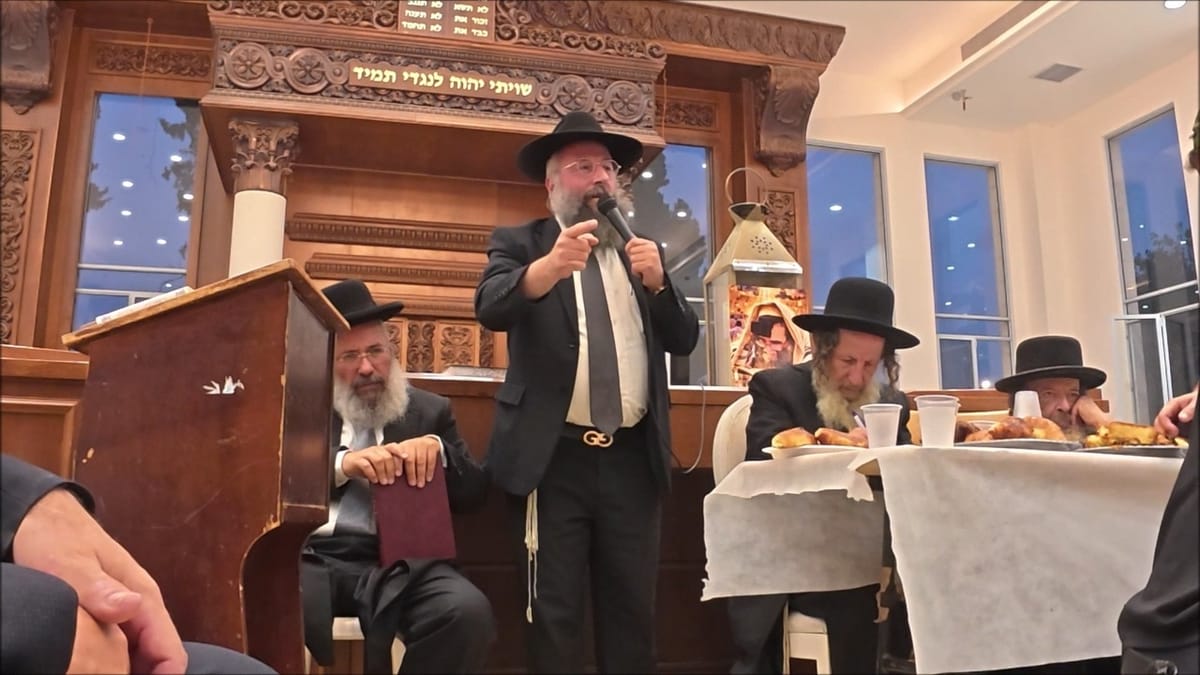
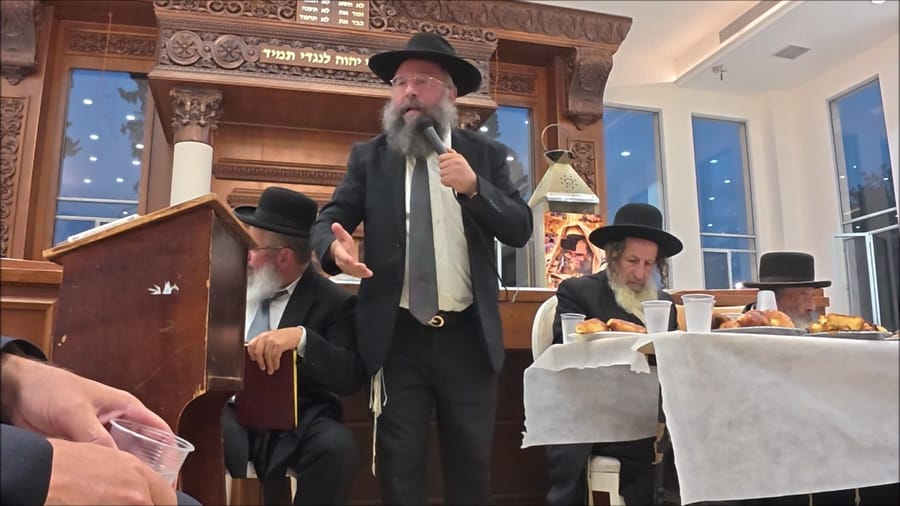
Rabbi Binyamin Chuta, a prominent Sephardic halachic authority, delivered a pointed eulogy marking thirty days since the murder of Rabbi Amos Guetta, a revered kabbalist from Netanya. In his remarks, Rabbi Chuta urged Rabbi Guetta's numerous followers to set aside mystical pursuits and concentrate primarily on Torah study, which he identified as the slain rabbi's authentic legacy and life's work.
"Anyone who comes here and walks through the surrounding streets understands what an enormous following this leader, Rabbi Amos, of blessed and holy memory, left behind," hebegan. "I want to touch on one point: the righteous deceased, whose soul is present here, built an enterprise here, and this enterprise must continue."
He cited the Talmudic interpretation of the verse "For the lips of a priest should guard knowledge, and they should seek Torah from his mouth, for he is an angel of the Lord of Hosts." The Talmud teaches that if a rabbi resembles an angel, seek Torah from him; if not, do not seek Torah from him. "This was difficult for me," Rabbi Chuta explained. "If he's like an angel, how can I learn from him? I want to learn from someone I can progress with; I cannot become an angel."
He recounted telling the late Rabbi Ovadia Yosef, the former Sephardic Chief Rabbi of Israel and leading halachic authority, that reading a responsum in his work "Yabia Omer" discouraged him from studying. "When you try to review even ten percent of one responsum, you cannot succeed," Rabbi Chuta said. Rabbi Yosef encouraged him to persist and review repeatedly.
"I return to that point: if this is an angel of God, how can we seek Torah from his mouth? He's an angel, a seraph, he's not here," he said. "I wasn't connected to this place except in one single way. Whenever I merited to come here, I came for one purpose alone, that's the only aspect through which I knew Rabbi Amos. I saw one thing, and I hope you all noticed it."
He noted that Rabbi Guetta was known for his ascetic lifestyle. "You saw a man sitting six days a week in the same chair. Where? Beyond that, nothing. Suffering with his leg, changing bandages. How did he recite blessings according to the mystical intentions? This is the manner of kabbalists. In other words, anyone who came here, speaking with plain sense, there was a kind of asceticism here. Ostensibly, everyone who came should have left accepting upon themselves fasts and holiness."
"I saw something interesting, something different, and it's impossible to see it otherwise," Rabbi Chuta continued. "That holy pious one showed you in every situation: first of all, you should have Torah. Leave the mysticism aside. Visiting graves of righteous people comes later, fasts come later, all kinds of prayer shawls and everything (that's also good)but he knew, and these walls will testify, when I once arrived here, there were many people outside. I asked what happened today. They said there were, I don't remember if it was two or three weddings, the rabbi is supposed to perform weddings for them."
He understood that evening prayers would be held, followed by weddings, then a Torah lesson. "The rabbi came and said, 'Start the lesson.' I said to him, 'Excuse me, your honor, I understood there are grooms and brides outside.' What did he say to me? These are a groom and bride who are having a wedding and going to a hall where eight hundred people are waiting for them, first of all, a Torah lesson, and not a ten-minute lesson, and he never interrupted the lesson."
"He transmitted to his students: this place here is a place for Torah, because without Torah there's nowhere to progress," Rabbi Huta emphasized. "Our sages say, 'I created the evil inclination' --- do you know what the remedy for the evil inclination is? Not a mikveh, not graves of righteous people, not talleisim and not large kippas, those are also needed, but the Talmud says, do you know what the remedy for the evil inclination is? I created the Torah as its antidote. Do you set fixed times for Torah study, or do you come here once every two months to receive a blessing?"
"That's what I saw here, which is why I was drawn and came here many times," he said. "There's something here I didn't see in any other conduct: in every situation, in every circumstance, understand, Torah is before everything and above everything."
Rabbi Chuta noted that in recent days he had visited many graves of righteous people, and at nearly every grave there was a sticker of Rabbi Amos. "The entire nation is connected to him, but this place, the yeshiva he raised, must continue. Not just that there should be a kollel of married scholars here—that's also needed, but that's not his enterprise. His enterprise is that you, thousands of Jews in Netanya, people whose entire childhood I know was only through the channel called Rabbi Amos—God forbid this channel should be cut off? The scholars won't be here studying in such a place. You, the young people of Netanya, you need to come here regularly, there should be lessons here consistently."
He added that "if you don't continue this enterprise, to tread here with regular daily Torah lessons, know this: Rabbi Amos's legacy has been cut down. His soul, his life, was that there should be Torah here, that everyone who comes here should be connected to Torah. If his legacy continues, he lives."
"Gentlemen, I'm telling you, this is Rabbi Amos's enterprise," he declared. "You want a blessing from Rabbi Amos? I guarantee that he will bless you with the best blessing you could receive, you come here and say, 'I've come to continue Rabbi Amos's legacy,' to come hear a lesson. There are scholars here, there are students. I want half an hour to learn with you, I want an hour to learn with you, I want forty minutes with you. Rabbi Amos's soul will rejoice and flourish that in this enterprise he built with his ten fingers, with his 248 limbs and 365 sinews, giving up all materialism."
"You saw this figure, the angel who appeared in human form? What interested him? Torah and Torah."