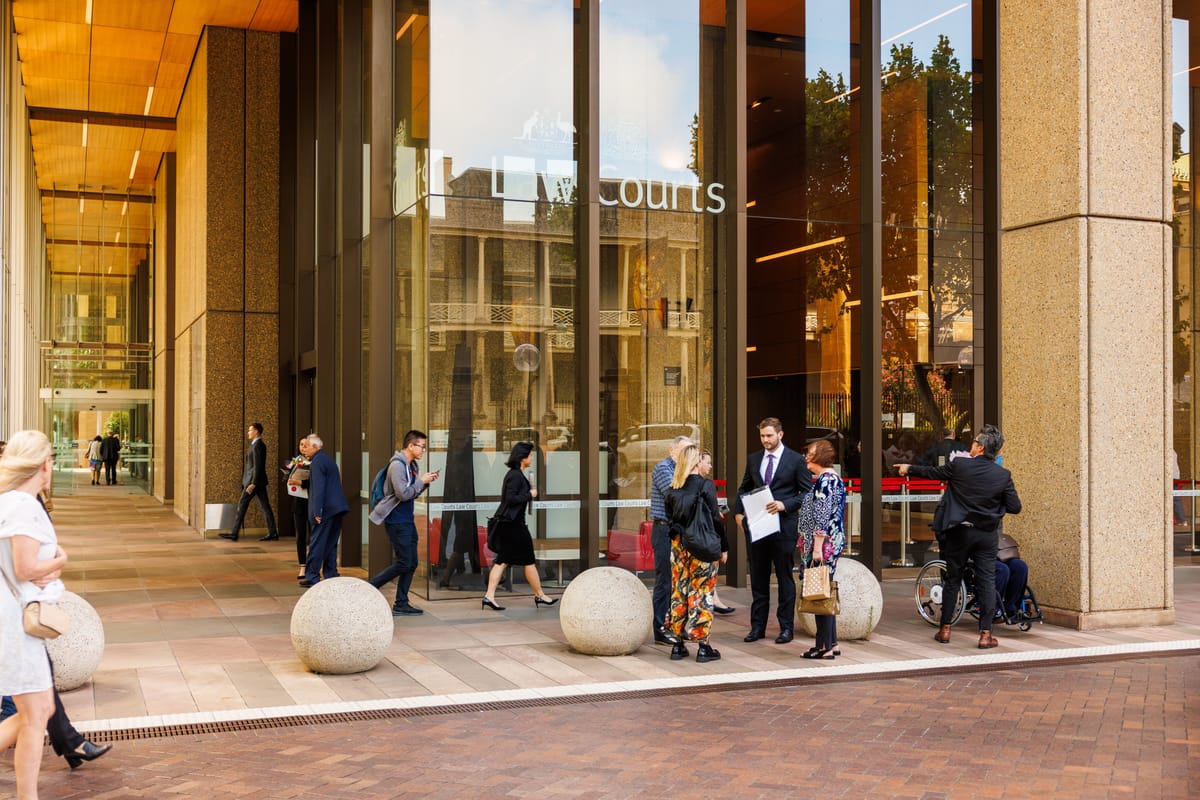
A NSW Supreme Court judge has rejected prosecutors' bid to place vandal Mohommed Farhat under a terrorism supervision order, finding that hostility toward Israel does not automatically constitute antisemitism or evidence of extremist radicalization.
In a decision delivered July 30, Justice Desmond Fagan ruled the evidence fell short of the statutory threshold for an unacceptable risk of serious terrorism offence. He found Farhat's offending was motivated by promised payment rather than ideology, and repeatedly distinguished between political criticism of the Israeli state and hatred of Jewish people as a group.
"They are not the same thing," Fagan said during the week-long hearing. "You are treating all Jews as monolithic. It's quite wrong to treat all Jews as supporting Israel, because they don't. But you treat a statement of hostility to Israel as a statement of hostility to the Jewish people, which it is not."
Farhat, then 21, led a 41-minute spree of vandalism through Woollahra on November 20, 2024, spray-painting slogans including "F**k Israel" and "PKK coming" (referring to the proscribed Kurdistan Workers' Party) on approximately 10 cars and four buildings, including chef Matt Moran's Chiswick restaurant. Two vehicles were set on fire. Total damage exceeded $100,000.
He pleaded guilty to property damage and related charges, receiving one year and eight months imprisonment with a non-parole period of 10 months. Lower courts treated the offences as reflecting hatred toward Jewish people and Israel, consistent with the targeting of a suburb with significant Jewish population amid broader antisemitic incidents.
Prosecutor Patricia McDonald SC had argued Farhat's phone messages discussing Hezbollah, the death of leader Hassan Nasrallah, Israeli military operations in Lebanon, and anger over southern Lebanon demonstrated an extremist pathway. Fagan rejected that characterization, finding the exchanges reflected young men discussing a conflict affecting their families and community, not evidence of antisemitism or future terrorism.
Fagan challenged the prosecutor's argument that targeting a Jewish-heavy area transformed the offending into antisemitic hate crime. He argued prosecutors must distinguish between the political content of a message and the unlawful way it was expressed. A person criticizing Israel's actions, even outside a synagogue, would be exercising political expression, he said, with criminality arising from property destruction, not political views.
The court's decision carries implications for how Australian law distinguishes between anti-Israel political expression and antisemitism per se. Federal and state governments have endorsed the International Holocaust Remembrance Alliance (IHRA) definition of antisemitism, which includes examples suggesting some forms of Israel criticism may be considered antisemitic depending on context, a feature fueling ongoing debate among legal scholars and Jewish community leaders.
Dr Elyse Methven, criminal law lecturer at University of Technology Sydney, told Deepcut News that Fagan's observations were significant amid growing efforts to treat disputed political language as having fixed meaning. "Courts must pay close attention to context and meaning rather than relying on assumptions about what particular political expressions are presumed to represent," she said.
The ruling arrives as a Royal Commission into Antisemitism and Social Cohesion, established following the December 2025 Hanukkah terror attack at Bondi Beach, continues examining how Australian law and institutions address antisemitic violence.