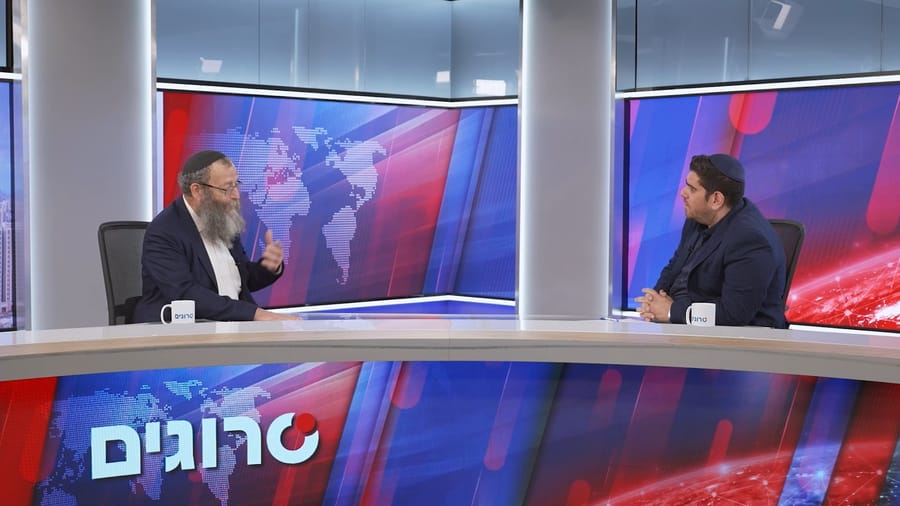
Marzel pinpointed the breaking point between himself and Ben-Gvir to a vote within Otzma Yehudit's leadership after Ben-Gvir's first entry into the Knesset. According to Marzel, the party's governing body voted on whether it would be acceptable to form a government relying on support from Ra'am, an Arab Islamist party. Ben-Gvir, Marzel claims, was one of only two members who supported the idea, facing six opponents.
After losing that vote, Marzel alleges, Ben-Gvir stopped convening the party's institutions entirely: "From that day on, illegally, he canceled these bodies, stopped convening them, didn't invite us to meetings, and illegally appointed himself chairman of Otzma Yehudit."
When asked why they didn't appeal to the party registrar or the courts, Marzel replied that he doesn't believe in the judicial system and doesn't want to use it against Ben-Gvir. He added that Rabbi Dov Lior also asked him not to pursue the matter through the courts.
He insisted that the Otzma Yehudit name belongs to the party's original founders. "This party belongs to us. We established it," he said, noting that he invested his own money and worked to gather the required signatures for its formation. However, he clarified that he and his colleagues no longer support the party bearing that name. "We support the path, not the name."
He also addressed Ben-Gvir's distancing from Rabbi Kahane's ideology, saying the statement should be taken at face value. "The day he decided to give up the ideology to be a minister, you have to believe him," Marzel said.
He pointed to Ben-Gvir's support for Amir Ohana in the Likud primaries and his treatment of Ohana after his election as Knesset speaker as evidence of this transformation. Marzel recalled that the two once protested together against pride parades, and argued that Ben-Gvir has clearly deviated from their original path.
When confronted with the possibility that Ben-Gvir simply moderated to gain influence within the system, Marzel responded: "That's exactly what I'm saying ---he's no longer connected to the path we walked from day one." Ben-Gvir is entitled to change his positions, Marzel said, but voters deserve to know: "Today he's just another Likudnik."
Alongside his attack on Ben-Gvir, Marzel surprised listeners with praise for Finance Minister Bezalel Smotrich and Settlement Minister Orit Strook. Though he clarified he has never voted for Religious Zionism, he said: "When we talk about accomplishments in this term, I think Bezalel Smotrich and Orit Strook broke records in achievement across all areas."
The two have led dramatic change in settlement activity in Judea and Samaria, he said. "You drive from Hebron to Jerusalem and there are twenty new points. It's crazy, no one else would have done that."
Yet even these achievements, Marzel argued, don't justify supporting Smotrich. He accused Netanyahu, Smotrich, and Ben-Gvir of missing a "historic opportunity" to promote voluntary emigration from Gaza. "They could have drained the swamp and they didn't do it," he claimed. "This is an extremely serious failure, and for this alone they don't deserve votes, not Smotrich, not Ben-Gvir, and not Bibi."
Looking ahead to the elections, Marzel declared he would support any list that includes Michael Ben-Ari. "Michael is a man of truth who walked with the truth and pays a heavy price for it," he said. He explained that he doesn't intend to run himself, arguing that Ben-Ari and others are better suited to lead the list.
He also rejected the argument that small parties risk wasting right-wing votes. The large parties raised the electoral threshold and created difficulties designed to prevent ideological lists from competing, he said, and now use those same rules to pressure them to withdraw.
"You had four years, you could have lowered the threshold and you didn't," he charged. "I don't vote for evil. Evil in smaller amounts is still evil. I vote for good."
He called on small right-wing parties, including Zehut, Noam, Tzomet, and Ofer Winter's party, to unite in a joint list or technical bloc. The parties could establish a mechanism for distributing seats, run together, and return to operating separately the day after the election, he suggested.
"We're in the 90th minute," he warned. "We can create a mechanism for how to divide who's in first place, who's in second, who's in third. The day after the election, everyone can go their own way."
Marzel even said he would have no objection to joining a technical bloc with Smotrich. "As long as I can ideologically continue on the path of truth and my own path, coalitions and technical blocs are not a problem," he said. Such a union could return between five and ten mandates of right-wing voters who currently don't intend to vote, he argued.
Asked whether some small parties will withdraw before the election, he refused to name names to avoid harming them, but estimated that at least two or three lists intend to compete until the end. If unity isn't achieved, he said, it could lead to defeat for the right-wing bloc.
At the interview's conclusion, Marzel also addressed the race for prime minister. He estimated that under current circumstances, Benjamin Netanyahu won't remain in office after the election, but clarified that he prefers him over Gadi Eisenkot. "Netanyahu isn't good, but he's much less bad than Eisenkot."