trump calls iranian leaders 'sick people'

BREAKING: Trump Declares Iran Ceasefire "Is Over" 

Trump declares the Iran ceasefire "is over" at the NATO summit as new strikes trigger Iranian retaliation against Bahrain and Kuwait.

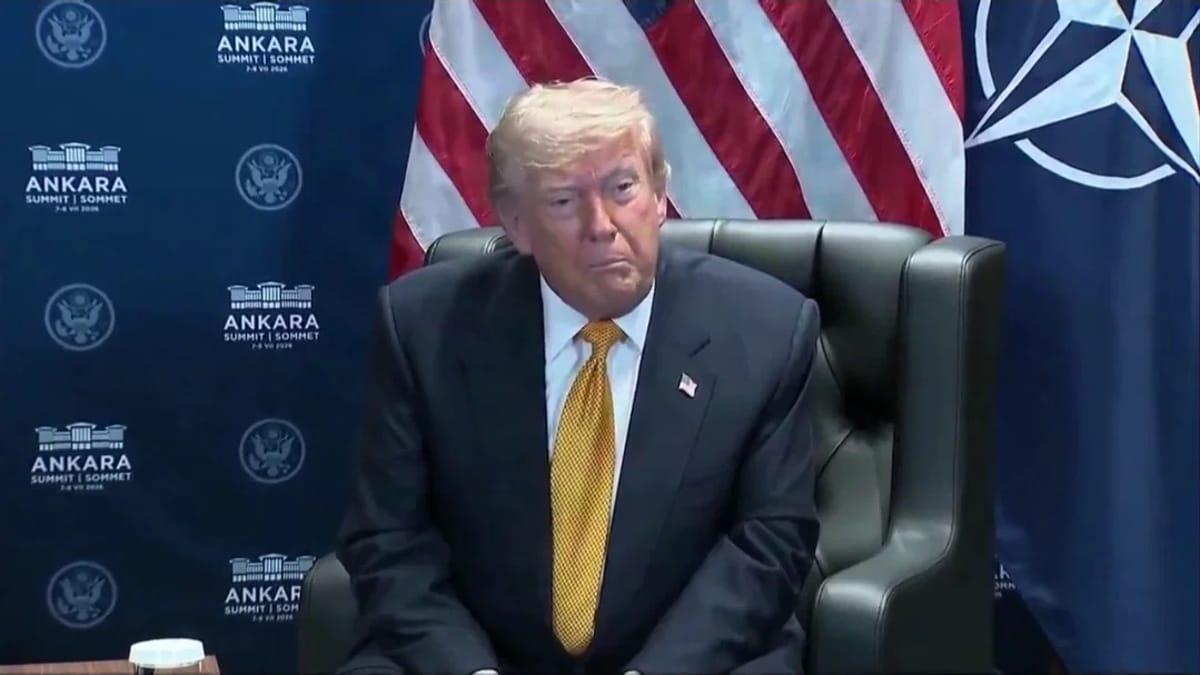
President Trump at NATO Summit

President Trump used the closing hours of the NATO summit here to declare that Washington's fragile truce with Iran effectively no longer exists, hours after a fresh round of American strikes triggered retaliatory attacks from Tehran that reached as far as Bahrain and Kuwait.

Trump said Wednesday morning that he believes the memorandum of understanding with Iran "is over," telling reporters at the summit that "it's a waste of time dealing with them." It was, by the account of reporters traveling with him, the clearest signal yet that the deal he signed in France last month has all but collapsed.

The president did not soften his language for the cameras. He described the Iranian government as "evil, sick people," and accused Tehran of behaving like "dirty players" for targeting commercial vessels in the Strait of Hormuz in violation of the ceasefire.

He also said "They are scoundrels. I hate them, nobody likes them. They must not be allowed to obtain nuclear weapons ...
For me? The ceasefire is over. Talking to the Iranians is a waste of time. Something's wrong with them. They're cuckoo.
Ready for more?

I don't want to deal with them anymore. They're scum. And if they get a nuclear weapon.. They're liars.. In my eyes, it's a waste of time to continue talking to them. They're crazy, for me it's over."

He went further in remarks carried by Israeli outlets, saying overnight strikes had hit Iran roughly twenty times harder than earlier rounds and adding that a nuclear-armed Iran could never be tolerated. He also referenced the two assassination attempts against him, in Butler, Pennsylvania, and at Mar-a-Lago, that American officials have linked to Iranian plotting, saying he intends to "eliminate the cancer."

The rhetoric came against the backdrop of a rapidly escalating military exchange. Central Command said the United States had launched a "series of powerful strikes" against Iran on Tuesday, and Washington reimposed sanctions on Iranian oil sales in response to attacks on commercial shipping near the Strait of Hormuz. One American official described the operation as a "punishment," explicitly distinguishing it from a "proportional" response.

Iran did not wait long to answer. Iran's army said it launched a drone attack on Bahrain's Isa Air Base, which hosts American forces, in the early hours of Wednesday, according to the semi-official Fars news agency. Sirens sounded across Bahrain, with the country's interior ministry posting warnings urging citizens to seek safety, the second such alert within roughly two hours. Iranian state media also reported explosions on Kharg Island, a critical hub for the country's oil exports, as well as in the port cities of Bandar Abbas and Sirik and on Qeshm Island.

Iran's Foreign Ministry accused Washington of openly violating the ceasefire and the Islamabad understanding by striking coastal bases and civilian facilities in Hormozgan and Mahshahr provinces, a statement that notably made no mention of Iran's own attacks on shipping in the strait. Parliament Speaker Mohammad Bagher Qalibaf wrote that "the era of bullying and extortion is over," adding, "We don't fold." Kuwait, which was also struck, said the attacks on its territory undermined efforts to de-escalate tensions in the region, according to Agence France-Presse.

The timing is not incidental. Iran is currently holding funeral observances for Supreme Leader Ali Khamenei, who was killed early in the war, and the latest strikes land as a bid to rebuke Trump while he sits at a NATO summit in a country that borders Iran, and to flex leverage Tehran believes it gained during the conflict. Mourners along the funeral procession have increasingly called for Khamenei's death to be avenged, chanting for the killing of both Trump and Prime Minister Benjamin Netanyahu.

NATO's leadership offered Trump rhetorical cover, if not military support. Secretary General Mark Rutte called the new American strikes "absolutely necessary," telling reporters ahead of the summit that "when you have a ceasefire and Iran is basically violating the ceasefire, I think it is totally crucial that the US forcefully react." Rutte said Iran's nuclear program would be on the day's agenda, adding he expected allies to "reconfirm that Iran should never ever get its hands on a nuclear capability," and that reopening the Strait of Hormuz to free navigation was "crucial for all 32 allies."

But the goodwill has limits. Trump told reporters Tuesday he was "very disappointed" with NATO's response to the war the United States and Israel launched jointly against Iran, a grievance rooted in what Fox News described as allies' refusal to grant military bases and overflight rights during Operation Epic Fury. By contrast, Trump praised Turkey as "a great ally," saying Erdogan's government "could have gone on the side" but was instead "very instrumental" in helping during the war.

That warmth toward Ankara is precisely what is unsettling Jerusalem. Trump has signaled openness to restoring Turkey's access to the F-35 program, a possibility he raised directly with Erdogan on the summit sidelines, and one Israeli officials view as a threat to the qualitative military edge Israel has held since becoming the only country in the Middle East to fly the jet.

Defense Secretary Pete Hegseth was expected to break off from the president's delegation in Ankara to fly to Israel on Wednesday for talks with Netanyahu and Defense Minister Israel Katz, in part to manage the fallout. In an interview with CNN published Tuesday, Netanyahu called Erdogan "not exactly a model ally of the United States," warning that the Turkish leader "threatens to destroy my country, the one and only Jewish state."

The result is a NATO summit meant to project unity that instead closes with an American president openly questioning his allies' reliability, an Iranian regime signaling it has not been deterred, and an Israeli government watching nervously from the sidelines as Washington weighs a decision that could reshape the region's military balance for years to come.

Ready for more?

Join our newsletter to receive updates on new articles and exclusive content.

We respect your privacy and will never share your information.

Enjoyed this article?

Yes (18)
No (1)
Follow Us:
1

Unmissable content


Loading comments...

Also of Interest