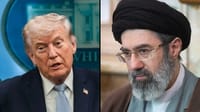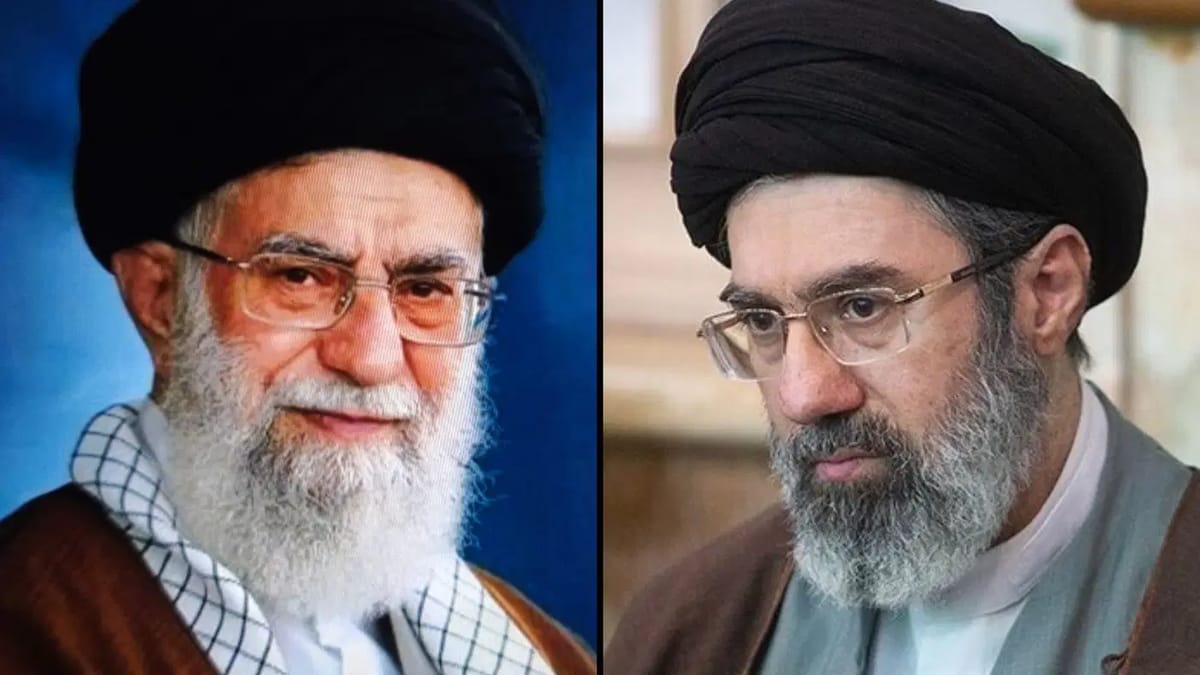
Two sources close to President Masoud Pezeshkian's administration told IranWire on August 6 that Mojtaba Khamenei has not met with any cabinet members since the U.S.-Israeli airstrike on February 28 that killed his father and predecessor, Supreme Leader Ali Khamenei. According to both sources, rumors that Iran's third Supreme Leader is in extremely critical condition and could die imminently are circulating widely within the regime's highest echelons.
Pezeshkian's recent comments appear to confirm the growing difficulty surrounding access to the nation's leader. In a televised interview marking his second anniversary in office, broadcast on Iran's state IRIB channel, Pezeshkian stated that communicating with Mojtaba Khamenei under current circumstances is "very difficult." The president's acknowledgment marks the first public comment on decision-making constraints involving the Supreme Leader since Mojtaba took office in early March.
Since assuming power in March 2026, Mojtaba Khamenei has not made a single public appearance or delivered any speeches. Communication from him has been limited to written statements released through official Iranian news agencies. Kikar HaShabbat reported that one government source asserted Mojtaba's physical condition "is not good" and that word of his death "would not surprise" certain political circles in Tehran.
The physical isolation surrounding Iran's Supreme Leader stands in stark contrast to the expectations that typically accompany high office. In May, when public speculation about his whereabouts intensified, Pezeshkian initially claimed to have met with Mojtaba for two and a half hours, stating the encounter was "completely unmediated." However, he provided no details of when, where, or with whom the meeting occurred. That claim has not been independently confirmed.
Earlier intelligence reports indicated that Mojtaba sustained severe injuries in the February 28 strike, including serious burns, loss of mobility in at least one limb, and facial scarring. According to reporting by the New York Times, U.S. Defense Secretary Pete Hegseth said the new Supreme Leader was wounded and likely "disfigured," though Tehran has never officially confirmed those accounts.
Foreign Minister Abbas Araghchi acknowledged in a rare interview that visibility of the Supreme Leader has been tightly restricted. "Only a handful of people have seen him," Araghchi stated, adding that he himself has not observed Mojtaba and does not believe anyone aside from a small circle of officials has done so.
The regime has offered no official explanation for the Supreme Leader's sustained absence from public life, nor has it issued any statement addressing the circulation of health rumors within government circles. Some analysts and observers have speculated that the Revolutionary Guards may be staging messages attributed to Khamenei to maintain the appearance of continuity and preserve the legitimacy of regime decisions, particularly regarding the ongoing U.S.-Iran negotiations and military posture.
Pezeshkian's statement that accessing Mojtaba is "very difficult" appeared in the context of his discussion of recent National Security Council votes. He revealed that 12 of 13 Supreme National Security Council members approved a memorandum of understanding with the United States, and that he subsequently sought approval from Mojtaba on that basis, which was granted. The president did not specify the mechanism by which that approval was conveyed or whether it constituted an actual meeting between the two leaders.
The uncertainty surrounding Iran's Supreme Leader compounds an already precarious period for the Islamic Republic. The regime continues to manage the aftermath of the U.S.-Israeli strikes that decapitated much of its senior military and intelligence leadership, negotiate with the United States over regional conflicts, and contend with internal questions about succession and legitimacy that remain unanswered nearly five months after Mojtaba took office.