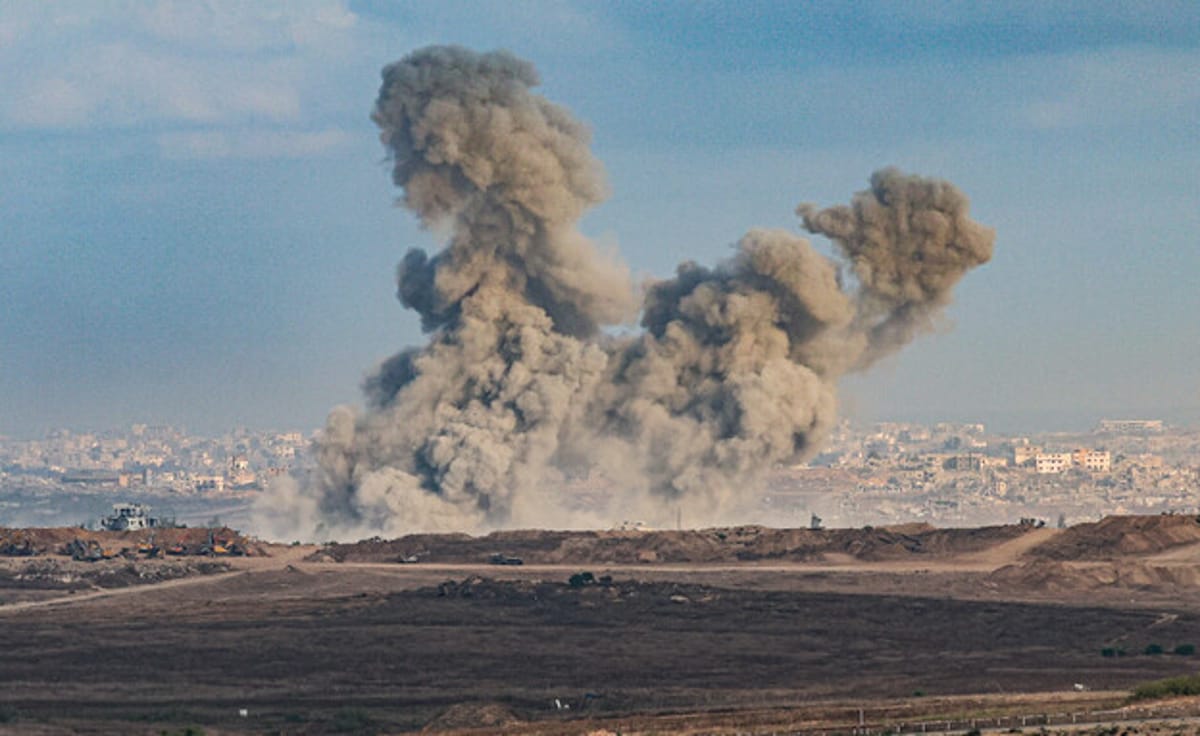
Hamas terrorists are deliberately slowing the return of deceased hostage bodies to buy time in talks with the United States, fearing that Israel will use any violations of the ceasefire as a pretext to continue targeted military actions, a strategy the terror group refers to as the "Lebanon scenario." This fear is heightened following the recent assassinations of five significant Hamas field commanders by Israel.
The terrorist organization has been returning the bodies of deceased hostages in small batches, handing over two coffins on Tuesday but none on Wednesday. This calculated delay appears intentional, designed to keep Hamas relevant as a negotiating partner while regional and international powers race to shape the "day after" in Gaza.
Fear of Reprisal and Disarmament
Hamas sources have expressed deep anxiety that Israel's strategy mirrors actions in Lebanon, where any infraction is met with a military response. The recent killing of five important field operatives by Israel has fueled this concern, with the group fearing that its own violations could establish an "equation of fire" from Israel.
Sources within Hamas told the Saudi newspaper Asharq Al-Awsat that the assassinations confirm Israel's intent to continue this role and "may use the issue of disarmament as an excuse to carry out attacks inside the Gaza Strip in the near future, using the same pretext."
One source claimed: "The scenario currently developing in Lebanon is expected to be repeated in Gaza. This scenario has not escaped the attention of the organization's leadership, which clearly insisted throughout all stages of the negotiations on the necessity of a complete ceasefire and obtaining clear guarantees on this matter from all mediators, including the US." This commitment to a complete and guaranteed ceasefire, the source noted, was achieved during the Sharm el-Sheikh negotiations.
Strategic Delay and Regional Power Race
The deliberate delay in releasing all bodies at once serves two strategic purposes for Hamas: it ensures the group remains a significant factor in discussions after a two-year war, and it allows time for more "favorable" international actors, specifically Turkey and Qatar, to increase their influence and presence in the Gaza Strip.
In a related development, a Hamas leadership delegation led by Muhammad Darwish met yesterday in Doha with Turkish Foreign Minister Hakan Fidan and Turkish Intelligence Chief Ibrahim Kalin. The meeting focused on the implementation of the ceasefire agreement and methods for delivering humanitarian aid into Gaza. Other senior Hamas leaders, including Khaled Meshaal, were present.
This action highlights the main geopolitical competition currently underway for control and reconstruction of the Strip: the axis of the Muslim Brotherhood, Turkey, and Qatar versus the alignment of Egypt, Saudi Arabia, and the UAE. The visit by the Egyptian Intelligence Minister to Israel today is seen as highly significant, reflecting Egypt's emerging central role in shaping the "day after," especially after days of genuine concern over the fate of its peace treaty with Israel. Saudi Arabia and the UAE, however, are reportedly not yet ready to participate fully until the Palestinian Authority is present in Gaza.
Details of the Recent Assassinations
The elimination of five key Hamas field terrorists was carried out recently using advanced military capabilities. Sources within Palestinian factions reported that on Sunday, Israel utilized a suicide drone to assassinate Taji al-Din al-Wahidi, the Deputy Commander of the Western Battalion in Jabalia, which belongs to the military wing's Northern Brigade. Al-Wahidi, who was residing in an apartment near the port area, was a veteran field commander who had planned and executed numerous operations against Israeli forces during the war and was involved in the October 7 attack on Zikim.
Another source confirmed that a separate drone launched a missile that struck and eliminated four additional terrorist leaders, including their field commander, who served as the commander of the Nukhba unit in the Eastern Battalion of Jabalia. The five terrorists were reportedly near a beach resort in the town of Al-Zwaida in the central Gaza Strip and had carried out numerous military missions throughout the war.