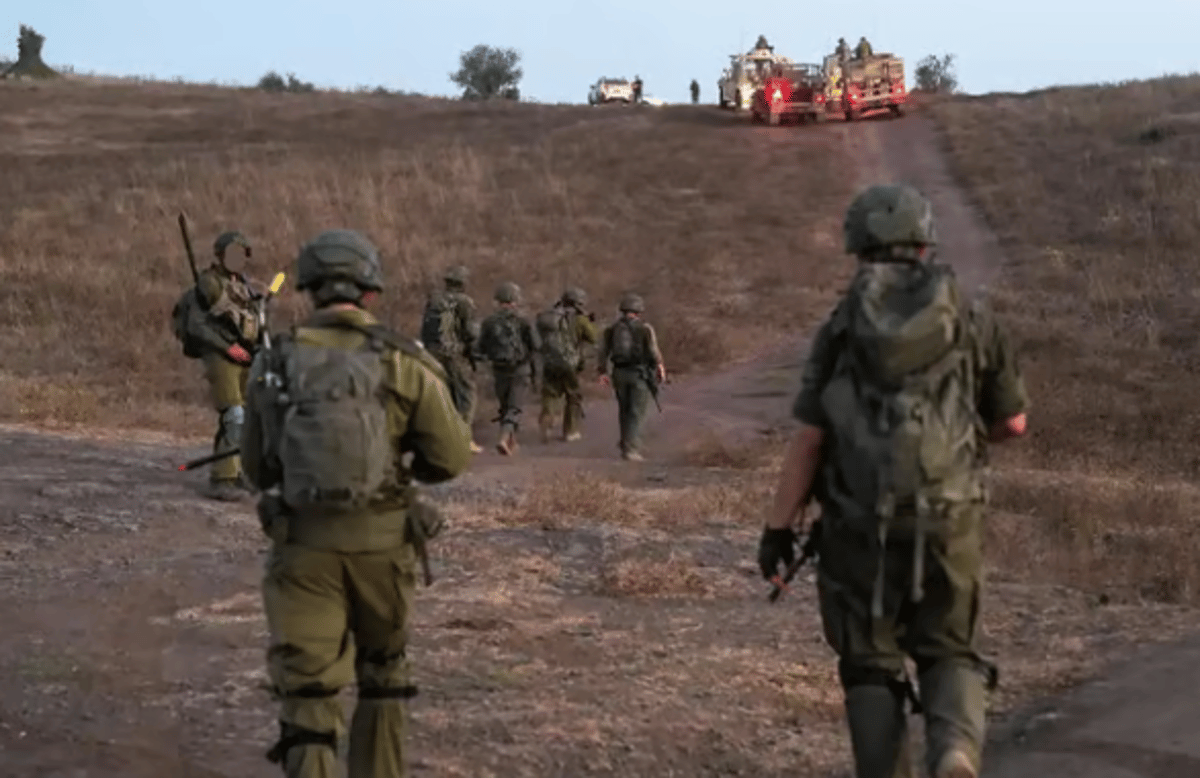
An Israeli military commander has publicly detailed IDF operations across nine military positions established deep within Syrian territory, describing the mission as essential to preventing Iranian Shiite forces from threatening Israeli communities in the north. The commander's account, published by Srugim, offers rare insight into one of the more obscure theaters of Israel's current regional conflict.
"We are operating in the buffer space, and we go in with the understanding that when we are there, residents of the north are more protected," the major, identified as Lt. Col. D., told the outlet. He commands three of the nine positions, which are located in the Kunitra area, an approximately nine kilometers from the border, according to the report.
The officer emphasized that preventing Iranian-backed militias from establishing footholds in southern Syria is the central mission. "The forces working against us are Iranian Shiite forces. They try through people in Syria to harm our forces and Israeli residents. We are in a mission to thwart the cells operating in this space, we are essentially pushing them back," he said.
The military operations span territory that still contains Syrian civilians, primarily Sunni Muslims and Druze, who remain in villages throughout the area. This distinguishes the Syrian front from operations in Gaza and Lebanon, where civilian populations have largely evacuated. The IDF works through population liaison officers to maintain communication with local Syrian residents while conducting military operations.
When asked whether Israeli forces have encountered direct clashes with Syrian army units, the commander indicated that underlying agreements are in place. "We have oral understandings according to which they are stationed far away. We have complete freedom of action and can carry out all defense operations," he said.
The commander characterized intelligence on the precise size of Iranian forces in the area as uncertain and noted that to date there have been no direct confrontations. His battalion consists of former paratroopers who have already rotated through most operational sectors during recent years before deployment to Syria.
One significant operational challenge has emerged from Israeli civilians crossing into Syrian territory without authorization. The commander dismissed such incursions with frustration. "These are wild kids trying to make a scene. It interferes with us in defense operations. We want to not have a problem operating there," he said, characterizing civilian crossings as creating friction with his mission parameters.
The extended reserve duty required for operations in Syria has imposed heavy strain on soldiers' families. Reservists have left their families for the entire summer period, missing family vacations and children's summer programs. The commander acknowledged the toll: "Reservists who left their families for all of summer, enormous burden on the families and on the children. It's not crushing us but it's very difficult, it breaks up families. We know how to be strong and strengthen each other, it's not like before when you'd do a month a year."
Despite the burden, compliance with reserve call-ups has remained high. The commander attributed this to soldiers' commitment to protecting the state: "People who made the decision to sacrifice their lives and their families for the state's sake are showing up. They made the decision and they're coming. As a system we're trying to help them integrate however we can."
The commander also noted that the brigade has maintained training capacity despite operational demands, conducting a two-day divisional exercise during the summer mobilization period, described as a high operational capability achievement during a time when typical training is limited.