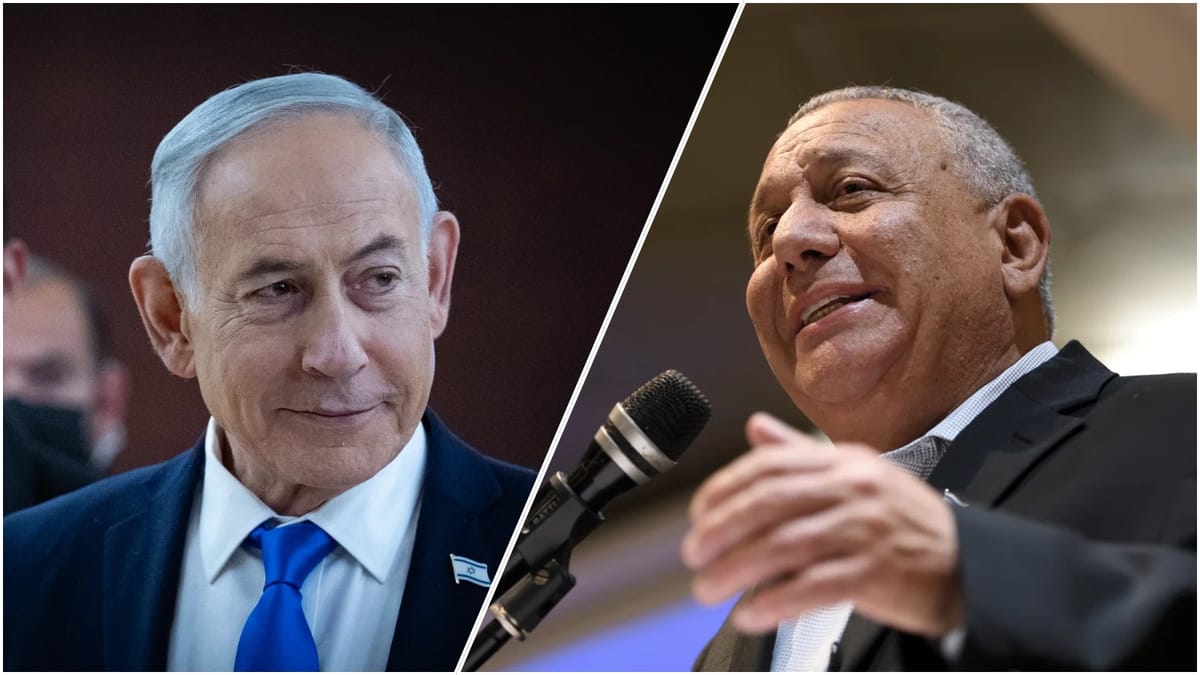
The first meeting between negotiating teams from Likud, Gadi Eisenkot's Yashar party and Naftali Bennett's Beyachad party ended on Sunday afternoon after about an hour at the Dan Accadia Hotel in Herzliya. There was no reported breakthrough toward a national unity government.
Earlier assessments had suggested the talks could run long. According to later reports, people who attended the meeting said no progress had been made.
Likud was represented by its Knesset faction chairman, MK Ofir Katz, and attorney Michael Rabello. Yashar sent MK Chili Tropper and Yoav Horowitz, a senior adviser to Eisenkot who previously served as Prime Minister Benjamin Netanyahu's chief of staff. They were joined by former cabinet secretary Shalom Shlomo, who represented Bennett at Bennett's request to take part. Shlomo was also Bennett's representative in the 2021 negotiations that formed the so-called "change government."
Yashar had also proposed bringing in MK Elisha Madan, who set up a protest tent outside the Knesset the day before to call for a unity government. He did not attend the meeting.
The talks followed days of mutual accusations, public declarations about unity and political maneuvering behind the scenes. Holding talks does not necessarily mean the sides are moving closer. The central dispute is over who would lead the government, and it presents a major obstacle from the outset.
Eisenkot wants to form a government under his own leadership, without a rotation agreement with Netanyahu. Likud has made clear it will not accept a government in which Netanyahu is not prime minister. For now, neither side is willing to accept a rotation.
According to the outline attributed to Eisenkot, he wants to bring Likud into a government he leads, along with other parties from the current coalition, but without Itamar Ben Gvir's Otzma Yehudit. Likud is demanding that every party in the Netanyahu bloc be included, Ben Gvir's party among them, and insists that Netanyahu remain prime minister.
The gaps go beyond who holds which post. Eisenkot speaks of a government founded on shared values and a broad concept of unity. Likud, by contrast, wants to explore a unity government without preconditions. Likud sources said there was no intention to set preconditions for a personal conversation between Netanyahu and Eisenkot, and that all options were on the table.
The talks also drew sharp opposition from within the opposition bloc. Democrats chairman Yair Golan attacked the meeting before it had even ended and said he saw no way to form a government in which Netanyahu stays in office. "The path to change does not go through unity talks with Netanyahu and Likud," he wrote. He added that the focus should be on building a partnership that could replace the current government.
Yisrael Beytenu MK Yulia Malinovsky also criticized the contacts. "Making a deal with Netanyahu is like making a deal with the Tinder Swindler," she said. She argued that when Netanyahu is in a position of strength he divides and incites, and that when he senses his standing slipping he talks about unity and looks for someone who will believe his promises.
Criticism also came from inside Beyachad. MK Merav Ben Ari took aim at Transportation Minister Miri Regev, who had written in support of Netanyahu's unity initiative. Ben Ari asked how anyone could talk about unity while delegitimizing representatives of parties that, she said, represent more than 20 percent of the population.
Before the meeting, Eisenkot and members of his party visited the Ben-Gurion Heritage Institute and David Ben-Gurion's grave at Sde Boker, where he laid out his view of unity. "In my eyes, the content of unity in values is far more important than the political closing of a national unity government," he said.
Eisenkot stressed that the question is not only who joins whom to reach a Knesset majority, but which shared values and issues the government would advance. Among them he listed state education, mutual responsibility, military service, public service and the mutual commitment of Israel's citizens to the state.
"We are at a historic crossroads that can and must be reshaped," he said. He added that unity should be measured by its substance, not by a political headline meant to create an appearance of stability.
Netanyahu, for his part, renewed his call for direct negotiations with Eisenkot "without preconditions." The prime minister argued that rather than forming a shaky and dangerous government, the sides should sit down together and reach agreements for Israel's security and future. Eisenkot dismissed the call as "spin" and a "ploy." He said Netanyahu had issued it after a meeting had already been scheduled, while continuing to attack and divide.
Meanwhile, Eisenkot has also been in contact with the chareidi parties. Last week he met secretly with United Torah Judaism chairman Yaakov Asher. United Torah Judaism confirmed that exploratory talks are taking place with various political figures. The party stressed that no detailed negotiations have begun and that the discussions so far have dealt only with general principles.
Asher also met last week with Yisrael Beytenu chairman Avigdor Liberman. United Torah Judaism has declined to confirm or deny the daily reports of political meetings.