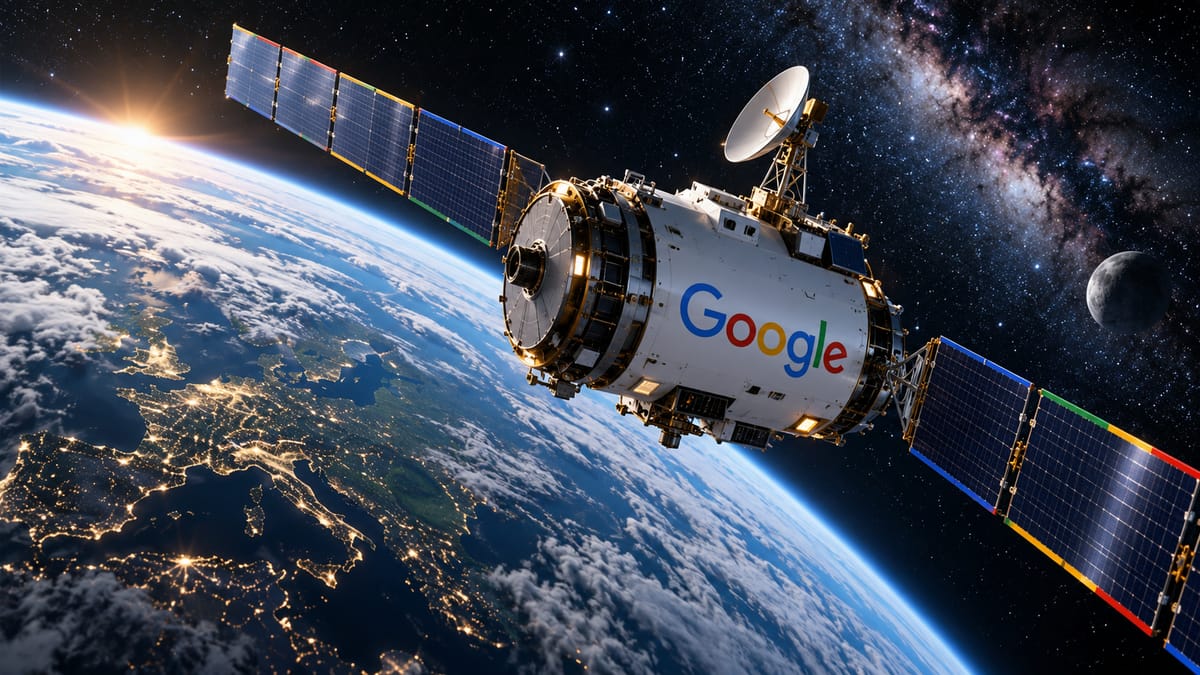
Google is preparing for an ambitious first step toward a bold vision: moving part of the computing infrastructure that powers artificial intelligence into space. The company announced plans to launch an experimental satellite under "Project Suncatcher," a research initiative examining the possibility of operating large-scale AI computing systems in low Earth orbit.
The satellite is scheduled to launch aboard SpaceX's Transporter-18 mission, in partnership with satellite company Planet. The initial goal is not to establish a complete data center in space, but to test how Google's TPU chips, designed specifically for AI computations, perform under the harsh conditions beyond the atmosphere.
One significant challenge comes at the launch stage itself. During ascent to orbit, satellite components are exposed to severe vibrations and high acceleration forces. According to Google, some components may experience loads tens of times greater than Earth's gravity. The company conducted a series of pre-launch tests designed to simulate these conditions, and reports the hardware passed successfully.
Another challenge is space radiation. Cosmic rays and solar activity can damage electronic components and cause computational errors. Google has already tested its Trillium TPU chips using proton radiation in laboratory settings, reporting that initial results showed resilience to radiation levels exceeding those expected during a five-year mission. However, the company emphasizes that only a real orbital test can provide the complete picture.
Heat dissipation also presents a complex problem. Data centers on Earth use massive cooling systems, but in space there is no air to assist in heat removal. Google is therefore developing systems based in part on heat pipes and radiators, which it intends to test under real conditions.
The primary reason technology companies are interested in space is energy. Satellites in the right orbit can receive sunlight for a very large portion of the day, and Google estimates it could generate up to eight times more solar energy there compared to similar facilities on Earth. This possibility could be especially significant for AI systems, whose power consumption is growing rapidly.
The long-term vision includes arrays of satellites, each carrying dozens of TPU chips, connected to one another via high-speed laser communication. For the system to function as a single supercomputer, the satellites will need to maintain precise and rapid communication while moving in orbit at high speed.
Google is not alone in looking skyward. Other companies, including SpaceX and Starcloud, are examining possibilities for establishing data centers in space, partly in an attempt to harness solar energy and reduce dependence on electricity and ground infrastructure on Earth.
At this stage, this remains long-term research, and the path to massive data centers orbiting Earth is distant. However, if the initial experiment succeeds, it could mark a first step toward a reality in which some of the heaviest computations of the AI era are performed hundreds of kilometers above our heads.