
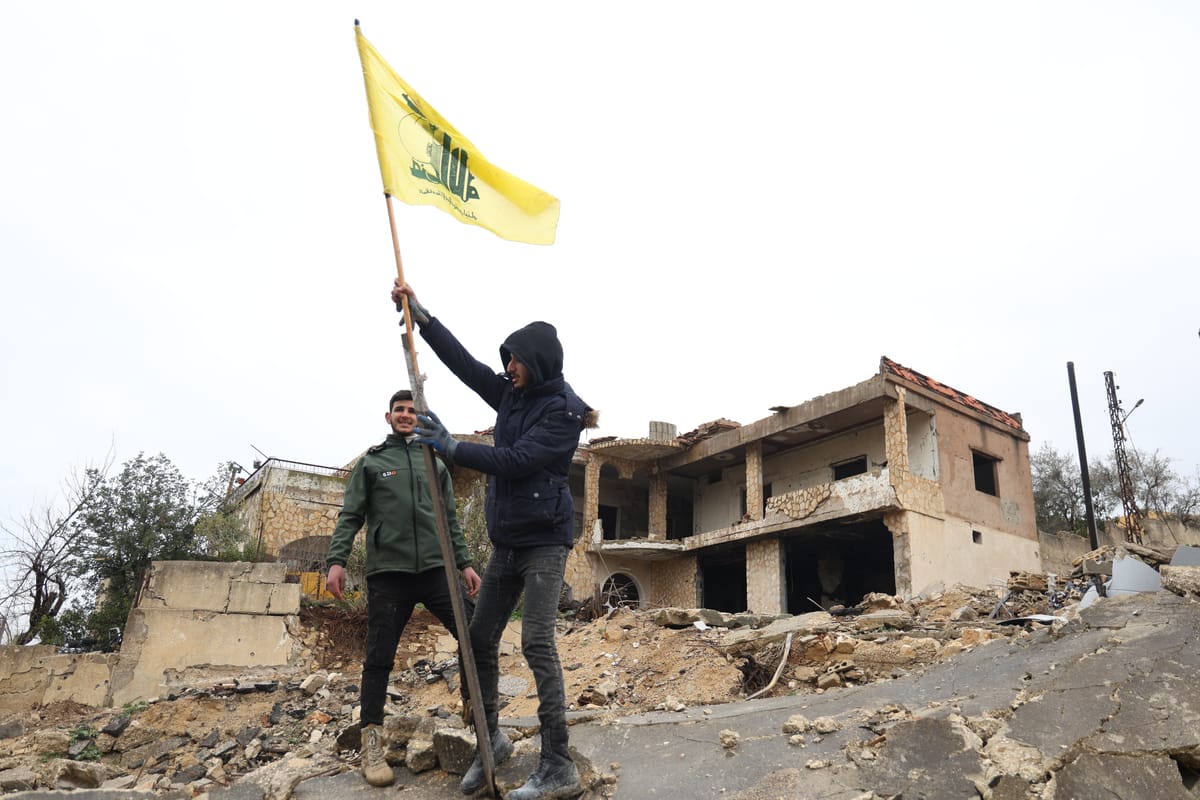
The IDF's presence in the buffer zone isn't just a military calculation. For 55,000 Israelis who finally came home, it's the only thing standing between them and the road out again.
The U.S.-Iran memorandum of understanding signed this week calls for a ceasefire "on all fronts, including Lebanon." Iran says that means Israel must pull its troops out of southern Lebanese territory. Israel says it means nothing of the sort.
In the gap between those two readings lies one of the most consequential and emotionally charged questions of the post-war moment: can the communities of northern Israel stay home if the IDF leaves?
The answer, in the view of Israel's government, its military, and the residents of the north themselves, is almost certainly no.
How We Got Here
When Hezbollah fired rockets at northern Israel on March 2, the first time since the 2024 ceasefire, it set off a chain of events that reshaped the entire region. Hezbollah resumed fire on Israel days after the U.S. and Israel launched a war against Iran, vowing retaliation for the assassination of Iran's supreme leader. Israel responded with a massive aerial campaign and, by mid-March, a full-scale ground invasion of southern Lebanon.
The objective Israel stated from the outset was not simply to punish Hezbollah, but to permanently change the physical reality on the northern border. Netanyahu's government declared its intent to establish what it calls a permanent security buffer zone in southern Lebanon, to push Hezbollah forces and its rocket arsenal away from Israel's border. Israel had occupied a similar strip of southern Lebanon from 1982 until 2000, when Hezbollah forced it out.
This time, the IDF wasn't going back to the old model. After the April 2026 ceasefire, the IDF said that five divisions were operating simultaneously south of the Forward Defense Line in southern Lebanon, dismantling Hezbollah terror infrastructure sites and preventing direct threats to communities in northern Israel.
The 55,000
To understand why the buffer zone question carries the emotional weight it does, you have to understand what northern Israel went through before this war.
Some 55,000 residents of northern Israel who had been displaced for over a year returned home after the November 2024 ceasefire between Israel and Hezbollah, reassured by Netanyahu that the Iran-backed militant group had been significantly weakened. They came home to damaged houses, shredded routines, and a nagging awareness that the threat had not been eliminated, only paused.
When Hezbollah opened fire again in March, the fear was that it would happen yet again, that the north would empty out a third time.
That fear is precisely why Israeli officials, opposition politicians, and residents speak about the buffer zone not as a bargaining chip but as a baseline condition of normal life. Former defense minister Benny Gantz said it was "forbidden to agree to restrict Israel's freedom of action in Lebanon or to a withdrawal that endangers the residents of the north."
One kibbutz resident near the border put it plainly to CNN: "We cannot be the first line with Hezbollah. We need the army before the enemy."
What Iran Is Demanding — and What Israel Is Refusing
The gap between the two sides is not subtle. Iranian Foreign Minister Abbas Araghchi told foreign diplomats in Tehran that any continued occupation of Lebanese territory would be regarded as a violation of the memorandum of understanding, and that in Iran's view, Hezbollah was a party to the agreement.
Two regional officials with direct knowledge of the interim deal told the Associated Press that it would require Israel to leave nearly all the territory it occupies in Lebanon, minus a few hilltop points along the border seized earlier.
Israel's response has been unequivocal. An Israeli source told the Jerusalem Post that Israel will not withdraw from southern Lebanon as part of the deal despite Iranian demands, and a senior White House source confirmed to Walla that an IDF withdrawal from Lebanon is not part of the deal. Defense Minister Israel Katz stated plainly that the IDF will remain in the security zones in Lebanon, Syria and Gaza without a time limit, in order to protect the border and Israeli communities.
Netanyahu himself, at a press conference Monday, said Israeli troops would remain in the buffer zone "for as long as necessary."
The Pressure From Washington
The situation is further complicated by the fact that Israel's closest ally is, at the moment, not entirely on the same page. According to a Channel 13 report, Netanyahu recently held a tense phone call with Vice President JD Vance in which Vance asked Israel to scale back its presence in Lebanon, but Netanyahu refused. Trump himself said publicly that Israel was "fighting Hezbollah too long and too many people are being killed," and suggested Syria should take over the fight against the group.
These are not the words of an administration fully committed to Israel's position on the buffer zone. Yet both U.S. and Israeli officials insist the MOU does not mandate an IDF withdrawal. A senior U.S. official told reporters that the memorandum of understanding signed with Iran is not conditioned on Israel withdrawing from Lebanon, though the deal still envisions a ceasefire that covers Lebanon.
The tension came to a head over the weekend. On June 20, Iran declared that it had closed the Strait of Hormuz again due to Israeli strikes in Lebanon, describing them as a violation of its deal with the U.S., a claim denied by the U.S. military. The ceasefire framework, still fragile, nearly collapsed before it was signed.
Why This Won't Be Easily Resolved
The history alone explains why Israel is not inclined to trust alternative arrangements. The 2024 ceasefire agreement required Hezbollah to withdraw north of the Litani River and the Lebanese Army to deploy in its place. IDF sources said that without clear instructions that preserve the military's gains, the military could very quickly find itself back in the situation that existed before the maneuver began.
Northern Israel's residents have lived that story once already. They came home. Rockets fell again. A 43-year-old father of four from Nahariya was struck by shrapnel while biking to a shelter. A 27-year-old woman from Moshav Margaliot was killed after sheltering in a roadside ditch during a siren.
A buffer zone enforced by the Lebanese Army, or by a UN resolution, is, in Israel's assessment, the arrangement that already failed. A buffer zone enforced by the IDF, inside Lebanese territory, is the only version Israel believes will hold.
That calculation may be right or wrong. It may prove sustainable or, as critics warn, draw Israel into another 18-year occupation.
Perhaps no one has framed the stakes more starkly than retired Colonel Professor Gabi Siboni, who warned in an interview Sunday on Galei Yisrael radio that an IDF withdrawal from the buffer zone would be catastrophic in a way that goes beyond any conventional military calculation.
"If we withdraw from the security buffer zone in Lebanon, if we allow Hezbollah to rehabilitate itself on the border, we will see the northern communities dismantled," Siboni said. "We will effectively receive the result of a nuclear bomb being dropped."
He argued that presence alone is not enough, that it must be paired with a clear doctrine of disproportionate response. Every ceasefire violation by Hezbollah, he said, must be met with force that far exceeds the provocation. "If they hit us with one drone, we drop buildings and strike infrastructure."
It is a vision of deterrence built not on trust, but on cost. Which may be precisely the point. After two evacuations, after years of living under the rhythm of sirens and shelters, after watching the 2024 ceasefire hold until the day it didn't, northern Israel's residents have heard enough promises about what the other side will or won't do. What they want is distance. Buffer. The IDF, not them, as the first line.
Whether that is sustainable, politically, diplomatically, militarily, remains the open question hanging over every negotiation. But for the families of the Galilee and the Golan, the Finger of the Galilee and the communities along Route 90, it is not really a strategic question at all.
It is the question of whether they get to stay home.