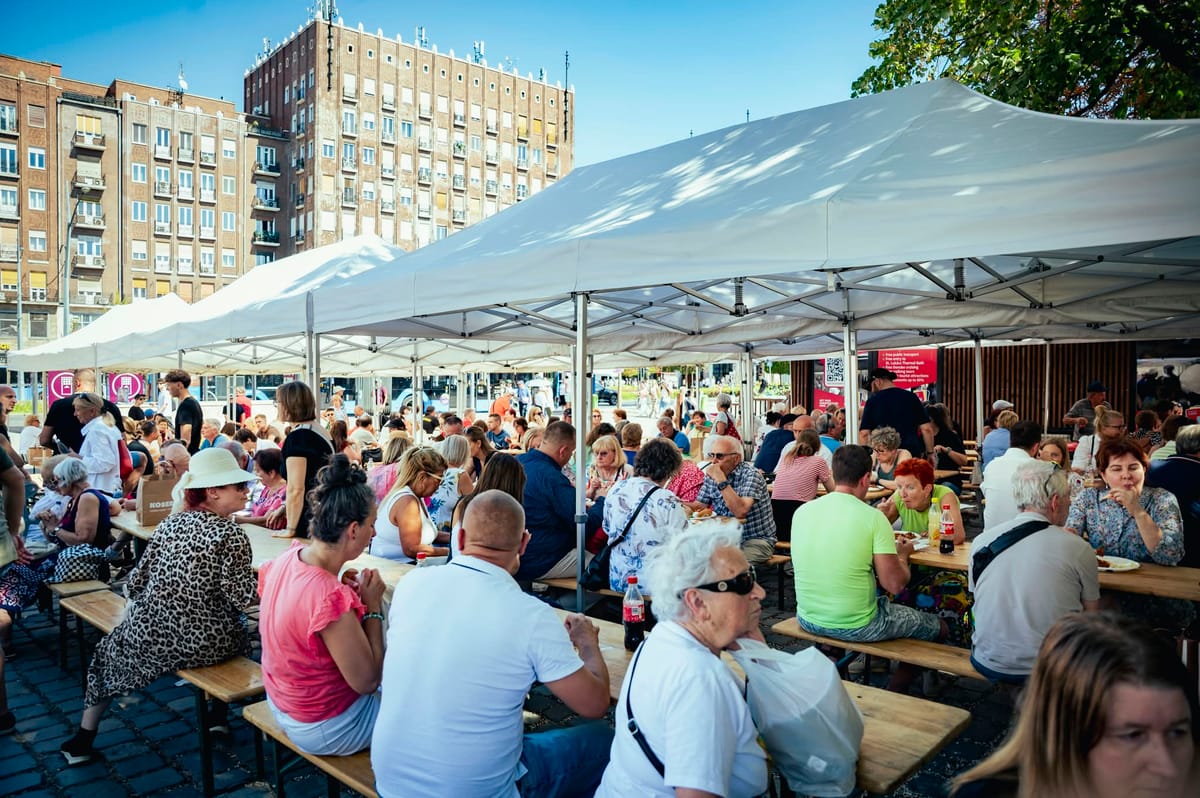
Two major Jewish events opened this week in Budapest, Hungary's capital: Synagogue Week and the International Hungarian Cholent Festival. Both aim to connect the country's approximately 100,000 Jews with synagogues and Jewish tradition, while also introducing non-Jewish Hungarians to Jewish faith, customs, and cuisine as a means of combating antisemitism.
Now in its tenth year, the Cholent Festival has become one of Hungary's largest Jewish cultural events and enjoys widespread popularity among the general Hungarian public. The free festival features kosher food stalls showcasing Jewish culture, tradition, and cuisine. Both the festival and Synagogue Week are organized by EMIH, the Alliance of Hungarian Jewish Communities, and together draw tens of thousands of Hungarian participants, both Jewish and non-Jewish, with attendance growing annually.
This year, amid dramatic political changes in Hungary following the ousting of longtime Prime Minister Viktor Orbán, who had prevented pro-Palestinian demonstrations in city streets, a well-known local rapper named Gergely Komáromi, known as G Ras, announced last week that he would hold a protest at the Cholent Festival entrance. The demonstration was titled "Together for Justice – From Palestine to Budapest."
The announcement sparked fury within the Jewish community due to its provocative nature. Hungarian Jewish leaders emphasized a critical distinction between holding a regular demonstration and staging one inside a community event in the heart of the Jewish quarter. "This is a dangerous, malicious, and ugly provocation designed to hurt the feelings of the Jewish community while Hungarian Jews gather to celebrate together," they said.
The controversy intensified because just the week before, the same radical anti-Israel organization had held a Budapest demonstration demanding the release of Abu Safiya, director of Kamal Adwan Hospital in northern Gaza. Protesters claimed he was a medical professional being mistreated, but Israeli Ambassador to Hungary Maya Kadosh clarified that he is not a doctor but a lieutenant colonel in the Hamas terror organization, and that Kamal Adwan Hospital served as a hub for terrorist activity.
That demonstration provoked sharp reactions in Hungarian politics, with Budapest Mayor Gergely Karácsony publicly opposing the protest and the portrayal of Abu Safiya as a figure worthy of public solidarity. The protest organizers, in turn, accused the mayor of adopting the Israeli narrative, attacked him explicitly, and claimed that Israeli public officials were spreading "false propaganda."
Hungary's Chief Rabbi, Rabbi Shlomo Köves, responded: "When anti-Israel protest deliberately comes into the physical space of a local Jewish event, a dangerous red line is crossed. The initial choice to hold such a demonstration specifically at the location and time of one of the city's largest public Jewish events raises concern because it crosses the boundary between political protest, even if false and illegitimate, and directing confrontation toward local Jews. This is particularly worrying given the experience of Western European countries in recent years, where anti-Israel demonstrations have become a separate name for hostile harassment against local Jews."
Public outcry had its effect: the demonstration route, initially approved to pass by the festival opening, was moved to prevent antisemitic harassment of Hungarian Jews. EMIH praised the authorities for understanding the sensitivity and relocating the march. According to Rabbi Köves, "The response to these events is not to hide Jewish life or retreat from the public sphere, but exactly the opposite: the Jewish community in Hungary is an integral part of the fabric of life in the country. Jews have a full right to conduct their culture, religion, and community life openly, safely, and proudly, without becoming a target for antisemitic and anti-Israel protests."