
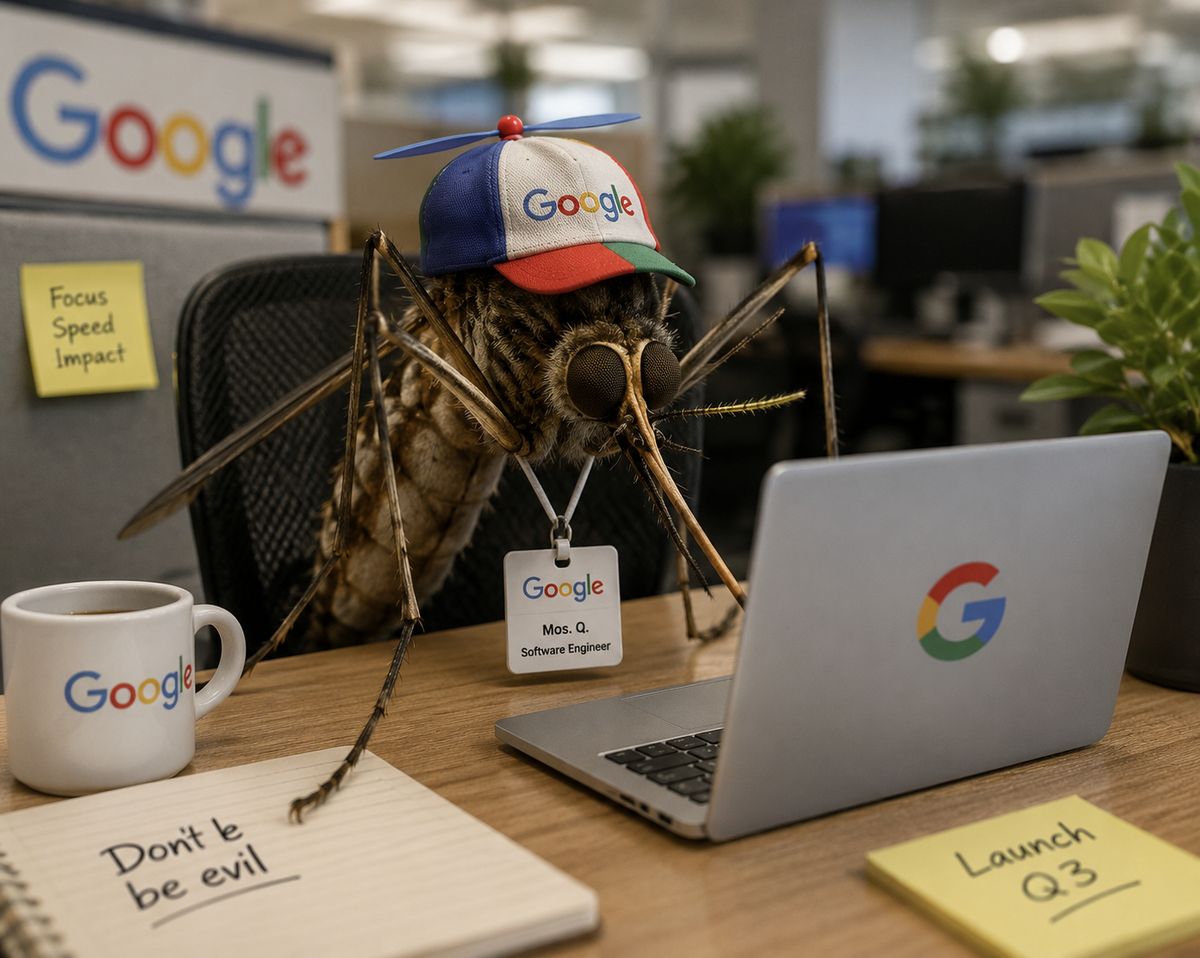
Google’s parent company Alphabet is backing an unusual weapon in the fight against mosquito-borne disease: millions of mosquitoes.
Through its health-tech subsidiary Verily, Alphabet has been running the Debug Project, an initiative designed to reduce populations of disease-carrying mosquitoes without relying on traditional chemical pesticides. As part of the project, researchers have released tens of millions of lab-raised male mosquitoes into targeted areas.
The key point is that male mosquitoes do not bite humans. In nature, only female mosquitoes feed on blood, which is why the release itself does not pose the same nuisance or health risk as a normal mosquito swarm.
The method relies on a bacterium called Wolbachia. Male mosquitoes carrying the bacterium are released into the wild, where they mate with female mosquitoes. The resulting eggs fail to hatch, causing the local mosquito population to decline over time.
The project combines biology with advanced automation. Verily has used robotic systems to raise and sort mosquitoes at scale, smart release vehicles guided by GPS, and software that can track the release process with high precision. The goal is to make mosquito control cleaner, more targeted and less dependent on broad pesticide spraying.
Early results have drawn attention. In trial areas in California, mosquito populations reportedly dropped by as much as 95%. Similar efforts in Australia showed reductions of around 80%.
The technology is aimed at mosquitoes that spread dangerous diseases, including dengue, Zika and chikungunya. Mosquito-borne illnesses remain one of the deadliest public health threats in the world, with estimates suggesting that more than one million people die each year from diseases transmitted by mosquitoes.
The approach is still being studied, especially when it comes to long-term ecological effects. Reducing one species on a large scale can raise questions about food chains and environmental balance.
Still, supporters say the method could become one of the most promising tools in modern pest control: precise, non-chemical and focused only on the mosquitoes most dangerous to humans.
Instead of fighting mosquitoes with sprays and nets alone, Alphabet is betting that the best way to beat them may be to send in more mosquitoes, just engineered to end the cycle.