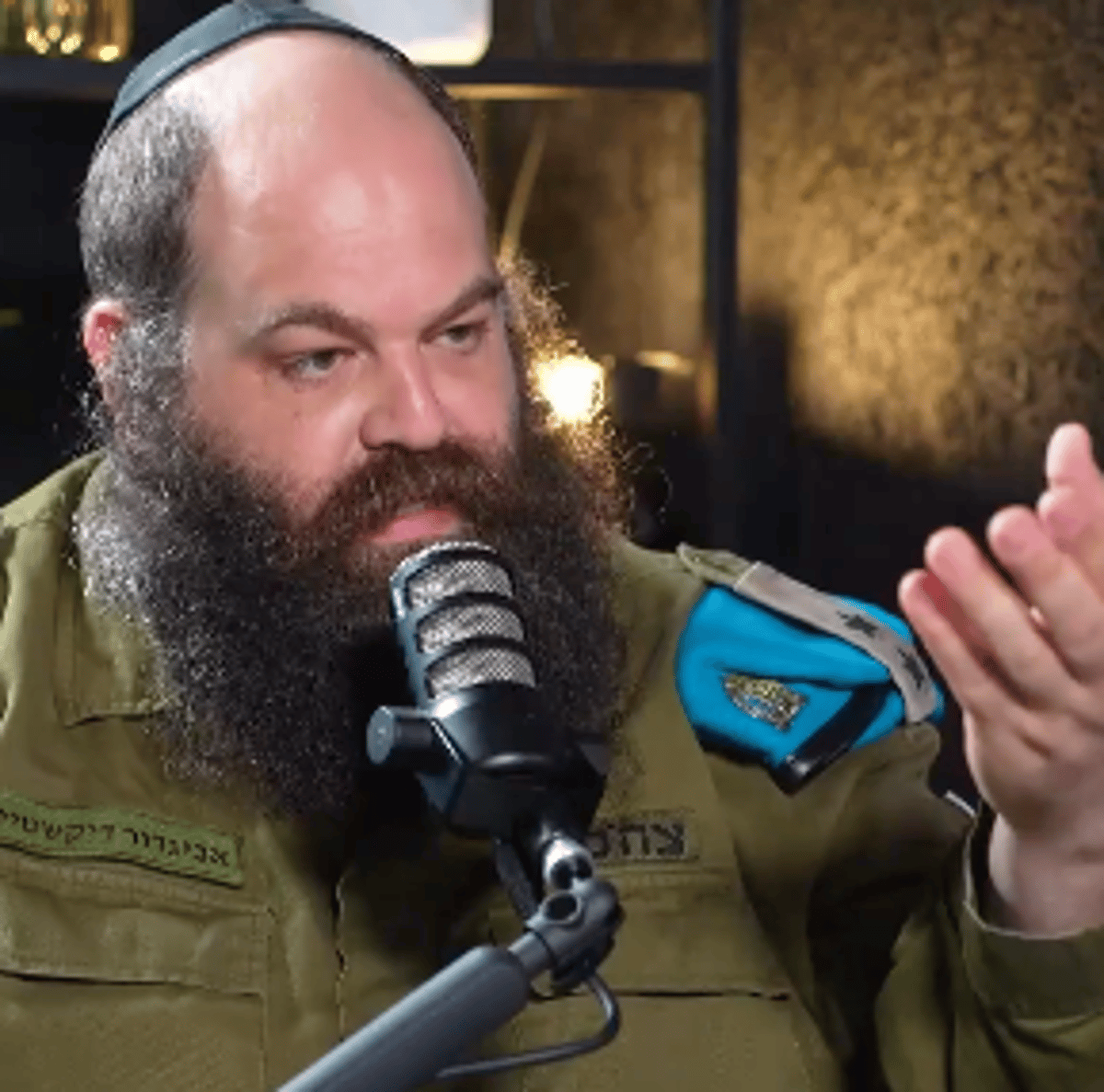
Lt. Col. Avigdor Dickstein was not born into the military. He was born into shlichus, the seventh of eleven children in a veteran Chabad family in Beersheba, the son of a rabbi who was among the Rebbe's first emissaries to the southern city. And yet on the morning of October 7, 2023, it was Dickstein, the Chabad boy from 770, who found himself inside the war room of the Gaza Division at Re'im, trying to build a picture of a battle that had already begun swallowing the base around him.
In a wide-ranging interview on the Kikar FM podcast with host Eli Gothelf, Dickstein, who now heads the IDF Personnel Directorate's Haredi branch, described a life that moved from the yeshiva world of Chabad emissary families in Moscow and Beersheba, through the kitchens of an army base, into the war room where Israel's defenses collapsed on Simchat Torah morning, and finally into one of the most sensitive assignments in the IDF today: integrating Haredi soldiers into the army without asking them to give up their identity.
Dickstein grew up in a home built entirely around the idea of self-effacement for the sake of others, he said, describing a childhood filled with guests at every Shabbat table and a father who traveled by public bus to secure kosher-for-Shmita produce as a stringency. He followed the standard yeshiva track through cheder, yeshiva ketana in Netanya, yeshiva gedola in Safed, and finally the traditional year of "kvutza" at Chabad's world headquarters at 770 in New York, before heading out on his own half-year of shlichus at a Jewish community school in Moscow.
It was in Russia, he said, that the idea of shlichus stopped being an abstraction. He compared it to a good cholent, something that develops slowly on a low flame until, when the lid finally comes off, everything he had absorbed growing up rose to the surface at once.
The moment his path diverged from the expected one came toward the end of his time in Moscow, as he prepared to continue on to a prestigious Chabad yeshiva in Brunoy, France, to complete his rabbinic ordination. At 21, unlike his older brothers who had received standard exemptions, he found himself facing a draft notice from the IDF. He and his rabbi wrote to the Lubavitcher Rebbe's Igrot Kodesh for guidance, expecting an answer that would clear the way for him to continue his rabbinic studies. Instead, he said, he opened the volume to find one letter in which the Rebbe told a soldier the army was an important place where he could make a difference, alongside a second letter in which the Rebbe sharply rejected the idea that someone should simply sit and learn rather than help the Jewish people, calling that position "a shocking claim that has no place." He enlisted the following week.
His father, he said, struggled with the decision, having served in the army himself only after marriage, and found it difficult to watch a Haredi son from the direct yeshiva track head straight into basic training. But his father also understood shlichus, Dickstein said, and recognized this was his son's version of it.
His early army career gave little indication of what would come. Testing scores from his initial draft evaluation, which he had never taken as seriously as students in the general education system, landed him a quiet, unglamorous logistics posting, peeling potatoes and briefing junior kitchen staff at a remote base, a jarring comedown from his position running programming at the Moscow school. He described real frustration during that period, writing to yeshiva friends stationed at Chabad houses in India and Guatemala while he handled food scraps in a mess hall. He said he chose to reframe the work through the lens of shlichus, deciding that whether the task was cooking schnitzel or cleaning the dining hall, he would do it as well as he possibly could. Within a week and a half, the kitchen manager offered to make him shift supervisor.
That approach eventually earned him a transfer to the IDF Spokesperson's Unit at the Kirya, where he said he was exposed for the first time to the full scope of the army's operations and the dedication of soldiers in the field. He recalled organizing a tour for a sensitive delegation of yeshiva heads and senior rabbis that accidentally wound up near a Egoz unit preparing to cross into Gaza in pouring rain, the soldiers reciting the Shema together before heading toward the border fence. He remembered two rabbis on the bus turning to each other, asking how they could possibly convey that level of devotion to a student in their own yeshiva who complained of a headache before heading to sleep in his dormitory.
Dickstein went on to officer's course and moved into the logistics corps, serving in company and battalion command roles before becoming a brigade supply officer, describing the administrative company of a battalion as the operational heart of the army, holding food, ammunition, medicine, intelligence, and communications together for the fighters on the line. As a Haredi career officer, the schedule was demanding, often eleven days on base to three days home, sometimes stretching to three full weeks. During this period, he and his wife had four children, with a fifth born in November 2023, in the middle of the current war.
He credited his wife entirely for making that life possible, describing her as a partner in his shlichus who absorbed the difficulty of raising young children largely on her own and chose, together with him, to frame his long absences to their children not as an absence but as their father's mission within the IDF.
Alongside his military career, Dickstein completed a bachelor's and master's degree in logistics, economics, and business administration, and also finished the rabbinic ordination exams he had set aside back in Moscow. He now holds both a combat logistics career and rabbinic ordination.
On Simchat Torah morning, October 7, 2023, Dickstein was serving as assistant logistics officer for the Gaza Division at Re'im. At 6:29 a.m., he ran from his bed to the base's armored shelter, and within minutes was at the division's war room as the duty officer for logistics and rear support. What began as what looked like routine rocket fire toward the Gaza border communities quickly revealed itself as a devastating surprise assault that collapsed the division's defenses.
He described the acute helplessness of those hours: the primary task of a war room is to build a real-time operational picture, but communication systems were failing, there were no functioning observation feeds, and brigades weren't responding. He recalled watching screenshots of WhatsApp messages from besieged civilians begging for help and trying to translate their locations into map coordinates for military systems that were no longer functioning properly.
As the war room struggled to manage the battle, terrorists breached Re'im itself. Dickstein recalled hearing gunfire outside and a tracking officer bursting in shouting that terrorists were attacking the base. The order was clear: trained fighters would go out to engage, while everyone else would stay to protect the war room from within, since it was considered a strategic national asset that could not be allowed to fall. He spoke with reverence of officers including Lt. Col. Sahar Machluf and Maj. Ilay Ezer, both of whom died fighting terrorists face to face to defend the base and the soldiers in the residential quarters, calling their sacrifice an experience that fills him with awe even now.
As a religious man, Dickstein acknowledged the theological weight of that day directly. He said he does not understand why God allowed that blow to fall, and that the Rebbe taught followers it is permitted, even necessary, to cry out and ask "why" even over far smaller hardships, so certainly over a tragedy of that scale. At the same time, he pointed to the halachic principle in the Shulchan Aruch permitting Jews to take up arms even on Shabbat against gentile forces besieging Jewish towns, framing October 7 in those terms rather than through political ideology: a mitzvah to save fellow Jews from those who came to slaughter them.
The horror did not end at the base fence for the Dickstein family. His father, Rabbi Moshe Dickstein, who had spent decades as commander of the ZAKA emergency response unit in Beersheba, was called that Saturday night to Shura camp, where hundreds of bodies of the murdered were being brought for identification, only months after completing a long reserve stint as rabbi for the Gaza border region. Avigdor's brother Mendy served hundreds of days of reserve duty with the Home Front Command, helping identify casualties and process the bodies and hostages who eventually returned.
Dickstein's voice cracked describing the toll that work took on his father, who had already witnessed decades of terror attacks in Beersheba and Jerusalem. What he encountered at Shura, he said, went beyond anything his father had faced before, and after months of what Dickstein called sacred work, his father's body gave out; he suffered a stroke and was left disabled. Dickstein described the psychological weight of searching through the remains of terrorists hoping to find some small trace of a murdered Jew, so a mother could bury her son according to Jewish law, or so a wife would not be left an agunah, unable to remarry.
Out of that family tragedy, Dickstein said he wants to deliver one message to Israeli society, Haredi and secular alike: unity, and a refusal to rush to judgment of one another. He recalled a civilian event where someone dismissively remarked to his brother, who serves in the Home Front Command, that soldiers there mostly just eat waffles. His brother's reply, he said, was, "Waffles, and bodies." Dickstein said all parts of the Jewish people need to stop judging each other, embracing combat soldiers, bereaved parents, Haredi soldiers, and traditional Israelis alike, warning that baseless hatred and zealotry are what tear the nation apart.
After the fighting in Gaza, Dickstein was approached by the head of the Personnel Directorate and other senior commanders to take on the position of head of the Haredi branch, one of the most complex and sensitive assignments in the army today. He said he was told the role goes well beyond processing draft orders, representing a decision by the army to take institutional responsibility, from enlistment through discharge, for a Haredi soldier's ability to maintain a full religious lifestyle while serving.
To critics who view the integration effort with suspicion, framing it as an experiment better left until it has already proven itself, Dickstein was blunt: the army does not run experiments on human beings, and certainly not on Haredi soldiers. He acknowledged failures happen, as they do in any system, but said the army investigates every failure and works around the clock to improve. He described a series of measures the army has built recently as evidence of the system's seriousness: a dedicated mehadrin unit inside the Military Rabbinate ensuring stringent kosher standards and religious support reach soldiers in the field; enlistment processes now run through the same manpower planning branch that handles staffing and logistics, so that recruitment and unit welfare speak with one voice; mandatory training for every commander of a Haredi track, covering everything from Yiddish to yeshiva culture, tested through scenario-based exams to ensure they know how to speak with a Haredi soldier without wounding his core identity; and ongoing inspection teams that move through bases daily to verify Haredi tracks are meeting the standards set for them.
The most important piece for him, he said, is that the army is directing Haredi soldiers toward genuinely essential roles rather than peripheral ones. He pointed to the Hashmonaim company, a mehadrin track where Yiddish fills the air alongside what he called phenomenal operational achievements, and to Haredi soldiers working in communications and air force units repairing night-vision equipment and tanks, pushing back on those who dismiss such roles as merely "support," and insisting that a tank returning faster to the front line, or a night sight functioning because of the Haredi soldier who repaired it, is a direct matter of saving lives.
Asked how he separates the heated Knesset politics around Haredi conscription from the army's actual work, Dickstein said there is no connection at all. The army's presence at Knesset committee hearings, he said, exists solely to lay out the military's professional position, with the IDF acting as the responsible adult in the conversation, breaking a complex mission into components and working to succeed at it. The army's message to a Haredi recruit, he said, is that it wants him, needs him, and will give him everything necessary to remain fully Haredi while serving with full respect for his community.
Closing the interview, Dickstein said he has stopped concerning himself with whether he is loved or vilified for the role he holds, saying neither excites nor frightens him. What matters to him, he said, is the mission itself, and the historic crossroads he feels privileged to stand at, where the IDF is telling the Haredi community that this integration effort is not temporary, and inviting the community to become part of the defense of the Jewish people without giving up a single iota of their faith.