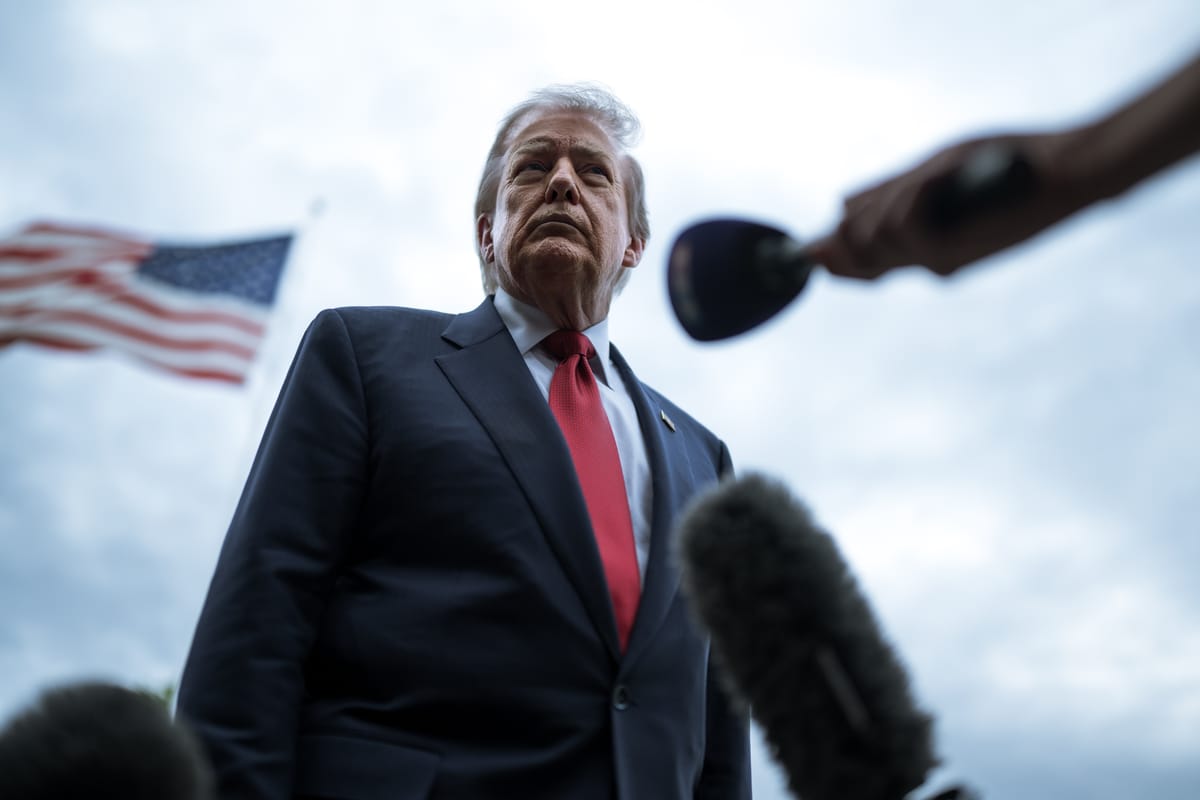
There is something deeply strange about President Donald Trump’s insistence that Iran must return to the negotiating table, or face additional American strikes.
After all, Trump himself has repeatedly described the Iranian leadership as dishonest, fanatical and incapable of honoring its commitments. The recent memorandum and ceasefire have already broken down, while Tehran has again rejected negotiations under military pressure. Yet the administration’s answer is apparently to bomb Iran until the same regime agrees to sign another document.
What, precisely, would such an agreement accomplish?
A treaty is valuable only when the parties signing it believe they are bound by it, or when an enforcement mechanism makes violating it prohibitively expensive. According to Trump’s own assessment, Iran’s rulers are not reliable negotiating partners. If that is true, returning to negotiations cannot itself be the strategic objective. At most, negotiations should formalize a reality that has already been created by overwhelming American power.
Instead, Washington appears to be using military force not to produce a decisive outcome, but to bring Iran back into an endless diplomatic process.
That is not a strategy. It is a cycle.
The United States attacks. Iran absorbs the damage, retaliates and closes or threatens international shipping routes. Washington then seeks a temporary agreement. Tehran signs, delays, reorganizes and violates the arrangement. America threatens another round of strikes, and the process begins again.
Trump now appears trapped between two contradictory positions. On one hand, he has spoken openly about the nature of the Iranian regime and encouraged the Iranian people to take control of their country. On the other, he has acknowledged why they have been unable to do so: Iran’s citizens are largely unarmed, while the regime possesses heavily armed security forces willing to fire on demonstrators.
That admission is crucial. If the Iranian people cannot overthrow the regime without outside assistance, simply encouraging them to rise up is not a policy. It is a slogan.
The historical question, therefore, is not merely why Trump is again threatening Iran. It is why the United States did not finish the job when the regime was at its weakest.
Was an extraordinary opportunity for regime change allowed to disappear? Did Washington conclude that it could destroy Iran’s nuclear and military capabilities while leaving the political system responsible for them intact? Did America’s Sunni allies, particularly Qatar and Saudi Arabia, pressure the administration to stop because they feared regional chaos more than they feared the survival of the Islamic Republic?
That possibility cannot simply be dismissed. Gulf governments have repeatedly used their influence to discourage escalation and promote negotiations between Washington and Tehran. Their fears are understandable: they would be among the first targets of Iranian retaliation. But what is rational for Qatar or Saudi Arabia is not necessarily rational for the United States, or for Israel.
Another possibility is that the diplomatic faction surrounding Vice President JD Vance genuinely believes Iran can be transformed through negotiations. Vance became the public face of the administration’s diplomatic effort, presenting the June talks as the foundation for a lasting agreement. Only weeks later, the arrangement was collapsing and American forces were striking Iran again.
At some point, optimism becomes denial.
Perhaps the administration is also constrained by domestic politics. Trump speaks constantly about gasoline prices, the stock market and America’s economic performance. Those concerns are not trivial. The renewed conflict has already disrupted shipping, increased oil prices and shaken financial markets.
But wars cannot be fought successfully while every military decision is subordinated to the next movement on Wall Street.
A president cannot simultaneously promise decisive victory, avoid the costs required to achieve it, protect every market index, satisfy nervous regional allies and maintain negotiations with an enemy he describes as fundamentally untrustworthy. Eventually, those contradictions become visible.
Trump must now decide what victory actually means.
If the objective is merely to prevent Iran from possessing a nuclear weapon, then the administration must explain how that outcome will be permanently enforced after the bombing ends. If the objective is to reopen the Strait of Hormuz, Washington must explain how it intends to guarantee freedom of navigation without repeatedly returning to war. If the objective is regime change, then the United States must stop pretending that airstrikes and rhetorical encouragement alone will necessarily produce a revolution.
Going “all the way” does not mean launching attacks without limits or purpose. It means identifying the political outcome America is prepared to pursue and refusing to end the campaign before that outcome is secured.
The alternative is the worst of all worlds: enough force to prolong the conflict, but not enough strategic clarity to win it.
This does not look like a glorious war. It looks like an improvised war, one conducted with one eye on Tehran, another on America’s Gulf allies and a third, somehow, on the Dow Jones.
Peace through strength requires more than strength. It requires knowing exactly what that strength is supposed to achieve.