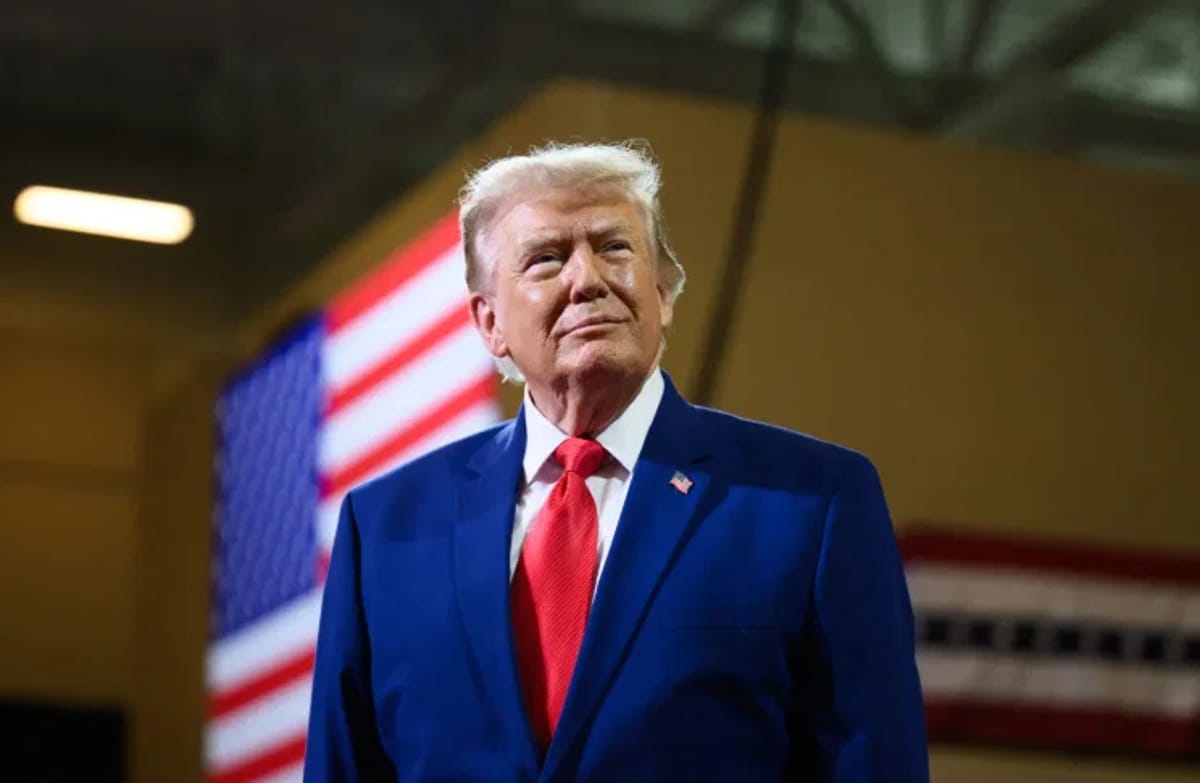
President Donald Trump announced Thursday evening that his Board of Peace had reached what he characterized as a "historic agreement" for the "complete disarmament" of Hamas and all armed groups in Gaza. The announcement, posted to Truth Social, laid out an optimistic framework for phased Israeli withdrawal contingent on Hamas weapons removal and the establishment of an international stabilization force to work with a new Palestinian police force.
But within hours, Prime Minister Benjamin Netanyahu's office issued a sharp rebuttal, stating that the Board of Peace's 15-point disarmament proposal does not meet Israel's fundamental security requirements. A senior Israeli political official conveyed the stark disagreement directly, explaining that the proposed framework falls short on the critical issue of weapons removal from Gaza.
The divergence between Washington's celebratory tone and Jerusalem's dismissive response highlights a deepening tension over what disarmament actually means. Israel is demanding complete demilitarization, including the physical removal of heavy weapons from Gaza and the eradication of Hamas's military infrastructure. The 15-point proposal under discussion reportedly calls instead for weapons to be warehoused and held in storage, not dismantled or transferred out of the territory.
"Israel demands full disarmament of Hamas, including the removal of all weapons from Gaza, as a precondition for any withdrawal," the Israeli official stated. "There will be no Israeli withdrawal from the Yellow Line until those conditions are met."
The Yellow Line, also known as the Philadelphi Corridor, is the narrow stretch of Gaza's southern border with Egypt. Israel views control of this territory as essential to preventing Hamas from reconstituting its military capabilities and smuggling weapons through Egypt. Relinquishing it has become a major red line for Netanyahu's government, one that officials say cannot be compromised.
Trump's announcement cited the Board of Peace's success in mediating between Hamas, Egypt, Qatar, and Turkey, and he credited his team with achieving what he claimed was impossible. "The threat that emerged from Gaza on October 7 will not be allowed to rebuild," he wrote, pledging that any agreement would prevent a recurrence of the terror attacks that triggered the current war.
The President described the accord as part of the implementation of his 20-point plan for Gaza's reconstruction, which envisions a phased Israeli military drawdown paired with the establishment of new Palestinian governance structures. He emphasized that the International Stabilization Force would work to ensure Gaza's security for both residents and neighboring states.
However, the official U.S. assessment contains significant caveats that underscore the scale of challenges ahead. Anonymous White House officials told reporters that no specific timeline has been established for Hamas's actual disarmament, and significant questions remain about enforcement mechanisms and the authenticity of any Hamas commitment to lay down arms.
Israel has lodged formal objections to Tony Blair, the former British Prime Minister serving as a chief mediator, regarding the 15-point proposal's adequacy. Officials made clear that Israel views the proposal as insufficient and has signaled it will not accept a framework that leaves Hamas's military assets intact or simply repositioned within Gaza.
The friction between Washington and Jerusalem comes three days after Netanyahu met with Trump at the White House, a meeting at which the Gaza question received limited substantive discussion, according to Israeli officials. That omission now appears significant, with Jerusalem's swift rejection of Trump's announcement suggesting the Israeli government was not meaningfully consulted on the terms being announced as final.
The announcement also comes amid reports that Palestinian factions, including Hamas, have committed in principle to a roadmap that includes disarmament, though no Palestinian official has issued a formal public endorsement of Trump's characterization of a "historic agreement."
A senior U.S. official warned that Trump would be "very, very disappointed" if Israel does not adhere to the agreement, suggesting the administration views Israeli compliance as central to the accord's success. The remark signals potential friction ahead, with Washington appearing to expect Jerusalem to accept the current proposal while Israel maintains that it does not address Israel's core security concerns.
The gap between Trump's optimistic declaration and Israel's hardline response reflects a fundamental disagreement over what constitutes successful disarmament. For Washington, the agreement represents a diplomatic milestone and a path toward ending the war. For Jerusalem, it represents an insufficient framework that does not guarantee the destruction of Hamas's military capabilities or prevent the reconstitution of the terror group's arsenal.