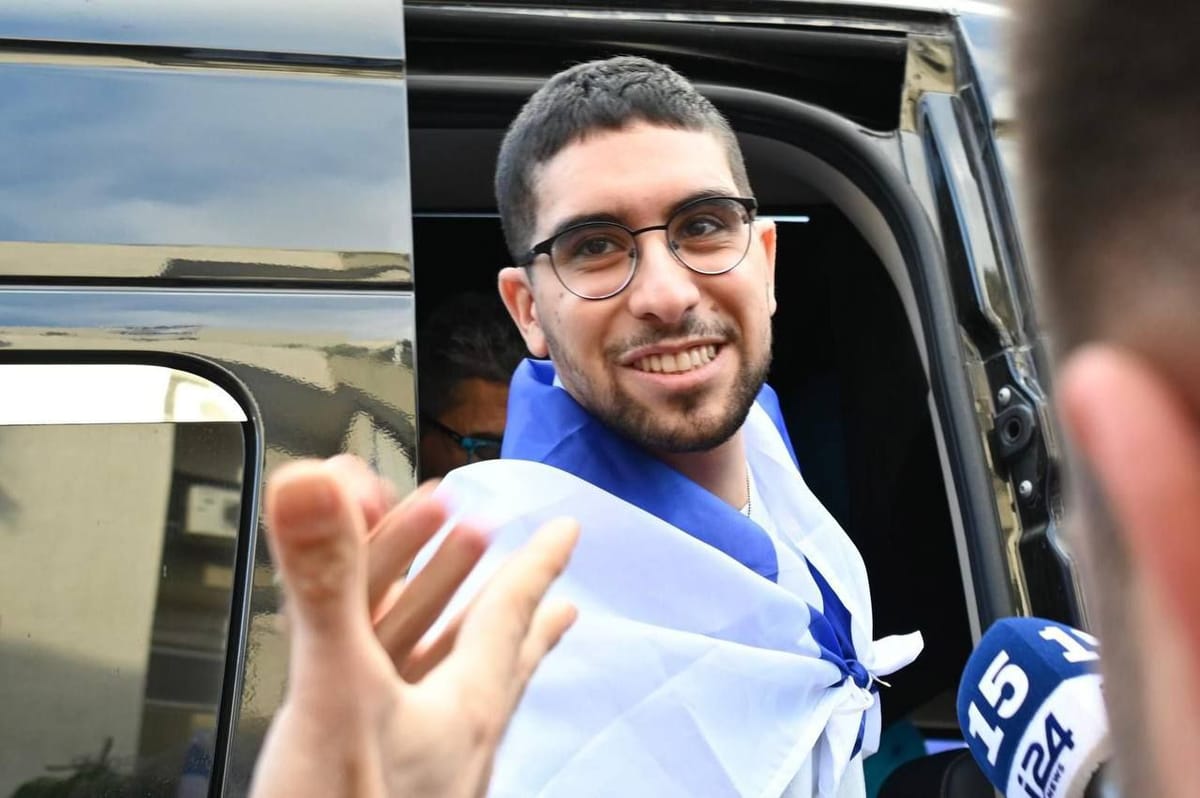
Released hostage Evyatar David offered a detailed account of his prolonged captivity in Gaza during an interview broadcast on Thursday, speaking alongside childhood friend Guy Gilboa-Dalal, who was abducted with him from the Nova music festival on October 7. Nine months following his release, David described severe starvation, psychological abuse, and forced participation in Hamas propaganda videos within subterranean tunnels.
Recalling the morning of the attack, David described fleeing amid gunfire alongside friends Ron Zarfati and Idan Harmati, whom he last saw gesturing before being separated. Both David and Gilboa-Dalal were captured after hiding in bushes and thrown into a transport vehicle by Hamas terrorists. "It is like we spoke in captivity, when we said 'at least we are in captivity together,' it is the same thing, we have the same fate," David recalled thinking at the time.
Upon arrival in Gaza, captors placed them in a apartment and prohibited verbal communication or eye contact for two weeks. "I was there with you, and until the end of the second week you and I did not exchange a single word," Gilboa-Dalal recalled. David added that his primary concern was confirming his friend's safety: "I just wanted to see that you were okay, to verify it, to simply ask you if you were okay."
Extreme food and water shortages created severe physical and emotional strain. Captors rationed dirty, salty water in small half liter bottles, leading to intense arguments over resource allocation. "There was almost nothing to eat, at all," David stated. "You are hungry and you get nervous. You do not know how to handle that feeling yet, and it comes out in anger."
David explained that systematic starvation intensified three months prior to the release of his hostage video. Captors eventually ordered him to remove his shirt, photographed his body, and selected him for a staged video recording due to his emaciated appearance. Before filming, captors added soap and dirt to water they forced him to drink, then led him blindfolded past guards consuming food.
Captors brought him to a partially excavated hole and handed him a shovel. "They simply said to me: 'Okay, take this, you have a shovel here, step inside. This is going to be your grave,'" David stated. "As far as I was concerned, it looked like I was on my way to my death. I dug that grave, and it was on the border of physically impossible to do it. I said to myself in my head, it could really be that if I die, I am going to lie in this hole."
Later, captors forcibly separated the two friends, causing intense distress and panic attacks. "When they separated me and Guy, I cried," David shared. "I remember being terribly angry and punching the walls there, and I did not know how to express the frustration I was feeling."
In conversations with defense establishment clinical psychologist Glen Cohen, who assists returned captives, David described the ongoing psychological toll, including persistent nightmares and rehabilitation challenges. "I do not like it when people say to me 'blessed is the one who revives the dead' because I was alive every single second," David emphasized. "People think captivity is death, but specifically there, you want to live even more."
According to clinical evaluations provided to Financial Times, former hostages require long term financial and psychological support systems to address severe post traumatic stress resulting from prolonged underground detention.