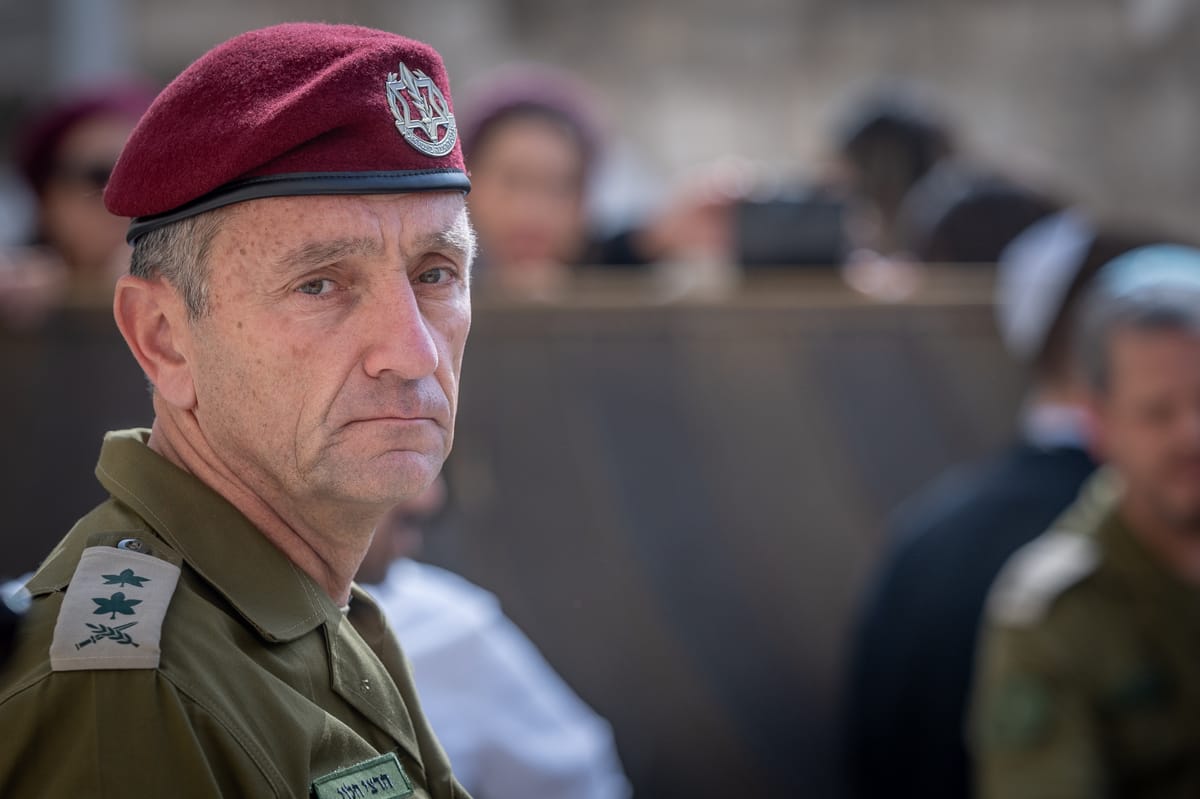
A former IDF chief of staff addressed the October 7 failures on Sunday evening at the "Rule of Law" conference on combating antisemitism in New York, calling for a state commission of inquiry and speaking candidly about the war in Gaza and efforts to return the hostages.
"October 7 was a failure that could have been prevented," he said. "We must look the failure in the eyes in order to be able to fix it." He added that the image of Shiri Bibas illustrates for him the scale of the disaster: "We were not there in time to help and save her."
Addressing claims of betrayal from within the security establishment, the former chief of staff made clear he does not believe any of his colleagues aided Hamas. "I can explain how October 7 happened down to the smallest details," he said, adding that after three years, not a single person has been proven to have cooperated with the organisation. According to him, aiding Hamas would have required a broad network, not a lone individual.
He also addressed the war in Gaza and efforts to return the hostages, arguing that military pressure was essential. "Without strong military pressure inside Gaza, we could not have brought back the hostages. I can prove it," he said. He continued: "Unfortunately, we made mistakes. Our bombs killed hostages. Of course, it was not intentional. We did not know they were there."
According to him, the IDF was forced to change its operational pattern, which had been based on short rounds of fighting and air strikes, and move to broad ground manoeuvres. The former chief explained that before the attack, Israel's assessment was that Hamas was not interested in war, partly because it sought to consolidate its rule in Gaza and later expand its influence into Judea and Samaria as well.
He recounted that Yahya Sinwar sought to surprise Israel and operate simultaneously on additional fronts. According to him, in the morning hours of October 7, the IDF conveyed a message to Hezbollah that despite the surprise in Gaza, Israel was monitoring what was happening in Lebanon and would act with force in the event of intervention. "If you make even a small move, a very heavy hammer will come down on Lebanon," he quoted from the message that was delivered.