The Story Behind the Tattoo
He revealed the harrowing story behind the ink:
"During my darkest days in Gaza, in the peak heat of August and September, the terrorist forced me to wear a jacket so no one would see my tattoo if anyone entered the place where I was being held."
He pointed out the irony of the situation, adding, "This tattoo is what gave me away as a Jew. It's absurd, because a true Jew isn't supposed to have tattoos on his body."
Jewish law explicitly prohibits tattoos, citing the biblical verse: "You shall not make gashes in your flesh... or incise any marks on yourselves" (Leviticus 19:28). The religious question of whether a newly observant Jew is required to remove existing tattoos is debated by rabbinic authorities, a topic recently addressed by Rabbi Benjamin Chuta on Kikar HaShabbat.
"I Am Ready to Suffer"
Describing the painful removal process, he wrote:
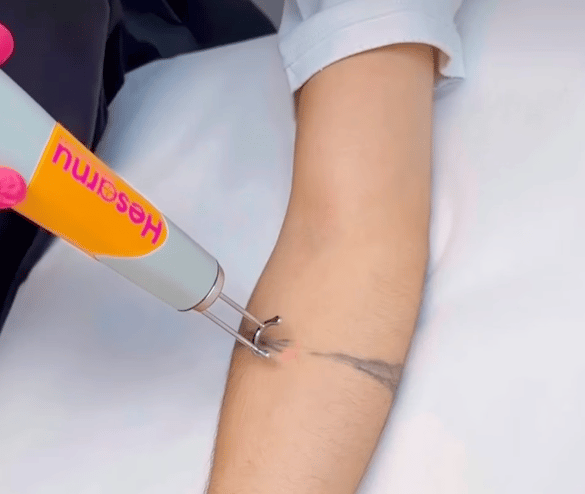
"Today, nearly six months after God, in His miracles and wonders, decided to release me from captivity and end my suffering, I feel strong and stable enough. I decided to take it upon myself to remove this tattoo with direct laser treatments and endure the pain."
Explaining his motivation, he added:
"It is for one purpose only—to serve and dedicate myself to God. I am willing to endure pain on my body, over and over, and would do anything to please my Father in Heaven."
Concluding his post, Rom expressed gratitude even for his trials:
"Thank you, Father, for the captivity in Gaza, for the suffering, and for every hardship You brought into my life. This is what Judaism looks like." He ended with the traditional blessing of gratitude: "Blessed are You... who has kept us alive, sustained us, and enabled us to reach this season—it is gone!"
A Spiritual Journey
Braslavski, who was held hostage for 738 agonizing days, has been open about his spiritual journey since his release. A few months ago, he drew significant public attention after sharing his decision to begin wearing a large, traditional headcovering (kippah).
His decision echoes the experiences of many newly observant Jews who choose to remove their tattoos. Rabbi Asa Paz, who runs a non-profit dedicated to tattoo removal, noted in an interview with Kikar HaShabbat that "most of the men in the yeshiva had tattoos," sharing that he underwent the same process himself after completing his service in the elite Golani reconnaissance unit and returning to faith.