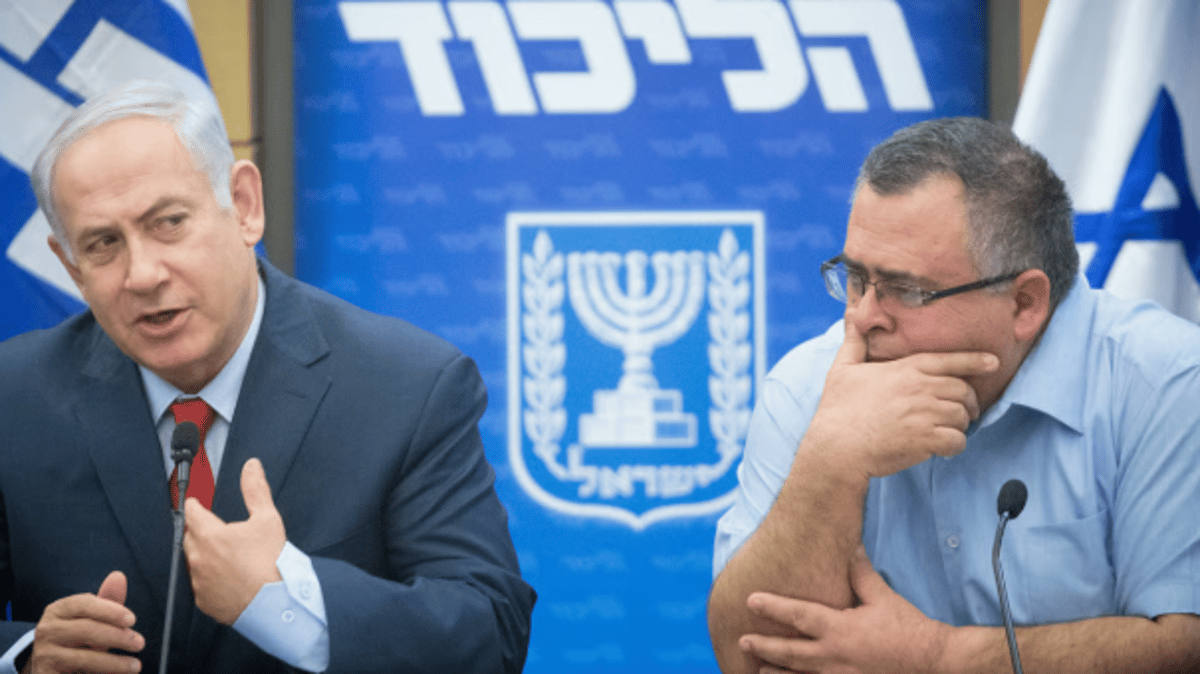
A dispute over how many seats Prime Minister Benjamin Netanyahu can personally control on Likud's next parliamentary slate escalated into open conflict this week, culminating in a heated exchange between the prime minister and one of his own lawmakers that has laid bare the tensions running through Israel's ruling party as it heads toward elections.
The immediate trigger was a Monday session of Likud's constitution committee, convened to settle a question that has occupied the party for more than a week: how many of the roughly 120 seats on its next Knesset list should be reserved for candidates Netanyahu selects himself, rather than determined through the party's traditional primary vote. The committee approved a proposal by Minister Chaim Katz, backed by Netanyahu, granting the prime minister eight reserved slots, with six falling in electorally viable positions. Ynet reported the specific placements as numbers 3, 5, 9, 11, 15, 18, 26 and 31 on the list.
The number itself represents a retreat from Netanyahu's opening position. Party officials told Ynet that the prime minister had initially sought ten or eleven guaranteed slots, a demand several described as a calculated opening bid intended to make a subsequent offer of eight appear to be a reasonable concession. One senior Likud figure, speaking to Walla News, said that even eight reserved slots in the list's upper tier would be without precedent in the party's history.
The scale of the request has unsettled a Likud faction already anxious about its standing. The party currently holds 43 seats in the Knesset, and under Israel's so-called Norwegian Law, which allows sitting ministers to temporarily give up their parliamentary seats to alternates, more than half of those incumbents already face uncertain prospects of securing a realistic spot on the next list, before any additional reservations are factored in. That dynamic has made the reservations question existential for many sitting lawmakers, and it explains why the fight has turned personal.
MK David Bitan, who chairs the World Likud Center and has spent recent years expanding his organizational footprint within the party's grassroots membership, emerged as the leading internal challenger to Netanyahu's approach. Bitan circulated a competing proposal that would have limited the prime minister to as few as four or five reserved slots and preserved a fuller primary process, arguing, in comments reported by Kikar HaShabbat, that a reservations committee on the scale Netanyahu sought amounted to an appointed slate dressed up as a primary. He also petitioned Likud's internal court seeking a secret ballot on the reservations, in an effort to shield rank-and-file committee members from what he characterized as pressure emanating from the prime minister's office.
The dispute boiled over during Monday's committee session, when Netanyahu, according to accounts relayed by both Srugim and Ynet, told Bitan directly that he was welcome to run for prime minister himself and see how many seats he could win, and that he had heard enough of Bitan's objections. Bitan left the meeting shortly afterward. Ynet's account of the exchange also quoted Bitan accusing allies of the prime minister of leaking against him during the session itself, and insisting that authority over the list ultimately rests with Likud's broader central committee, not the constitution panel.
The episode fits a broader pattern Netanyahu has employed throughout the negotiation, according to party officials who described his approach to Ynet as consistently opening with maximalist demands before settling on a middle position calibrated in advance. Critics inside the party, speaking to Walla News on condition of anonymity, said that framing has allowed what would once have been considered an extraordinary concentration of list-making power to be presented internally as a moderate compromise.
The reserved-slots formula approved Monday is expected to go before Likud's full central committee for ratification later this week, with the party's primary elections themselves currently scheduled for mid-August. The timeline is tight: Israel's Knesset is due to dissolve later this month ahead of elections, leaving Likud little room to resolve the internal rift before campaigning begins in earnest.
For Netanyahu, the outcome will determine how much latitude he retains to reshape a Likud slate he has told confidants privately could hurt the party's electoral chances in its current form. For Bitan and the lawmakers aligned with him, it will determine whether they retain a viable path back into the next Knesset at all.