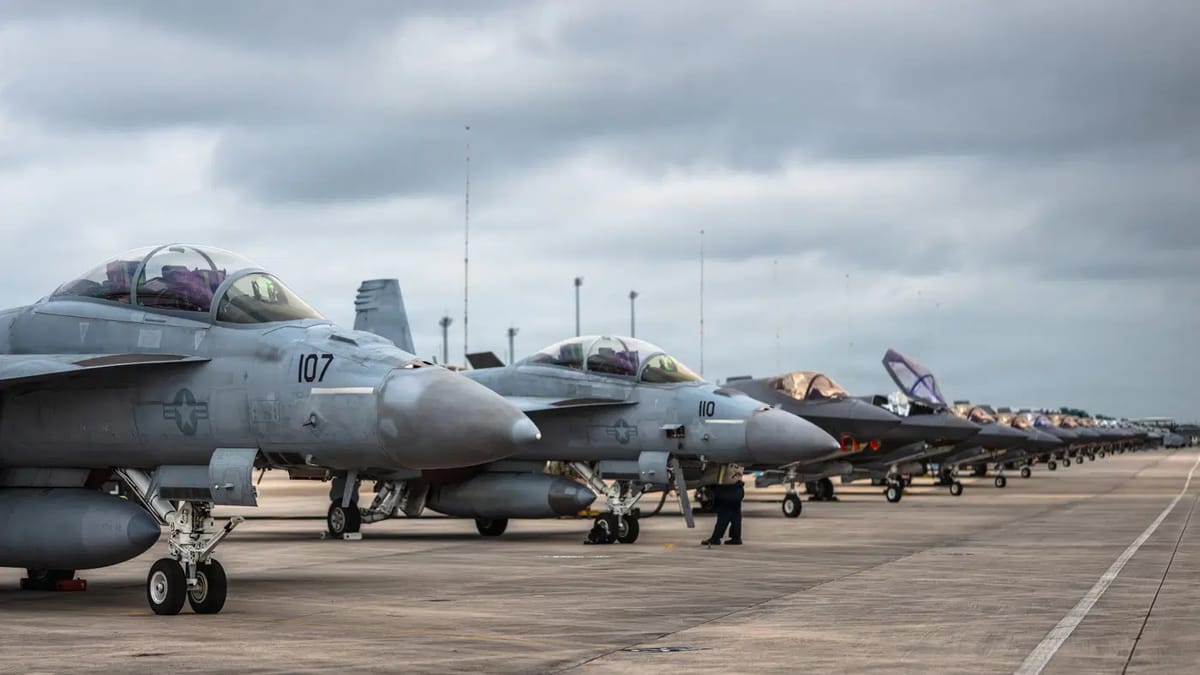
The United States government is finalizing plans to dramatically broaden its military campaign in the Middle East by expanding its designated target lists and increasing the frequency of airstrikes inside Iran.
The planned expansion will significantly elevate the scale of American military operations, though the precise timing remains dependent on final authorization from the White House. Defense officials in Jerusalem are closely tracking these developments to assess how the shifting battlefield dynamics might impact regional security. In response to the escalating pressure, military commanders in Tehran have issued direct public threats of severe retaliation against any offensive maneuvers.
A spokesperson for the Khatam al-Anbiya Joint Headquarters of the Iranian Armed Forces issued a stark warning regarding the potential for an expanded war. "The foolish enemy should know that what the security forces of Iran are doing is not an equal blow, but a supreme blow, more severe, extensive, and horrifying than anything that has happened in the past," the official declared. Tehran has threatened to vastly expand its operational firing range and increase the volume of its missile responses if the American military escalates its current operations.
Alongside these direct threats, intelligence reports indicate that Iranian leaders have instructed the Houthi movement in Yemen to prepare a total blockade of the Bab al-Mandab strait in the Red Sea. This coordinated maritime blockade is designed as an immediate countermeasure in the event that American forces target the domestic electrical grids and energy infrastructure of the Islamic Republic. Members of the Islamic Revolutionary Guard Corps already stationed in Yemen will determine the exact operational timing for sealing the vital shipping corridor.
Houthi fighters have reportedly completed all necessary tactical preparations, deploying heavy anti-ship missiles and advanced drone fleets along strategic coastal positions overlooking the shipping lanes. Sealing the Red Sea would leave two of the most critical energy transit routes in the Middle East completely disabled at the same time, as the Strait of Hormuz is already entirely closed. Such a dual closure would dramatically worsen the ongoing global energy crisis, especially considering that seven percent of the global energy supply currently routes through the Red Sea.
Despite these extreme regional preparations, Israeli defense analysts suggest that Tehran will likely maintain a posture of relative restraint toward Jerusalem as long as the American campaign does not undergo an extreme escalation. Intelligence assessments indicate that Iranian leaders prefer to focus their current military resources directly against American assets, rather than initiating a multi-front war that could threaten the survival of the regime. However, security officials emphasize that these strategic calculations can shift rapidly, keeping national defense systems on high alert for any sudden changes.