
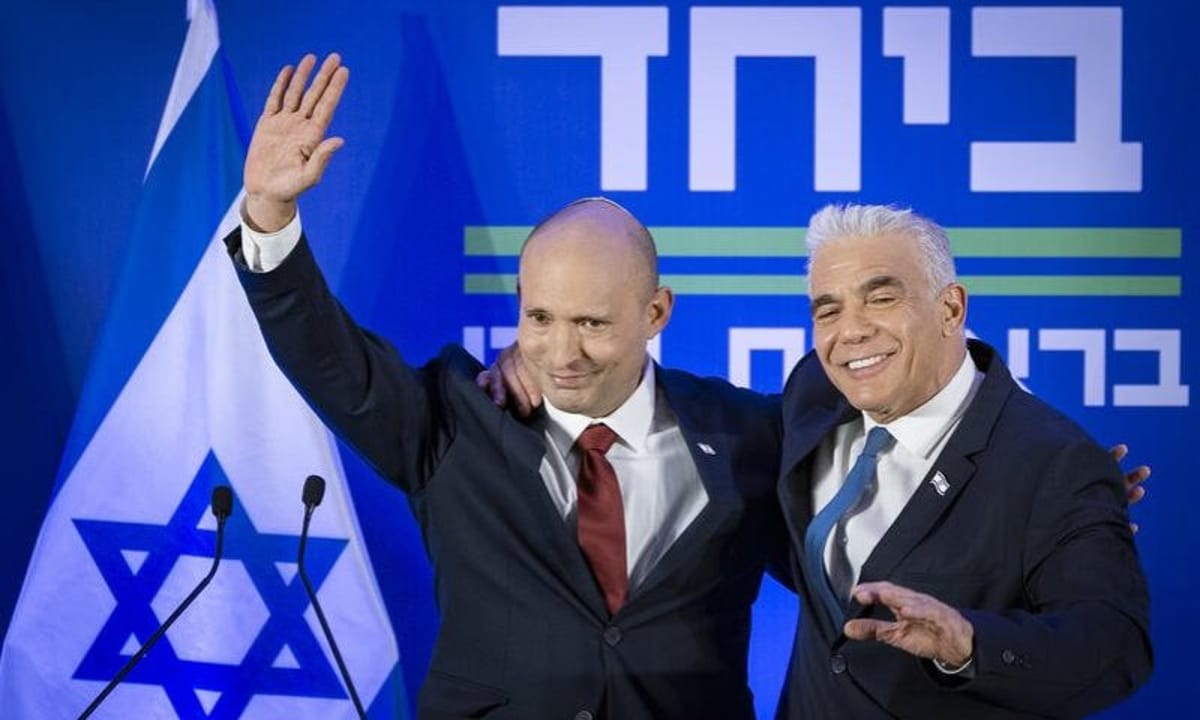
Former prime minister Naftali Bennett is facing growing political pressure as recent polling trends show his Together alliance weakening, while Gadi Eisenkot’s Yashar party continues to gain ground.
Pollster and Channel 14 commentator Shlomo Filber said Wednesday that Bennett’s position as the presumed leader of the anti-Netanyahu bloc may soon collapse if the current trend continues.
“You can see that Bennett and his party are bleeding one to two seats every week,” Filber said on the program “Five” with Yaara Zered. “It is happening in all the polls, and it will continue for at least another two weeks.”
According to Filber, the real turning point is expected in the next two to three weeks, if Eisenkot overtakes Bennett in the polls.
“The big drama is supposed to happen in the coming weeks, the moment Gadi Eisenkot passes Bennett in the polls,” he said. “From that moment, Bennett’s story as the bloc’s candidate is over.”
Filber argued that Bennett’s legitimacy inside the center-left camp rested on two claims: that he could bring right-wing votes into the bloc, and that he was the strongest candidate to lead it. In his view, both claims are now weakening.
“A year ago, he promised them he knew how to bring votes from the right. They no longer believe that,” Filber said. “The second thing was that he was the leading candidate of the bloc, and therefore everyone needed to line up behind him. Once those two things are not happening, Yair Lapid has no reason to stay there.”
Filber said center-left voters view Eisenkot as more naturally connected to their camp, while Bennett is still seen by many as an outsider. He said the shift in support reflects voters preferring what they see as an authentic candidate over a substitute.
The analysis also raises questions about the durability of the Bennett-Lapid alliance. Asked whether signed agreements and legal arrangements could hold the partnership together, Filber dismissed the idea that political agreements would necessarily survive changing polls.
“Political agreements can be broken whenever people want,” he said. “This union is the word of honor of two people who stood on a podium. We did not see a signed agreement.”
Filber said he does not rule out the possibility that if Bennett fails to deliver the additional seats he promised, Lapid could eventually break the alliance and become number two under Eisenkot.
“The moment Bennett does not know how to bring those ten Knesset seats, and Eisenkot does, I do not rule out that we will see the unity agreement fall apart and Lapid move to become Eisenkot’s number two,” he said.