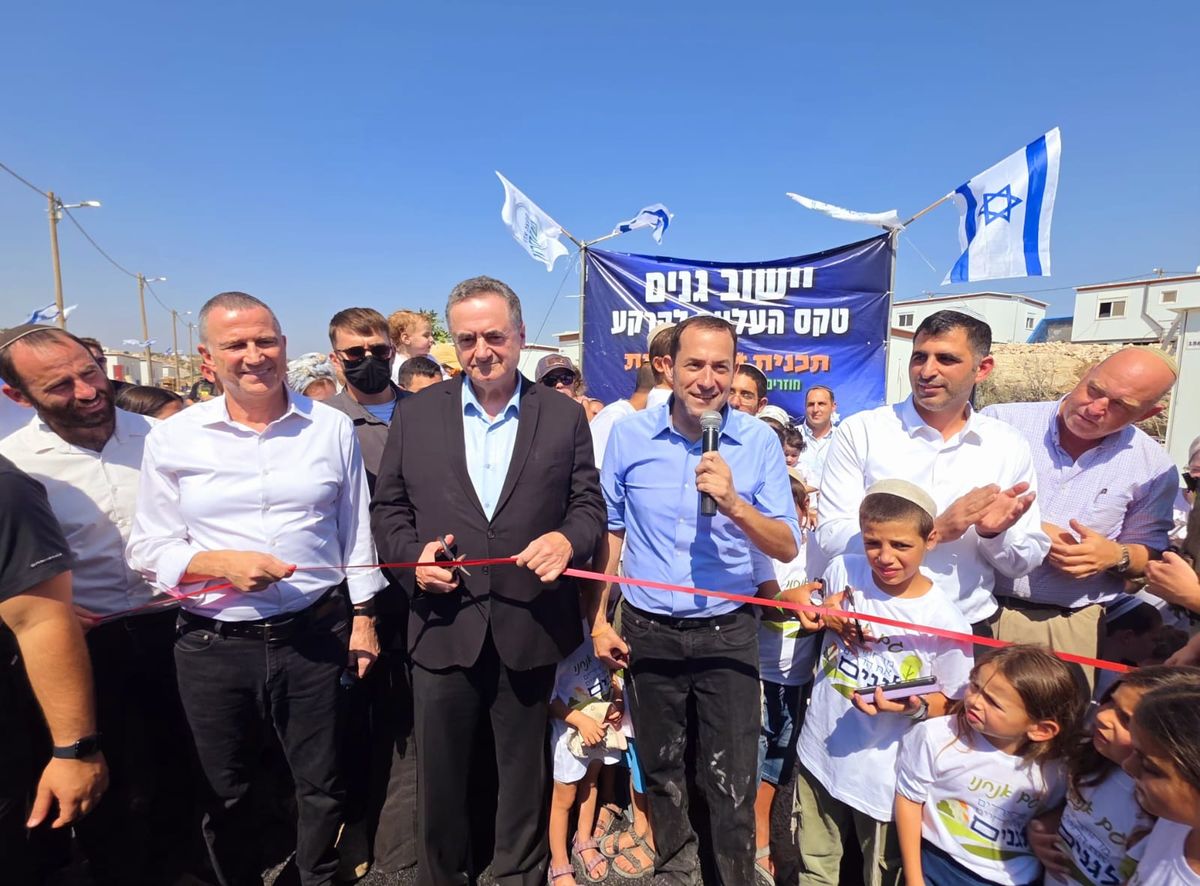
Hundreds gathered Thursday morning for a ceremony marking the official return of residents to Ganim, exactly 21 years after it was evacuated as part of Israel's 2005 disengagement plan.
The disengagement, primarily known for Israel's withdrawal from Gaza, also included the evacuation of four settlements in the northern West Bank. Ganim was among them.
The event drew the 30 families forming the new settlement core, along with government ministers, members of Knesset, rabbis, and leaders from communities across the Samaria region. Among the attendees were relatives of Katy Winterov, a Ganim resident killed in a shooting attack in 2004 while traveling with her three-year-old son Ariel.
Defense Minister Israel Katz, Communications Minister Shlomo Karhi, and Knesset member Yuli Edelstein attended, alongside Yossi Dagan, head of the Samaria Regional Council, which governs Israeli settlements in the northern West Bank.
The re-establishment follows a government cabinet decision led by Katz and Finance Minister Bezalel Smotrich approximately a year ago. It forms part of what the Samaria Council calls its "Connection Plan," which envisions establishing 19 new communities in northern Samaria as part of a broader initiative to significantly expand the settler population in the region.
Concurrent with the families' return, a branch of the Bnei David yeshiva from the settlement of Eli will open in Ganim. Rabbis Eli Sadan and Yigal Levenstein, who head the main institution, attended the ceremony, along with Rabbi Yehuda Sadan, head of the advanced yeshiva, and Rabbi Neriya Bulak, who will lead the Ganim branch.
The return represents the culmination of a 21-year campaign to reverse the disengagement law and restore the evacuated settlements, led by Dagan together with former Homesh residents and activists. Homesh, another of the four evacuated settlements, has also seen Israelis return in recent years despite legal restrictions.
Yossi Dagan declared: "This is a moment of historical correction. Twenty-one years ago, families were expelled from here, homes were destroyed, and they tried to uproot settlement from northern Samaria. Today we are returning to Ganim and re-establishing it. Not only have we returned to the four settlements that were uprooted, we are doubling and tripling settlement in northern Samaria. Instead of uprooting we are bringing life, instead of retreat we are bringing Zionism and growth. The era of uprooting has ended—the era of settlement has begun."
Defense Minister Katz stated: "Twenty-one years after the uprooting of Ganim, we are returning today to northern Samaria to build, to settle, and to stay. Where they tried to uproot settlement—we are growing it anew. Ganim, together with Emek Dotan, Sa-Nur, and soon Kadim, are part of a strategic move to strengthen northern Samaria and realize the goal of a million Israelis in Samaria. The approach guiding me is clear: where there is settlement—there is security. Therefore we are strengthening our hold on the ground while simultaneously acting forcefully against Palestinian terror: recognition of 104 new settlements and approximately 160 outposts, the return of IDF bases to northern Samaria, and offensive activity in terror camps that has brought about an approximately 80% decrease in terror incidents. We will continue to strike at terror, deepen settlement, and change the reality on the ground. I thank Prime Minister Netanyahu for his full backing of the moves we are leading, my friend Minister Bezalel Smotrich for the partnership in advancing settlement, and Samaria Regional Council head Yossi Dagan for the vision, determination, and action. We have returned to Ganim—and we have returned to stay."
Communications Minister Karhi said: "Twenty-one years ago, families were expelled from their homes here. Not by choice, not with consent, but in a painful expulsion that left a scar on the nation's heart. And today, here in Ganim, through the vigorous activity of my friend council head Yossi Dagan, we are writing a new chapter of return, of holding onto the land, and of erasing the disgrace of expulsion from the land of our forefathers' inheritance. Settlement is the real answer to anyone seeking to undermine our right to this land. We will continue to expand our borders, strengthen settlement, invest in infrastructure, security, communications, and everything that will ensure permanent life, growth, and prosperity. As in Homesh, Evyatar, and Sa-Nur, here too we will connect to advanced communications. The people of Israel returns to its land and deepens its roots in it. We connect to our land and will never disconnect from it again."
Knesset member Edelstein, one of the initiators of the law canceling the disengagement in northern Samaria, said: "After 21 years of injustice, I passed in a historic step the law to cancel the disengagement in northern Samaria. The renewed dedication of Ganim together with Kadim and Sa-Nur is the real victory over our enemies. Judea and Samaria are the guarantee of security for Israel's citizens and what will prevent the next October 7th. As chairman of the Land of Israel Caucus for many years, I will continue to work for the development of settlement and ensure that a Palestinian state will never arise."