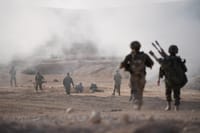
Twenty years after Palestinian terrorists snatched an Israeli soldier from a tank on the border with Gaza, Israelis on Thursday marked the anniversary of Gilad Shalit's abduction with newly released military logs that recount, minute by minute, the chaos of that summer morning.
On June 25, 2006, militants from Hamas’s Izz ad-Din al-Qassam Brigades, along with the Popular Resistance Committees and the Army of Islam, crawled through a tunnel under the border fence near the Kerem Shalom crossing. They emerged inside Israeli territory, opened fire with mortars and small arms, killed two soldiers and seized Corporal Shalit, then 19, dragging him back into Gaza.
Shalit, a gunner in a Merkava tank, suffered a broken left hand and a shoulder wound in the attack. Two other soldiers in the crew, Lt. Hanan Barak, the tank commander, and Sgt. Pavel Slutsker, were killed. The assault set off a diplomatic and military crisis that consumed Israel for more than five years.
The Defense Ministry on Thursday released previously unseen operational logs detailing the first chaotic hour and a half after the raid. The records capture the confusion in real time: reports of gunfire and explosions at 5:13 a.m., the first mentions of casualties minutes later, and by 6:40 a.m., the growing realization that a soldier was missing from the tank. The logs also reference the activation of the Hannibal Directive, the Israeli military’s controversial protocol aimed at preventing captures, even at the risk of harming the soldier. jpost.com
Shalit was held in isolation for 1,941 days, often without visits from the Red Cross or contact with his family, conditions that human rights groups described as cruel and inhuman. His face, beamed from posters across the country, became a national symbol. Israelis held vigils, protested and debated the price of bringing him home.
In October 2011, Prime Minister Benjamin Netanyahu’s government struck a deal with Hamas: Shalit was freed in exchange for 1,027 Palestinian prisoners, including many convicted in deadly attacks. The exchange remains one of the most contentious decisions in Israeli history, praised by some as a moral imperative and criticized by others as a strategic mistake that emboldened militants.
On this anniversary, Israeli news outlets aired documentaries, interviewed Shalit’s family and revisited the intelligence and operational shortcomings that allowed the raid to succeed. The reflections come as the country continues to grapple with the fate of hostages still held in Gaza following the Hamas attacks of Oct. 7, 2023.
Shalit, now in his late 30s, has largely stayed out of the public eye since his release, building a quiet life. But two decades on, his ordeal remains a touchstone in Israel’s long struggle with Hamas — a reminder of the human cost of a conflict with no easy resolutions.