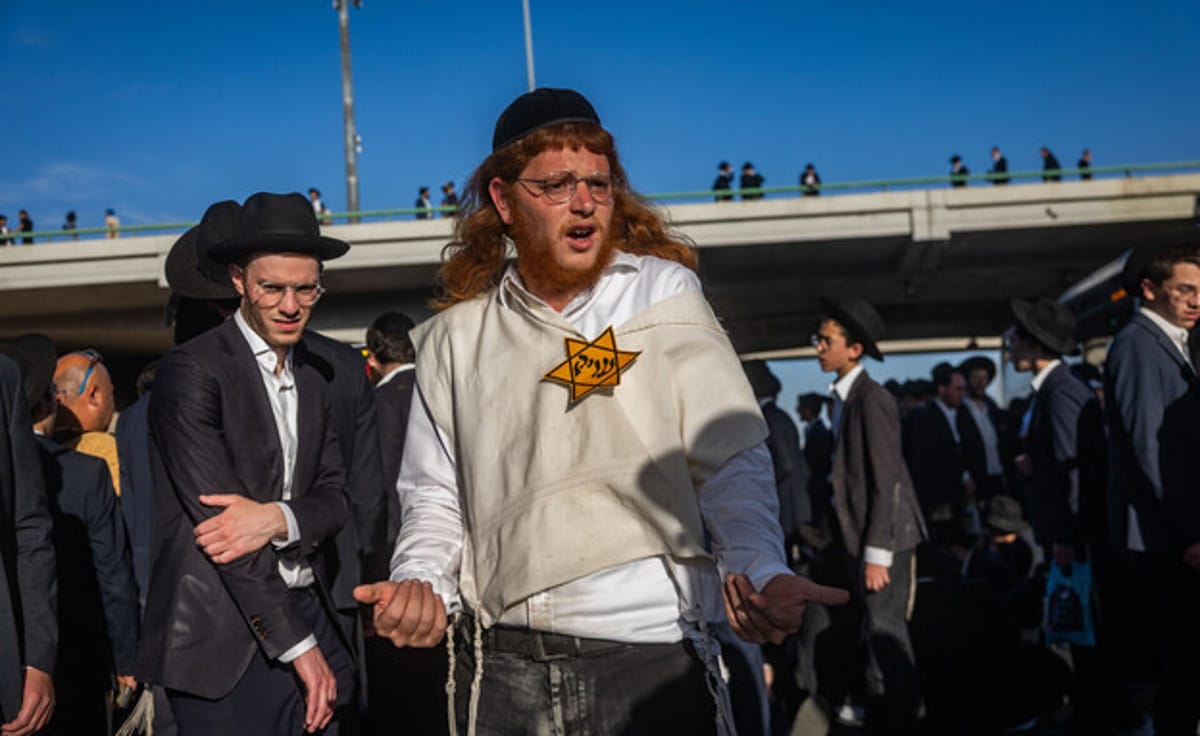
The High Court of Justice has delivered a definitive judicial challenge to the state's highly controversial draft exemption mechanisms, ordering the government to legally justify massive structural pay disparities that favor ultra Orthodox draftees over secular volunteers and active military personnel. The significant legal ruling, issued by a prominent three judge panel, requires the state to provide a comprehensive explanation within thirty days regarding the allocation of multi thousand shekel monthly stipends to Haredi men enrolled in alternative national civil service tracks. The distribution of the judicial decision was largely obscured last Thursday due to severe traffic disruptions and massive civil unrest orchestrated by radical ultra Orthodox factions protesting the arrest of military deserters.
The petition, formally advanced by the Israel Hofsheet movement, exposes a highly unbalanced financial framework wherein the state rewards ultra Orthodox individuals for alternative non military service at rates exceeding the compensation provided to frontline infantry forces deployed in dangerous combat zones. The data presented before Supreme Court Justices David Mintz, Yael Vilner, and Alex Stein reveals that the economic gap expands dramatically based on the age and marital status of the Haredi participant. While a single ultra Orthodox volunteer receives a baseline stipend comparable to standard civil service tracks, married individuals and parents receive massive structural bonuses funded by taxpayers.
According to the official figures analyzed by the court, standard married volunteers enrolled in traditional national service tracks receive a fixed monthly stipend of 1,325 shekels, completely regardless of whether they have children. In stark contrast, married ultra Orthodox men operating within specialized Haredi service tracks receive a highly elevated monthly baseline ranging from 1,063 to 3,825 shekels if they do not have children. For Haredi volunteers who are married with children, the monthly government payout climbs to an unprecedented range of 1,405 to 4,581 shekels, with the ultimate tier determined by the volume of weekly service hours completed by the participant.
The structural justification traditionally provided by state agencies for these imbalances is that Haredi alternative service tracks are specifically tailored for men aged twenty three and older who entered into marriage and fatherhood at an earlier stage of life. However, critics point out that these massive civil payouts heavily eclipse the financial reality of conscripted military personnel risking their lives in the ongoing regional war. For comparison, standard combat soldiers in the Israel Defense Forces receive a basic monthly stipend of 2,647 shekels, while elite frontline troops operating in their third year of mandatory service receive a maximum cap of 3,276 shekels.
The Supreme Court conditional order specifically demands that the state and the Knesset answer three central structural questions regarding the legality of the current framework. First, the government must explain why it allows ultra Orthodox individuals to enlist in civil national service frameworks when no formal, primary legislation has been enacted to legally establish this alternative track as a legitimate substitute for mandatory military service. Second, the state must explain why it actively finances civil service positions for individuals who are legally bound by conscription laws but have failed to secure an official deferment or exemption. Finally, the state must justify why the monthly living stipends allocated to Haredi service tracks should not be instantly equalized with the baseline rates paid to all other citizens.
The judicial intervention arrives during a period of maximum social friction regarding the collective distribution of civic duties, with defense networks experiencing immense strain from protracted mandatory and reserve obligations. Commenting on the legal breakthrough, Uri Kedar, the Executive Director of the Israel Hofsheet movement, stated that the High Court's decision to issue a conditional order is a clear message. Kedar added that it is impossible to continue creating draft bypass tracks for those required to enlist at a time when regular and reserve soldiers bear a heavy and continuous burden, concluding that there is absolutely no justification for a young Haredi man who is required to enlist to receive an alternative, eased, and funded track from the state that is simply not open to other citizens.