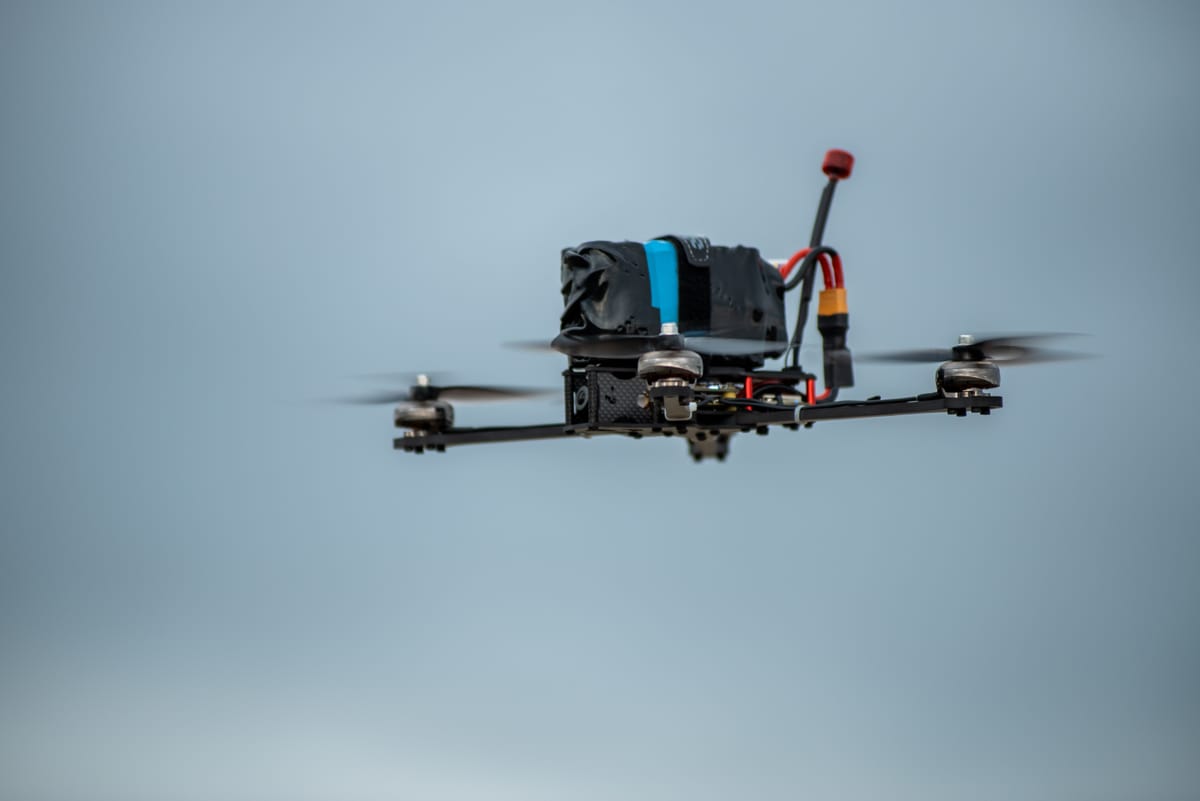
Israel is considering imposing strict new restrictions on civilian drone use amid growing concern that first-person view attack drones could be launched at the country from neighboring territory or from within Judea and Samaria as the escalation with Iran continues, Israeli officials told Ynet.
A senior Israeli official said the proposal was discussed extensively by the Security Cabinet, with officials hoping that curbing civilian drone activity would make it easier for security forces to identify and respond to genuine threats amid the ordinary clutter of hobbyist and commercial drone traffic. Security officials stressed that there is currently no intelligence indicating that FPV attack drones, particularly the fiber-optic-guided models that have proven especially difficult to detect and jam, are presently operating in Judea and Samaria. But the concern is forward-looking rather than reactive. "This is a very serious threat for which we do not have a solution," one official said. "It has to be said honestly. This is a very serious threat." Officials said they are particularly worried about scenarios in which such drones could be used to target senior government officials or key state institutions.
The discussion reflects how central FPV drones have become as a weapon across the region over the course of this war. Hezbollah has increasingly relied on cheap, fiber-optic-guided FPV drones against Israeli forces in southern Lebanon, weapons that are especially dangerous precisely because they are not guided by GPS or radio signal and therefore cannot be jammed by conventional electronic warfare, remaining instead physically tethered to their operator by a thin cable that can stretch for dozens of kilometers. Prime Minister Benjamin Netanyahu has previously acknowledged the difficulty of the problem directly, telling ministers at a cabinet meeting that Israel is "facing the challenge of neutralizing FPV drones" and directing his team to find a solution both for the current threat and for whatever comes after it.
The cabinet discussion came the same day the IDF said it killed a Hezbollah cell operating an FPV drone in southern Lebanon. According to the military, troops from the Commando Brigade spotted an enemy drone flying over an area near Kfar Tebnit where Israeli forces were operating, close to the security zone along the Blue Line, the UN-demarcated border between Israel and Lebanon. The Israeli Air Force searched the area, identified several Hezbollah operatives who were piloting the drone from a hiding position nearby, and struck and killed them. The IDF said the strike was carried out "to remove the threat to our forces." Kfar Tebnit has been a recurring flashpoint in the drone war between Israel and Hezbollah, the site of a Hezbollah FPV strike that killed four soldiers, including a battalion commander, in an earlier incident this year.
Any move toward a formal civilian drone ban would still need to work through the practical question of how broadly to restrict an activity used by hobbyists, photographers, farmers, and commercial operators across the country, a balance officials are said to still be actively weighing as the cabinet continues its deliberations.