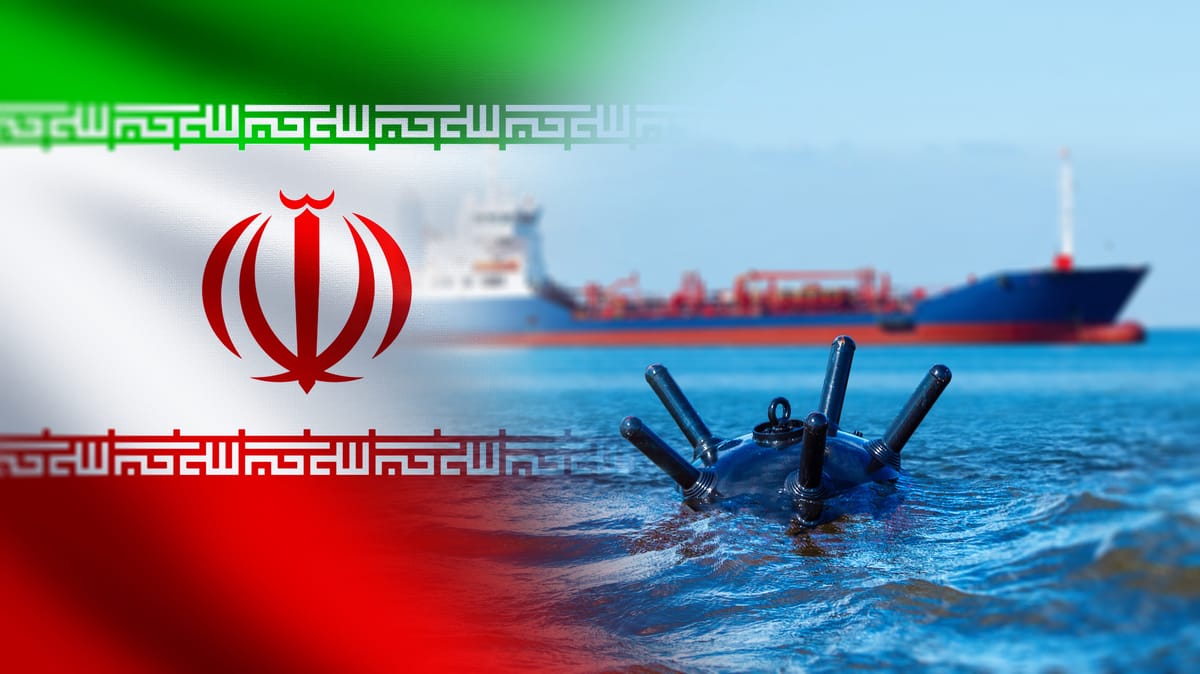
hen Iran closed the Strait of Hormuz in early March, it did so fast and dirty. Small Islamic Revolutionary Guard Corps (IRGC) boats, operating without a clear chain of command, scattered naval mines across one of the world's most critical shipping lanes. No unified record was kept of where each mine was placed. Some drifted from their original positions with the current. The result: Iran effectively trapped itself - and the world - behind a minefield it cannot fully map.
That chaotic decision, described by U.S. officials to the New York Times as "haphazard," is now the single biggest physical obstacle to any deal between Washington and Tehran. As President Trump announced Saturday that an agreement is "largely negotiated" and includes the reopening of Hormuz, the mines lurking beneath the surface are what stand between a signed deal and actual ships moving oil again.
"Iran does not have a clear idea of where each mine was placed."
- U.S. officials, cited by the New York Times, April 2026
How it happened — a timeline
Feb 28, 2026
The U.S. and Israel launch strikes on Iran. Within days, the IRGC announces the Strait of Hormuz is closed, warning ships they could be "targeted." Small IRGC boats begin mining the waterway in a decentralized operation.
March 11, 2026
Reuters reports that roughly a dozen mines have been laid in the strait. The U.S. military destroys 16 Iranian mine-laying vessels but the mines already in the water remain. Global oil prices surge toward $200 a barrel, according to Iranian military threats.
April 7–8, 2026
Trump threatens to bomb Iran unless Hormuz reopens immediately. A two-week ceasefire is reached hours before the deadline. Iran's foreign minister agrees to allow passage — but explicitly adds "with due consideration of technical limitations," a phrase U.S. officials immediately recognize as a reference to the mine problem.
April 9, 2026
Rather than clear the mines, Iran redirects ships to alternative routes through the strait, warning vessels to avoid the main shipping lane due to "possible collisions with sea mines." In effect, Iran acknowledges publicly it cannot guarantee the primary channel is clear.
April 11, 2026
The New York Times, citing U.S. officials, reveals the full picture: Iran has lost track of the locations of its own mines. The mining was conducted "haphazardly," with no systematic records, and some devices may have drifted. Crucially, neither the U.S. nor Iran has sufficient minesweeping capability on hand in the strait to clear it quickly.
May 24, 2026
Axios reports that the draft peace deal now includes a specific commitment: Iran agrees to clear the mines it deployed as part of the 60-day ceasefire framework. Trump's stated principle is "relief for performance" - the faster Iran clears the mines and lets ships through, the faster the U.S. lifts its naval blockade on Iranian ports.
The problem with the promise
Iran's commitment to clear the mines is now central to the emerging agreement, but the commitment runs directly into the physical reality that Iran may not be able to deliver quickly, or at all. Mine clearance is one of the most technically demanding military operations. Even the United States, which operates state-of-the-art mine-hunting vessels, does not maintain a surplus of such assets for a waterway as large and turbulent as the Strait of Hormuz. Iran's minesweeping capability, already limited, was further degraded by U.S. strikes on Iranian naval infrastructure during the war.
Iran acknowledged the problem as early as April 9, when it issued formal notices rerouting shipping around the danger zone rather than through the main channel. The IRGC's own statement cited "possible collisions with sea mines" - an extraordinary public admission that the regime had laid hazards it could not control.
Under the reported deal framework, the U.S. has built in an incentive structure to manage this: sanctions waivers and port blockade relief will be tied directly to mine clearance progress. The faster ships move, the faster Iran profits from oil sales. But if mines are not found, if they drift, if they sit undetected in shipping lanes, a commercial vessel striking one could trigger a crisis that unravels the ceasefire entirely, deal or no deal.
As of Sunday morning, the deal has not been formally signed. Iranian media has offered contradictory signals, with state sources insisting Hormuz will remain "under Iran's management" even as negotiators indicate progress. Secretary of State Marco Rubio, speaking in New Delhi, confirmed only that "there is progress" and that further news is expected "later today." The mines, for now, remain where Iran left them.