BREAKING: Israel Joins Trump Ceasefire Deal Just Moments Before Major Iran Strike
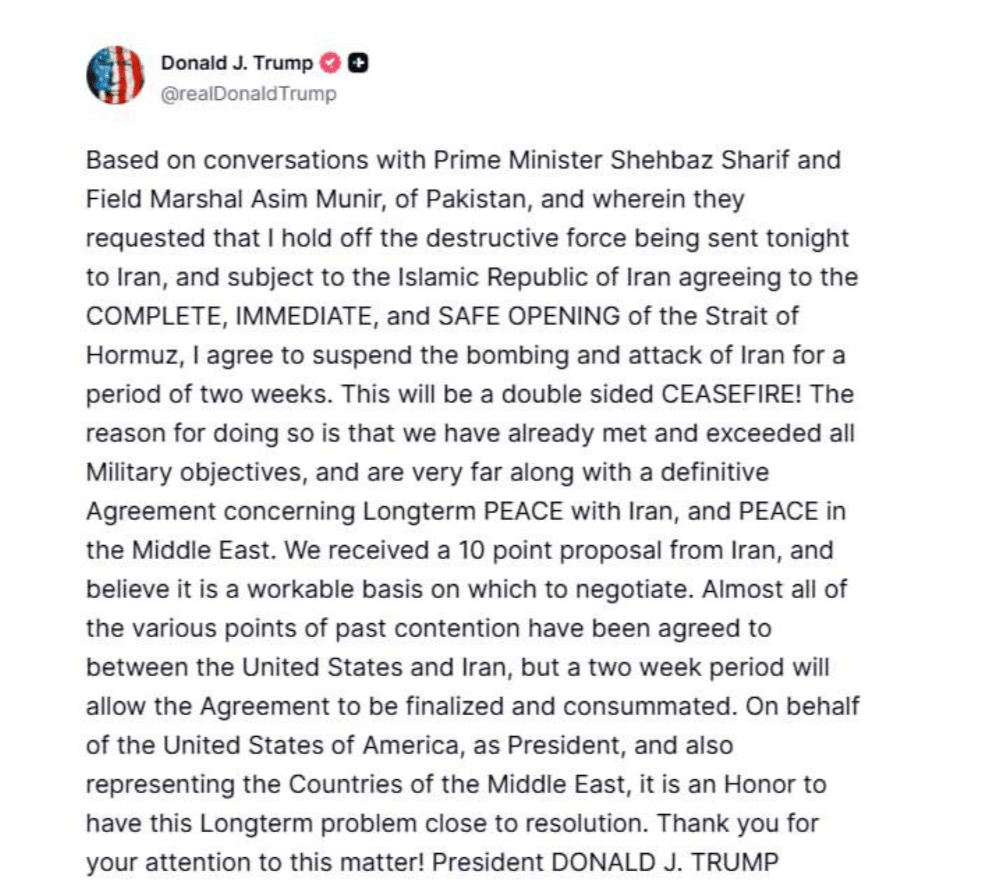
Israel joins the Trump-Iran ceasefire moments before U.S. strikes were set to begin. A 14-day window for peace opens as the Strait of Hormuz reopens.

In a dramatic last-minute development, Israel has officially agreed to join a two-week ceasefire with Iran, an agreement announced by President Donald J. Trump just 90 minutes before a deadline that threatened a massive military escalation.
Senior White House officials confirmed late Tuesday that Israel is on board with the temporary truce, transforming what was initially a U.S.-Iran standoff into a broader, coordinated pause in a conflict that had been rapidly spiraling toward full-scale regional war.
The ceasefire follows a period of extreme tension, during which President Trump had threatened to obliterate Iranian "civilization" if the Strait of Hormuz was not reopened. The shift toward diplomacy was reportedly catalyzed by:

The Israeli Position
While Israeli Prime Minister Benjamin Netanyahu confirmed support for the pause in strikes against Iran, a significant caveat remains. In a statement from the Prime Minister’s Office, Netanyahu clarified that while Israel is part of the truce regarding direct hostilities with Iran, the "ceasefire does not include Lebanon." Israel has signaled that its military operations against Hezbollah will continue independently of the two-week window.
Tehran has informed Pakistani mediators that they consider the strikes in Lebanon a violation of the "multi-front" agreement.
Tasnim News reports that Iran is now threatening to withdraw from the entire ceasefire if Israel does not halt its operations in Lebanon immediately.
What’s Next?
Trump characterized the deal as a “double-sided ceasefire,” claiming that U.S. military objectives have already been "met and exceeded."
"We are very far along with a definitive Agreement concerning Longterm PEACE with Iran, and PEACE in the Middle East," Trump posted on Truth Social.
Negotiations are set to begin this Friday in Islamabad, Pakistan, where delegations will attempt to finalize a long-term settlement. Key issues remaining include the permanent status of the Strait of Hormuz, the lifting of U.S. sanctions, and Iran’s nuclear enrichment rights.
The global markets reacted immediately to the news, with international oil prices dropping nearly 13% as the threat of a total energy blockade receded.
However, it looks like there is a major disconnect between the "peace deal" rhetoric and the reality on the water.
The WSJ reports that the Iranian Navy notified ships anchored near the Strait of Hormuz today that they still require Iranian authorization to cross the strait. "You must obtain permission from the Iranian Navy to pass through the strait. If a vessel attempts to pass without permission, it will be destroyed," according to a recording shared with the Wall Street Journal by a crew member.
Irans foreign minister said:
For a period of two weeks, safe passage through the Strait of Hormuz will be possible via coordination with Iran’s Armed Forces and with due consideration of technical limitations.