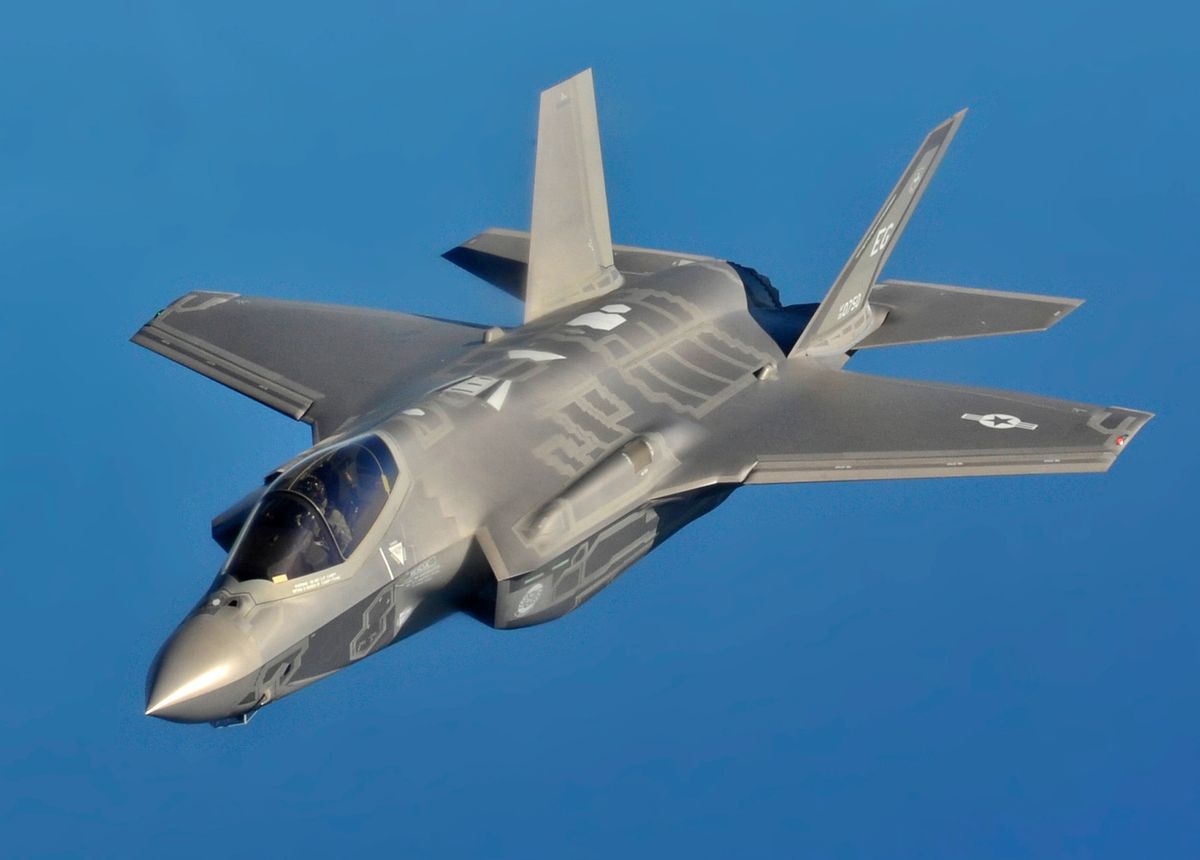
Last week brought reports of an incident almost without precedent in military logistics: components from an advanced fighter jet reaching America's primary global rival by accident.
According to the report, a cockpit canopy and a weapons-bay door were shipped from Australia to the United States but arrived in Hong Kong instead. Bloomberg reports that the Chinese government is now holding them. The central mystery concerns the approved shipping route and the division of responsibility among the US Department of Defense, Lockheed Martin, and the freight carrier.
According to a Bloomberg investigation published September 23, UPS transported the cockpit canopy and weapons-bay door from an Australian F-35 to the United States in late May for inspection and possible repair or disposal. The aircraft carrying the shipment stopped in South Korea, and from there the parts reached Hong Kong. Sources who spoke with Bloomberg said the Chinese government took possession of them and has not returned them. This account rests on sources familiar with the incident; US authorities confirmed there is a problem with the shipment and that they are working to recover the parts, but have not released independent documentation of the circumstances of their seizure.
What Is Known About the Parts, and What Remains Unproven?
According to Bloomberg, both components were coated with radar-absorbent material that contributes to the aircraft's stealth. The mere arrival of such components at an unintended destination raises a real concern about technological exposure. However, no official determination has been made public that the parts themselves were classified as secret, nor has it been proven that the stealth coating or the aircraft's capabilities can be reverse-engineered from them.
The US program office described them as parts unfit for use; describing their operational condition does not by itself answer the question of what information can be extracted from them. Australian Defense Minister Richard Marles said on September 22 that his understanding is that these are not sensitive parts, but he deferred the final determination on the matter to the United States and to Lockheed Martin.
The cause of the diversion has also not been established. Bloomberg found no public evidence distinguishing among a routing error, a pre-set shipping route, or deliberate interference. A follow-up Bloomberg report from September 25 pointed to the possibility that the routing is connected to UPS's commercial transport network in Asia, which passes through China. That possibility requires examination of shipping documents and approvals, but does not prove what happened to this particular shipment. There is therefore no basis yet to determine whether this was a Chinese intelligence operation or a "simple mistake."
Where Does Each Party's Responsibility End?
Here the heart of the story is exposed. Marles described Lockheed Martin as the contractor responsible for managing the global supply chain. In response, as quoted in the Bloomberg report, Lockheed said the US Department of Defense sets the transport options, and the company selects a carrier that meets the conditions set. UPS declined to detail publicly what occurred. These are not necessarily contradictory descriptions of the same operation: setting transport conditions, selecting the carrier, and controlling the shipment's routing are different stages. The question for investigators is who approved each stage, whether transit through Hong Kong was permitted, and when the parties involved noticed the deviation.
The case also does not arise in a vacuum. The US Government Accountability Office (GAO) warned in 2023 that the Department of Defense does not properly track the global inventory of F-35 spare parts held by external parties. The report documented more than a million parts recorded as lost, damaged, or destroyed, valued at over $85 million; fewer than two percent of the cases were then examined by the program office. This does not mean a million parts were stolen, or that those deficiencies caused the diversion of the shipment to Hong Kong. The report does point to a monitoring and documentation problem that preceded the current affair.
The Program's Cost Is Not Proof of the Leak's Cost
According to the GAO's estimate, the acquisition, operation, and maintenance costs of the F-35 program over its decades-long lifespan are expected to exceed two trillion dollars. This is a cumulative estimate for the future, not a sum already paid, and certainly not an assessment of the damage from the shipment. Precisely because of the program's scale, there is importance to the question of whether the control mechanism over the movement of sensitive parts meets the security requirements the system itself sets.
The US program office announced it is working with authorities and industry partners to recover the parts, investigate the incident, and prevent its recurrence. Until the investigation's findings are published, it is possible to determine that the shipment reached an unintended destination and that there is a concern about technological exposure; it is not possible to determine what caused it, what China succeeded in learning from the parts, or whether economic motives stood behind the decisions. The test of the investigation will be to reconstruct the chain of decisions from the first approval of the shipment until the moment control over the cargo was lost.