
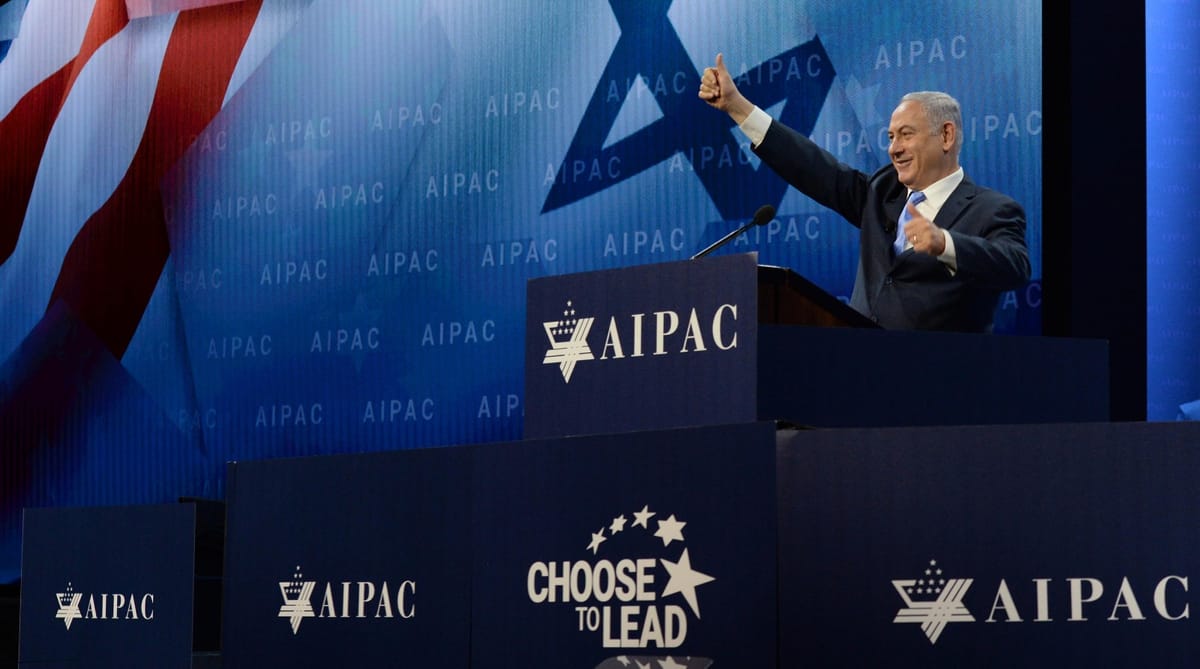
The American Israel Public Affairs Committee will stop endorsing candidates, making direct contributions through its political action committee and earmarking donations to candidates, reversing the strategy it adopted five years ago, the group told members on Wednesday.
In a letter first reported by Jewish Insider, AIPAC’s leadership said the organization will instead focus on increasing direct, organized contributions from individual Americans to candidates. “Endorsements, direct PAC contributions, and earmarking will no longer be part of our approach so we can expand individual giving and utilize new tools to help our friends win,” the letter said.
The group will keep operating its super PAC, the United Democracy Project, which makes independent expenditures supporting or opposing candidates. AIPAC spokesperson Deryn Sousa called the super PAC “one of the most important tools that AIPAC members use to help defeat anti-Israel candidates.”
AIPAC said the change was driven by where its political strength actually lies. Sousa said members contributed more than $90 million to candidates this cycle, including donations earmarked through the AIPAC portal, compared with about $3 million given directly by the PAC, which is limited to $10,000 per candidate per cycle. “Our mission and strategy remain the same,” she told the Jewish Telegraphic Agency.
The letter said AIPAC helped 290 pro-Israel candidates win elections this cycle and prevented 29 “detractors” from winning.
The decision follows a months-long strategic review by AIPAC’s board. For most of its history, AIPAC did not endorse candidates or run a PAC. It launched AIPAC PAC and the United Democracy Project in late 2021, ahead of the 2022 midterms. In 2025, AIPAC PAC was the largest PAC contributor to candidates and political committees in the country, giving $26.8 million, according to Federal Election Commission data.
The shift comes as AIPAC’s political involvement has become a campaign issue in both parties. Several lawmakers have pledged to refuse money from AIPAC or from PACs in general, and AIPAC suspended fundraising this year for 18 House Democrats who voted to cut U.S. assistance to Israel. In the Michigan Senate race, Democratic nominee Abdul El-Sayed made AIPAC a frequent talking point after the group spent heavily to support his primary opponent, Rep. Haley Stevens.
Jewish Insider noted that under the new approach, AIPAC supporters can continue giving to candidates who have publicly said they will not accept AIPAC money. The outlet also reported that activist groups such as TrackAIPAC had already been targeting individual Jewish and pro-Israel donors and labeling their contributions as AIPAC money, a practice that has drawn accusations of antisemitism.
AIPAC’s website will no longer list endorsed candidates with donation links, and the group will direct its remaining PAC funds to other political organizations rather than candidates, according to JNS.