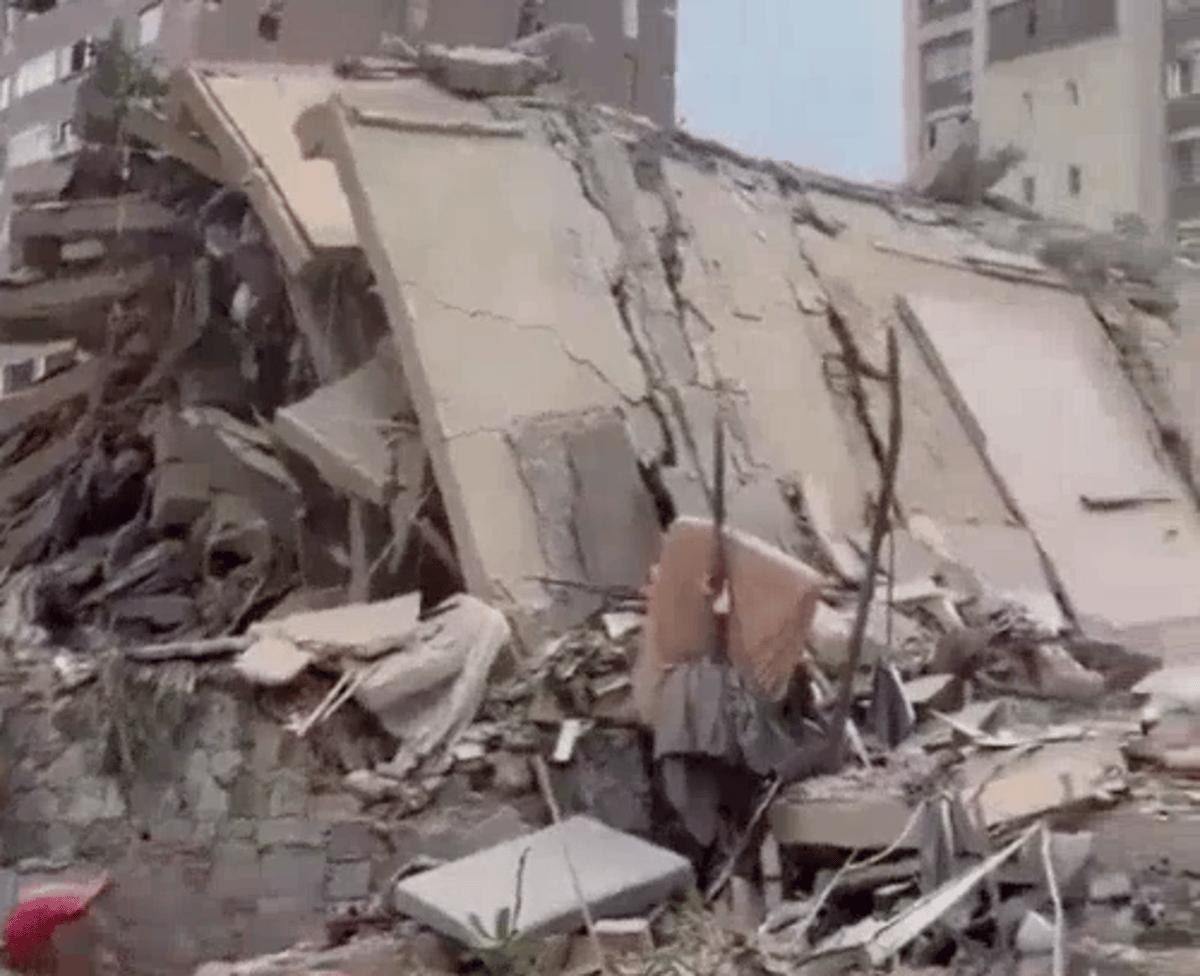
Two of the most powerful earthquakes to strike Venezuela in more than a century slammed the country's northern coast in rapid succession Wednesday evening, collapsing buildings in the capital, knocking out power and communications across multiple states, and killing at least 32 people in a nation already buckling under political turmoil and economic collapse.
The twin quakes, separated by just 39 seconds, sent residents of Caracas fleeing into the streets, left families waiting outside crumbled structures for news of loved ones trapped inside, and forced the interim government to declare a state of emergency as it scrambled to mount a rescue operation with limited resources and a damaged airport.
The U.S. Geological Survey placed the epicenter of the first earthquake, magnitude 7.2, near San Felipe, the capital of Yaracuy state, roughly 100 miles west of Caracas. Thirty-nine seconds later, a larger 7.5 magnitude quake struck near the town of Yumare, also in Yaracuy state.
"The building really shook from side to side. Unreal. The force was incredibly strong," said Roberto Damas, a Caracas resident. "We were walking and it was tossing us around. Everything in the apartment fell. Well, thank God we were able to get out."
One resident who had survived a quake that struck Caracas in 1967 said Wednesday's disaster was unlike anything he had experienced. Another, who escaped a damaged building, said the scene outside was "like a horror movie."
Acting President Delcy Rodríguez, speaking on state television in the early hours of Thursday, confirmed at least 32 dead and more than 700 injured. She cautioned that those figures did not yet include possible casualties from La Guaira, the coastal state immediately north of Caracas, which she described as a "true tragedy" and a "disaster zone." Twenty aftershocks had been recorded by the time she spoke.
"What I ask is that we act in national unity, with calm, and that we know that together we will overcome this tragedy," Rodríguez said.
The scale of the destruction was still coming into focus Thursday morning. Emergency assessments remained underway, with initial reports describing collapsed buildings, damaged hospitals, transportation disruptions, and widespread impacts to critical infrastructure. Rescue teams were searching debris for people believed to be trapped, while authorities worked to assess the full extent of the damage.
Simon Bolivar Airport, the country's main international gateway near Caracas, temporarily closed after sustaining damage. Internet connectivity dropped sharply across the country as the quakes severed power and telecommunications lines, according to the watchdog group NetBlocks. School classes were suspended nationwide for a week, rail services halted, and authorities cut gas supplies to certain buildings as a precautionary measure while engineers assessed structural damage.
Lucy Jones, a seismologist and visiting professor at the California Institute of Technology, said the event met the threshold of a major catastrophe. "This is one of the really great, very difficult, very damaging earthquakes, because you combined a very large event with residences of a lot of people," Jones said in a video briefing.
An Already Broken Country
The earthquakes arrived at what analysts described as the worst possible moment for a country that had already been pushed to the edge. Venezuela is still in deep political and financial crisis, led by an interim government following the U.S. capture of President Nicolás Maduro earlier this year, and facing an economy crippled by years of hyperinflation. For millions of Venezuelans already living in acute poverty, the destruction of homes and infrastructure represents not merely a humanitarian emergency but a potential breaking point.
For a population already enduring some of the world's worst poverty, the double-punch earthquakes struck at the worst possible moment.