
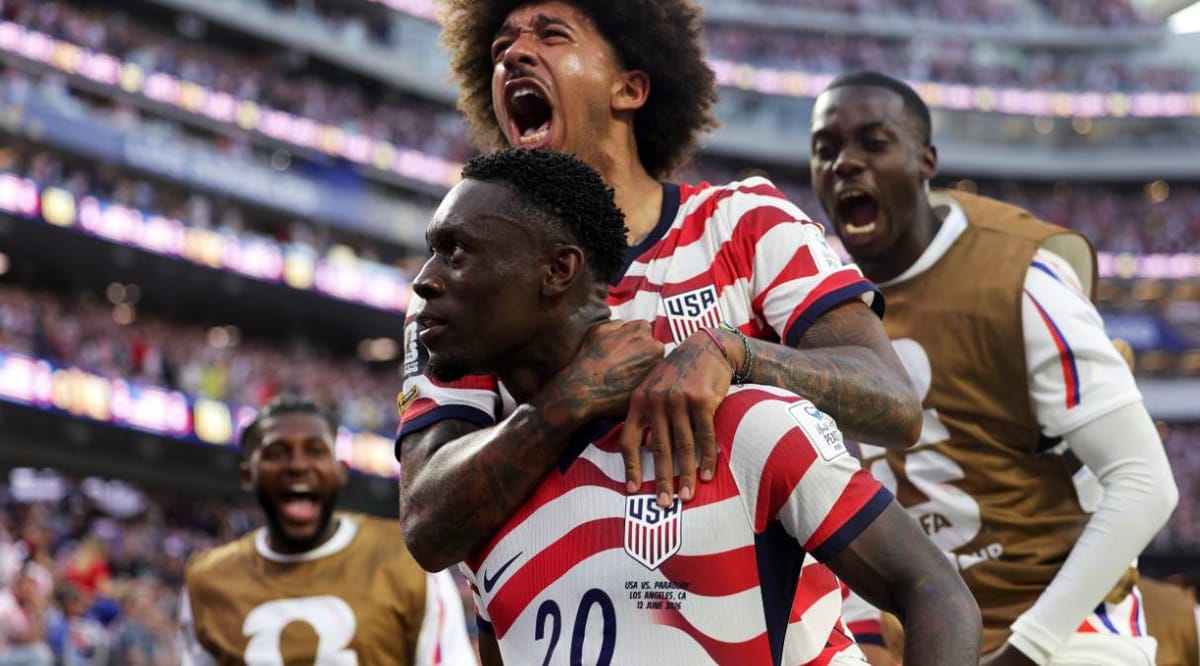
Americans are beginning to fall in love with soccer.
They are beginning to argue about it, to suggest ways to improve it, and to believe that if they are entering this game, they are allowed to ask questions about it too.
And that is a good thing.
Those who mock Americans on this subject are missing something. No, they did not invent soccer. Yes, for years they treated it as a foreign sport: slow, strange, full of draws and too few goals. But America is an enormous sporting civilization. It knows how to build a sports product, create drama, and turn a game into an event.
And sometimes, with almost innocent arrogance, it knows how to ask the question Europe rarely has asked for the last 150 years: why does it have to stay exactly the same?
We are already hearing ideas that could make the game more interesting.
More interesting from the country that invented baseball? Yes.
One idea is to prevent teams from constantly passing backward over the halfway line once they have crossed it, something like the backcourt rule in basketball. It could force teams to play forward, punish passive possession, and create more transitions. It would need testing, of course.
Another idea, which I actually heard from an Englishman, is to limit the number of defensive players allowed inside certain zones of the pitch. For example, no more than five defenders below a certain line. That tries to fight the low block not by begging teams to play “positive football,” but by changing the structure of the game so space has to exist.
Then there is the more radical idea: reduce the number of players from 11 to 10.
At first, this sounds like sacrilege. But is it irrational? Soccer was born in an era when players were less athletic, less fast, less powerful, and less tactically organized. Today, every player covers enormous distances. Every team closes passing lanes. Every winger defends. Every striker presses. The game has become fast, disciplined, compact, and sometimes almost suffocating.
If players have become super-athletes, perhaps the game needs a little more air.
And this is not merely the fantasy of an American amateur. Football minds such as Michel Platini and Luis Enrique have already spoken about the possibility. The logic is simple: one fewer player, more space, more one-on-one situations, more dribbling, more risk, and perhaps more football.
The real question is not only whether America will love soccer. The real question is what soccer will become if America truly begins to win.
This is where the American national team matters.
For years, the U.S. team was mostly associated with athleticism, discipline, running, defending, fitness, and fighting character. That is not nothing. But it is not enough to capture the imagination. Americans respect hard work, but they fall in love with talent. They respect struggle, but they pay for magic.
And in this American team, something else is beginning to appear. Not only athleticism. Not only pressing. Not only effort. There is more technique, more cleanliness, more confidence on the ball, and more of a sense that these players are not simply chasing the game, but can actually control it.
In that sense, this team has an interesting quality. On one side, there is something almost German about its cleanliness, order, fitness, and structure. On the other, there is a technical calm that at times recalls Croatia’s traditional ability to pass, control, and remain composed under pressure. No, the United States has not become Brazil, Argentina, Spain, or even Croatia. But it no longer looks like a team merely trying to survive.
And that is exactly what can make Americans fall in love.
For soccer to conquer America, the national team cannot merely win. It has to sell the game by showing Americans that soccer is not just 90 minutes of waiting for a goal. It is pressure, space, movement, courage, rhythm, and one sudden moment in which everything opens.
The 1994 American team could not do that. It hosted a World Cup in a country that did not even have a professional league. Its job was simply to prove that soccer could exist here. Today, the mission is different. Today, the national team has to prove that soccer can become an American story.
And here is the most important point: America loves underdogs, but in the end, America falls in love with winners.
If the United States reaches the later stages, especially a semifinal on American soil, it will do something for American soccer that no marketing campaign, no MLS investment, and no European superstar advertisement could ever do.
It will make children choose soccer not because it is a nice activity, but because it is a dream. It will make fans feel not only that they are hosting the world, but that they belong in it. And it will force soccer itself to understand that America is no longer standing outside the game. When a country like America enters a game, it does not only learn the rules. It starts asking how to win, improve, and make everything bigger.
To European soccer, that may sound dangerous.
To world soccer, it may be exactly what was missing.