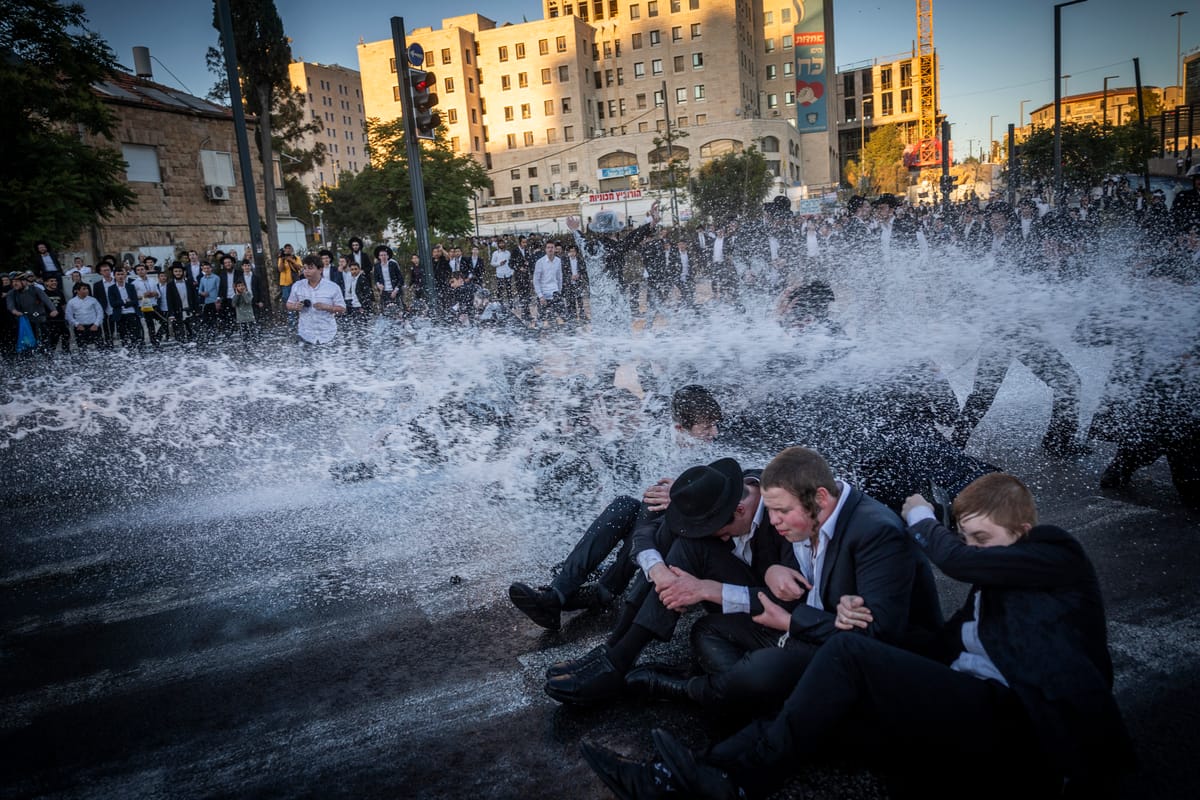
Something has shifted in Israel's ultra-Orthodox street, and it should alarm every Israeli regardless of where they stand on the draft debate.
The mainstream Haredi newspaper Yated Ne'eman, the flagship publication of the Lithuanian stream, not some fringe pamphlet, ran a headline this week that would have been unthinkable a decade ago: "War. Not in Lebanon, not in Gaza, not against Iran, war against the State of Israel." The editors framed the military draft enforcement campaign as a matter of pikuach nefesh, a halachic term reserved for life-threatening emergencies. The police and the state were named, explicitly, as the enemy.
This is not the language of the "Peleg Yerushalmi," the radical anti-Zionist faction that has long been dismissed as extremist. This is the mainstream. And that distinction matters enormously.
Broadcaster Moshe Manes, hosting Kikar Shabbat's Davar Rishon, opened his show this week with a warning that cut through the noise: "I would not be surprised if, at this very moment, a group of yeshiva students is organizing to kidnap a soldier or a policeman. They don't intend to kill him, but that too could happen by accident. The Haredi sector and the state are at war, and in war, some people will go all the way."
Whether or not one agrees with his framing, the underlying reality he is describing is real and growing.
How We Got Here
Yossi Levy, the first Haredi battalion commander in the IDF's history and director of the Netzach Yehuda association, offered perhaps the clearest diagnosis of the crisis. He arrived at the studio after 80 days of reserve duty inside the refugee camps of Judea and Samaria and he was visibly shaken by what he was reading in the Haredi press.
Before October 7, he explained, the military and political establishment had convinced itself that future wars would be won through air power and technological intelligence. Ground maneuver forces, the generals said, were yesterday's doctrine. The implication was clear: Israel didn't really need Haredi soldiers.
Then October 7 happened, and the entire conceptual framework collapsed.
Now Israel is fighting on seven fronts, its reserve soldiers are breaking under the weight of repeated and extended call-ups, and the army desperately needs more combat troops. Meanwhile, approximately 90,000 Haredi men are classified as draft evaders or deserters, with no law governing their status, no framework for resolution, and no legislative solution in sight.
The result is a pressure cooker. Every time security forces come to arrest a yeshiva student, a hotline called the "Black Color Line" mobilizes thousands of protesters within minutes. The reason this works, as political correspondent Avi Moskow observed, is that for the first time in Israeli history, mainstream Haredi men, not radical fringe elements, feel personally implicated. Nearly every Haredi family has a son, a brother, a nephew who is technically a fugitive from the law for the "crime" of studying Torah.
That is a radicalizing force unlike anything Israel has experienced in this conflict.
No One's Hands Are Clean
Levy did not spare the political class. When asked who bears responsibility, his answer was unambiguous: everyone.
"All the politicians are guilty," he said. "No party - not the Bennett-Lapid governments from the center-left, not Likud and the Haredi parties in the current coalition - managed to pass appropriate legislation. They all failed. Some want everything and others aren't willing to give up anything, and the result is no law and no law coming in the next year because of election season."
It is a damning indictment, and a fair one. The draft question has been weaponized by every political faction for short-term gain for so long that the structural problem has been left to fester into a genuine societal crisis.
Columnist Dov Aichler offered a bleak but clear-eyed prediction. He does not fear a dramatic civil war with a winner and a loser. He fears something worse: a slow, grinding deterioration in which no side defeats the other, Israel simply becomes a harder and more miserable place to live, and the people who pay the price — as always — are not the powerful or the wealthy, but the vulnerable. The person whose medical appointment is missed because a highway is blocked. The family whose livelihood is destroyed by economic disruption. "Israeli society," he said, "is living in an era of 'burn the country down as long as my son is okay.' There is no unifying value — just a collection of people stuck together, trying to defeat each other by force."
Is There a Way Out?
Moskow's proposed solution is counterintuitive enough to be worth taking seriously. He argues that the only path to a draft law that can survive legal, media, and public scrutiny is one passed with the backing of the left. A Haredi-left coalition, like the unlikely partnership that once brought Naftali Bennett to sit with Mansour Abbas, could produce legislation that wouldn't be branded in the press as a "draft-dodgers' law" but as a legitimate, proportionate framework.
It's a cynical solution to a cynical problem. But cynical solutions sometimes work.
What is not working is the status quo. The Haredi leadership has spent three and a half years promising its constituents that it would deliver a draft law and the funding guarantees that go with it - and it has delivered neither. That failure is now being paid for in the streets.
The voices on this week's program disagreed on almost everything, the blame, the prognosis, the fix. But they agreed on one thing: the language being used in Israel's Haredi mainstream today is not the language of a community preparing to compromise. It is the language of a community preparing for a long fight.
And in that kind of fight, someone usually gets hurt.