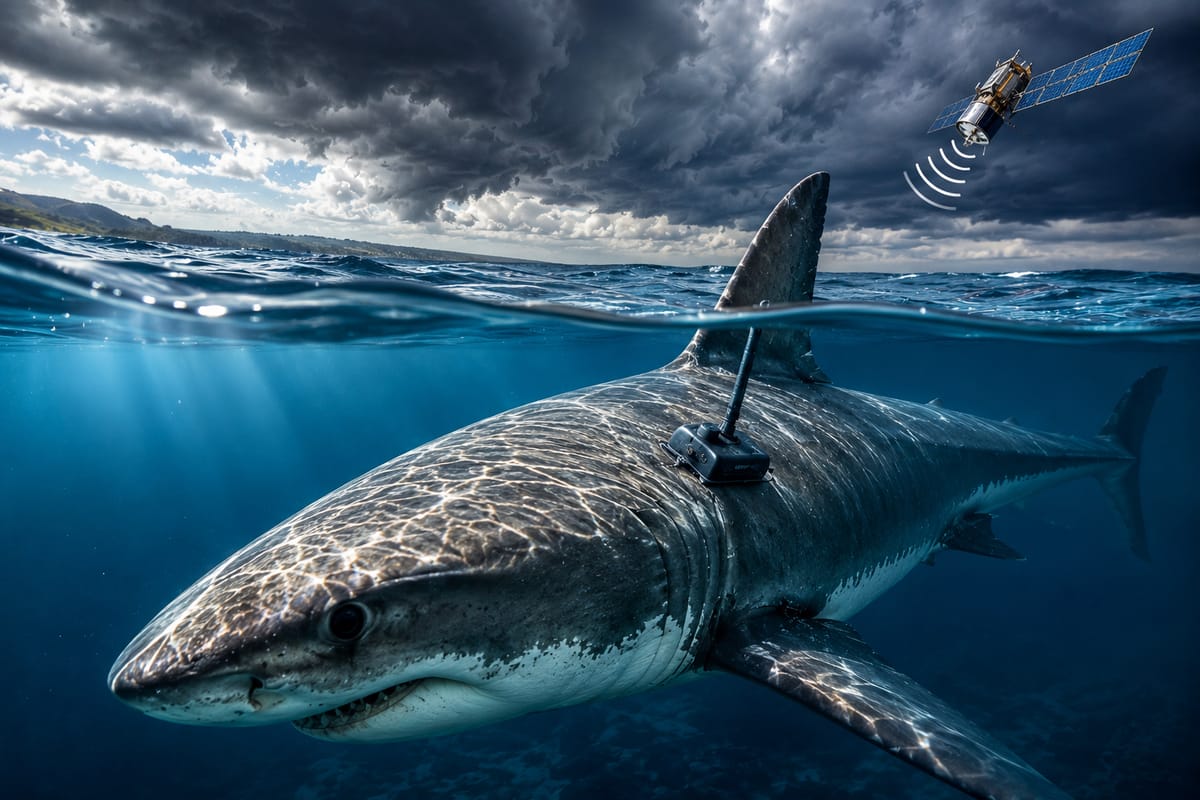
They have no idea they're working for science. They certainly don't understand what a hurricane is. Yet sharks swimming off the eastern United States may become an unexpected tool in the effort to predict deadly storms.
Researchers at the University of Delaware have begun testing sharks as mobile underwater weather stations. A small electronic sensor is attached to the shark's dorsal fin, and the animal continues its normal routine—swimming, diving, and surfacing.
All the while, the sensor is collecting data.
The device measures three key parameters: water temperature, depth, and electrical conductivity—a metric that allows scientists to estimate salinity.
Each time the shark surfaces, the sensor can communicate with a satellite network and transmit the information it has gathered. This provides researchers with measurements from areas and depths that aren't always easily accessible by ships, buoys, or other monitoring equipment.
Using animals to collect ocean data isn't new. Scientists have done this for years, including with elephant seals in polar regions. Sharks are particularly valuable because they're widespread, cover large territories, and can provide information from diverse ocean zones.
But what does this have to do with hurricanes?
This is where it gets interesting.
A hurricane doesn't draw its power solely from atmospheric conditions. Warm ocean water is actually part of its energy reservoir.
Researchers are especially interested in the upper mixed layer of the ocean. The more heat stored there, the more favorable the conditions for a storm to intensify. So it's not enough to know the sea surface temperature—it's crucial to understand how much heat is hidden beneath the surface as well.
That's where the shark comes in.
Instead of deploying dedicated instruments at every point in the ocean, researchers let an animal that's already moving through those waters collect a continuous stream of measurements for them.