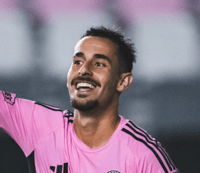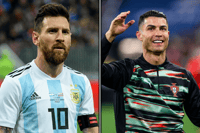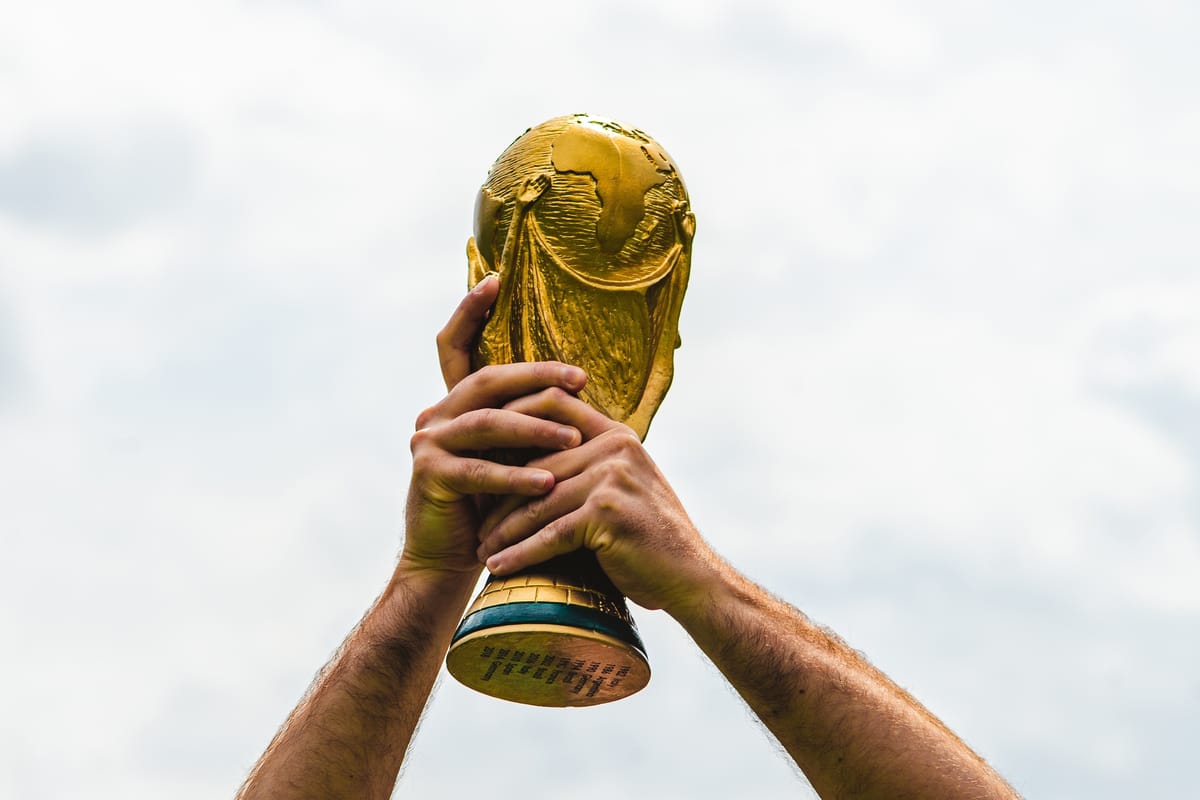
There is a version of this final where Lionel Messi lifts a second World Cup, thirty-nine years old, still the best player most of us have ever watched, closing the loop on the greatest individual career the sport has produced. There is another version where Lamine Yamal, eighteen, becomes the youngest World Cup winner of the modern era and the torch does not so much pass as get physically wrenched from Messi's hands on the same field where he tried to keep it.
Both stories are true right now. Only one gets to be true by Sunday night.
What the numbers say
Start with the market, because the market has been unusually decisive about this one. On Polymarket, Spain is trading at roughly 55 to 59 percent to win the final, with Argentina at 41 to 45 percent, depending on which snapshot you catch. That gap widened steadily over the past week. Spain's aggregated championship probability across prediction markets surged from 12.3 percent to 18.6 percent after a 1-0 win over Portugal, then jumped again following a 58 percent title probability reading after dispatching France in the semifinal. Argentina's odds have moved up too, on the back of that stoppage-time escape act against England, but nowhere near as sharply.
The analytics models tell the same story. Squawka's Signal model has Spain as its outright favorite at 59.3 percent, with Argentina, in the model's own words, "the one side left to beat." When the model and the market are this aligned, it usually means one of two things: either the market has genuinely priced in something real, or everyone is watching the same tape and reaching the same conclusion. Here, it looks like both.
And the tape is not subtle. Spain has conceded exactly one goal in seven matches at this tournament. One. They have not lost in 37 consecutive matches going back well over a year. Luis de la Fuente has built a team that does not need chaos, does not need a hero moment, does not need Messi-style late-game theater, because they simply do not put themselves in position to require it.
What the eye test says
Argentina's path to Sunday looks nothing like Spain's, and that is precisely the point of the debate. Lionel Scaloni's team has trailed or been level after 90 minutes in all four of its knockout matches at this World Cup. All four. And it has won all four anyway. Against Egypt, they were down two goals and came back. Against England, they were down 1-0 with five minutes left when Enzo Fernandez fired in from distance to tie it, and then Messi delivered the cross that Lautaro Martinez headed home in stoppage time to complete another escape.
That is either the profile of a team that lives dangerously and will eventually pay for it, or a team that has, deliberately or not, built an identity around never actually losing when it matters. Argentina's locker room clearly believes the latter. FOX Sports and CBS analysts covering the tournament have leaned toward the former, with the consensus among tracked expert picks skewing toward Spain, though not unanimously.
The tactical matchup sharpens the tension. Spain's midfield, anchored by Rodri, has controlled possession and match tempo against every opponent it has faced, including a France side many considered the tournament's most talented roster. Argentina's midfield, by contrast, has been the unit most frequently exposed this tournament, an issue Microsoft's Copilot AI model flagged explicitly in its own published prediction, backing Spain in part because it saw Argentina as "vulnerable" through the center of the pitch. Whether that vulnerability gets punished by a Spain side allergic to giving away possession, or gets papered over again by Messi conjuring something from nothing, is more or less the entire ballgame.
The variable neither model can price
Four of the last five World Cup finals have gone to extra time. That single fact should temper anyone treating Spain's market price as destiny. Betting analysts covering the match for outlets like Covers and Yahoo have split on the outcome even while agreeing on the general shape of the game, with several backing Argentina specifically because "composure, leadership, and championship mentality" tend to matter more than 90-minute dominance once a final gets tight and low-scoring, which this one almost certainly will be.
That is really the crux of it. Spain is the better team over 90 minutes, and the numbers, the model, and the market all agree on that. But finals are not always won by the better team over 90 minutes. They are won by whichever team handles the one moment the game actually turns on. Spain has not been tested in that specific way this tournament. Argentina has been tested in exactly that way four times running, and four times running, Messi has been standing there when it mattered.
The pick
If this were purely a probability exercise, Spain wins comfortably, and the model says so. But World Cup finals are not purely probability exercises, they are the one setting in the sport where narrative gravity is a real, measurable force, and Messi's entire Sunday is built to bend that gravity one more time.
Sunday's final kicks off at 3 p.m. ET, 10 p.m. Israel time, at MetLife Stadium in East Rutherford, New Jersey.