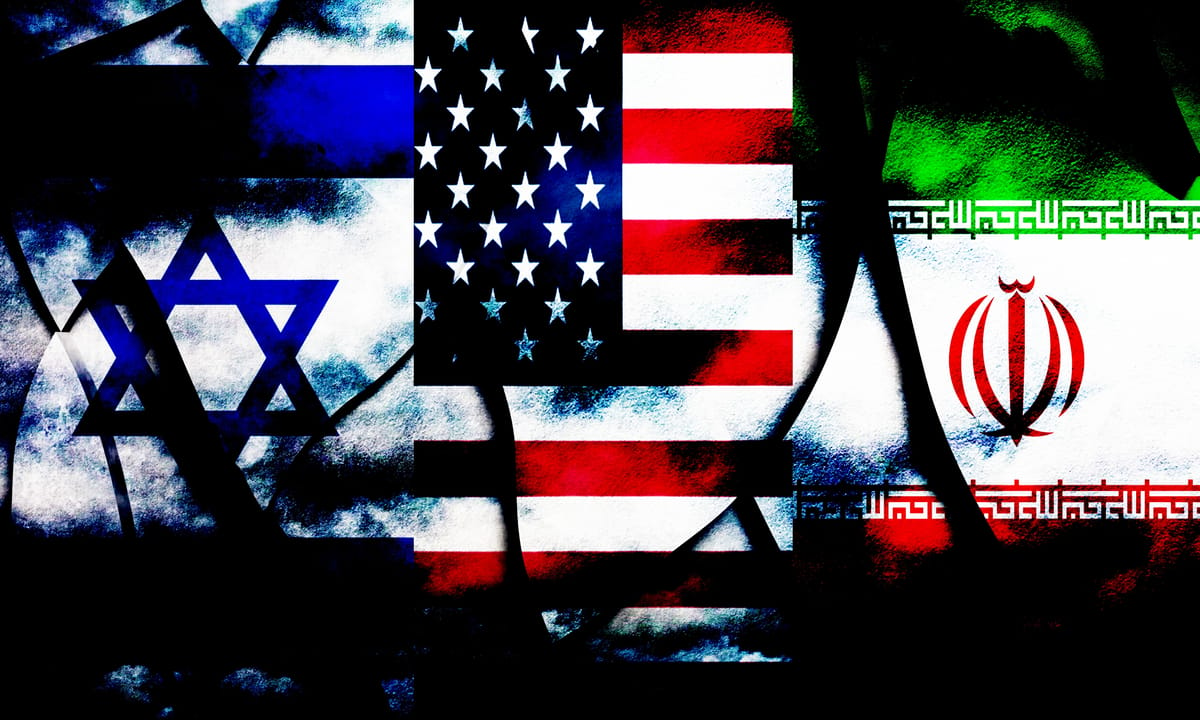
As tensions between the United States and Iran spiral toward what Israeli officials describe as a likely return to full-scale war, one detail stands out amid the escalation: Iran's retaliation has been aimed almost entirely at American targets, not at Israel. Understanding why offers a window into just how much the Islamic Republic's military capacity has been degraded since the war that began in February.
The current flare-up centers on the Strait of Hormuz and the collapse of the memorandum of understanding reached between Washington and Tehran earlier this summer. Iran's response to renewed American strikes has focused on U.S. bases in Bahrain, Kuwait, and Jordan, along with commercial shipping in the strait, rather than Israeli territory. Israel, according to recent reporting, has largely been watching from the sidelines rather than actively engaged in this particular round, a sign that Iran appears to be trying to keep this specific confrontation contained to Washington rather than reopening a second front against Jerusalem.
Iran's missile arsenal is a central part of the explanation. Following Operation Epic Fury in February and March, Israeli and American officials estimated that at least 70 percent of Iran's missile launchers and stockpile had been destroyed, and President Trump said at the time that Iran had "very few rockets left." Iran has reportedly worked since then to rebuild its capacity, but analysts monitoring the ongoing conflict describe the current state of its ballistic missile stocks as still poor. Firing what remains of that arsenal at Israel, which fields some of the most sophisticated layered air defense in the world, offers a far worse return than aiming it at Gulf shipping or bases with comparatively little defensive protection.
Iran's command structure also absorbed a severe blow. The opening strike of the February war killed Supreme Leader Ali Khamenei along with a chain of senior Revolutionary Guard and military leadership. Analysts tracking the war's second phase have noted that Iran's missile operations since have looked increasingly uneven, relying more on smaller units operating under pre-delegated authority rather than the large, centrally coordinated barrages Tehran launched against Israel during the twelve-day war in June 2025. That kind of degraded coordination makes mounting a major, synchronized strike on Israel considerably harder, even if Iran's leadership wanted one.
Israel's deterrent posture is likely playing a role as well. Every time Iran or its regional proxies have crossed a line with Israel, the response has been severe, culminating in the assassination of Khamenei himself. Israeli officials have made little secret of where they believe this is heading. Energy and Infrastructure Minister Eli Cohen said this week that the Iranian regime "will fall" and that it is "just a matter of time," a view he has repeated consistently in recent months while crediting American economic pressure with accelerating the regime's collapse. Tehran likely calculates that opening a direct front with Israel while already stretched thin fighting Washington over Hormuz risks dragging Israel back into a war it can even less afford right now.
There is also a strategic logic to where Iran is choosing to fight. Striking Gulf shipping and American bases allows Tehran to claim it is retaliating and project strength domestically, without needing to overcome Israel's far more effective missile defense system, which intercepted the overwhelming majority of Iranian missiles even during the heaviest exchanges of the war last year.
None of this necessarily means Iran has abandoned the idea of striking Israel again. Senior Iranian officials, including the late Ali Larijani before his death and Parliament Speaker Mohammad Bagher Ghalibaf, have said explicitly that Iranian forces are waiting for any ground incursion or renewed Israeli involvement. For now, though, the pattern suggests Iran is fighting the war it can still afford, and at this stage, that war is with the United States in the Gulf, not with Israel.