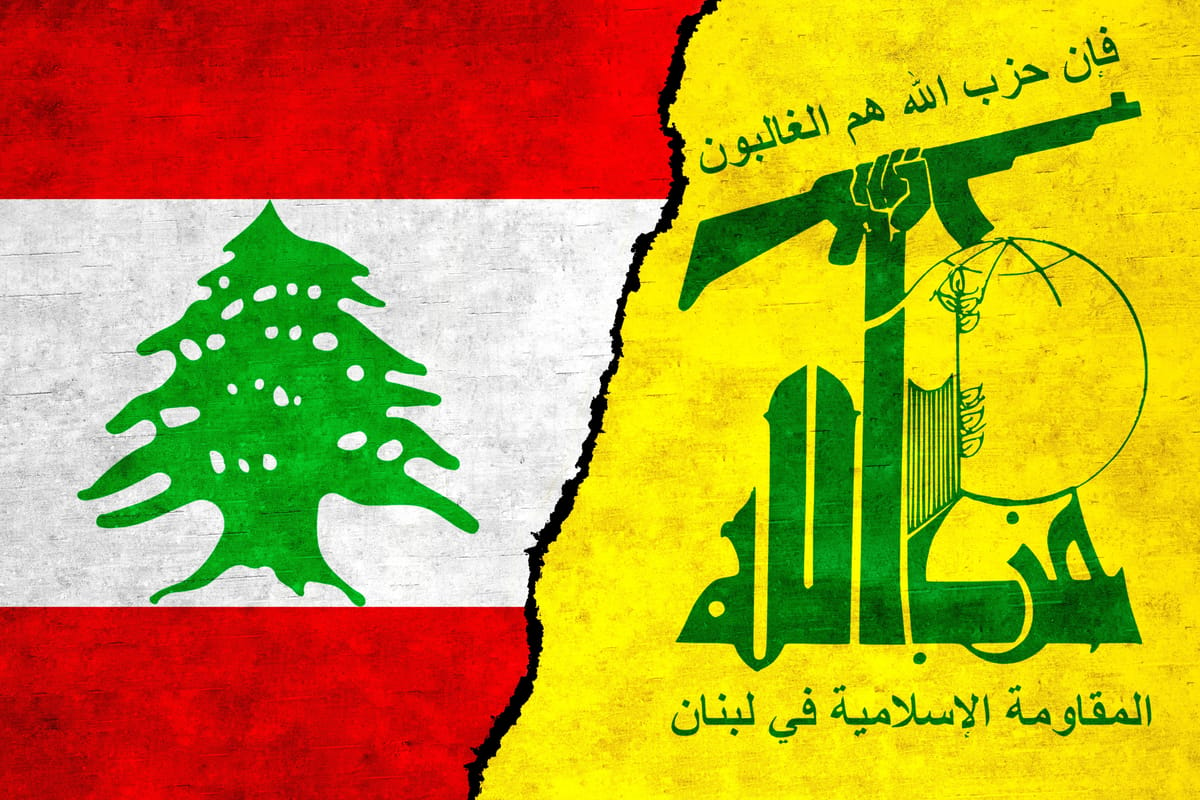
The ink on the Washington framework agreement was barely dry before the word was spoken aloud, not by analysts, not by think tanks, but by Hezbollah's own allies inside the Lebanese parliament.
Lebanese Parliament Speaker Nabih Berri, among Hezbollah's closest political partners, called the deal signed with Israel "incitement to civil war" and warned against its implementation. A senior Houthi official went further, declaring that "the inevitable outcome of this agreement will be one of two scenarios: a devastating Lebanese civil war or a direct Zionist occupation of Lebanon."
These are not idle threats. They are a roadmap to what comes next, if the Lebanese state actually tries to do what it has just committed to doing.
The Agreement and Its Impossible Ask
The framework deal signed in Washington on June 26, the result of five rounds of direct Israeli-Lebanese talks in the US capital, does not mandate Israeli withdrawal from the nearly 20 percent of Lebanese territory the IDF currently occupies. Instead, it ties that withdrawal to a "sequenced process" requiring the Lebanese army to restore "effective sovereign authority over all Lebanese territory, pending the verified disarmament of non-state armed groups," a transparent reference to Hezbollah.
Hezbollah was not at the table. It was not consulted. And it has made its position unmistakable.
Hezbollah leader Naim Qassem called the framework "humiliating, shameful, and a surrender of sovereignty," declaring it "null and void" and demanding it be replaced by the US-Iran MOU, which he sees as more favorable to the group's position. His fighters, meanwhile, took to the streets of Beirut, blocking roads with burning tires in protest.
Lebanon's Army, and Its Impossible Task
The Lebanese Armed Forces are being asked to do something they have demonstrably failed to do for decades, and for reasons that go beyond political will.
The Lebanese army teeters on the brink of collapse. Qatar funds their payroll and the US supplies rudimentary equipment, but soldiers often moonlight as nightclub bouncers and Uber drivers to survive. Their logistics verge on the farcical: troops in the field frequently beg civilians for drinking water or food. Since the 1991 end of Lebanon's civil war, first the Assad regime and later Hezbollah itself barred the Lebanese military's intelligence branch from gathering any information on the pro-Iran militia.
When the Lebanese army was tasked with disarming Hezbollah south of the Litani River after the November 2024 ceasefire, it largely reacted selectively to intelligence provided by Israel via a US-led cell, avoiding sites Hezbollah deemed sensitive. Hezbollah tolerated some weapons collection in the south but vowed to attack the state if operations continued north. The LAF blinked, and the Lebanese government said nothing.
The result was predictable. Lebanon declared "mission accomplished" in early 2026, announcing it had completed phase one of Hezbollah disarmament. Only a month later, US Central Command announced the LAF had uncovered a "massive underground tunnel" used to store missiles and attack drones in the south. Then, on March 1, Hezbollah fired six rockets into Israel, demonstrating conclusively that the zone south of the Litani was anything but cleared.
The Sectarian Fault Lines
Lebanon's communities are not united against Hezbollah, but they are not united behind it either, and that ambiguity is itself a warning sign.
Hezbollah's solidarity with Iran has angered Sunnis, Christians, and even its long-term Shiite ally Nabih Berri of the Amal Movement. Berri was reportedly "shocked" when Hezbollah launched strikes against Israel at Iran's behest, having been assured by the group that it would stay out of the US-Israeli conflict with Tehran. Growing calls for federalism, even partition along sectarian lines, are being heard from Christian and Sunni communities. "If you want to keep your arms, keep your army, keep it in your region," analysts quote these voices as saying. "You cannot force us to align with Iran."
But the picture inside the Shiite community is more complicated. Shiites in southern Lebanon are just as encumbered by Lebanon's economic collapse as everyone else. An Israeli 'invasion', and the displacement it brings, could encourage them to rally behind Hezbollah, turning its existential crisis into a collective battle of survival. Lebanon has seen this before. The 2006 war briefly unified the Shiite street behind Hezbollah even as other communities recoiled.
Lebanese political analyst Michael Young has warned that despite real anger at Hezbollah within the Shiite community, "this will slowly be absorbed in light of the fact that the community feels besieged, isolated, and rejected at home. Hezbollah may ultimately benefit from this deep sense of anxiety. Lebanon's sectarian politics can hold many surprises."
The Critical Variable: Iran
One factor separates 2026 from 1975: Hezbollah's patron is wounded.
The killing of Supreme Leader Ali Khamenei in February, the battering of Iran's military infrastructure, and the financial pressure of sanctions and war have all degraded Tehran's ability to fund and direct its Lebanese proxy at the levels it once did. The US-Iran MOU, whatever its flaws from Israel's perspective, includes explicit commitments to cut off funding flows to non-state armed groups, a direct reference to Hezbollah's Iranian lifeline.
Hezbollah has reportedly closed the majority of its training facilities, and while it has begun rearming through seaport channels and smuggling routes from Syria, its capabilities are significantly diminished from their prewar peak. A Hezbollah without the full weight of Iranian backing is a different entity from the one that fought Israel to a bloody standstill in 2006.
That does not make it willing to disarm. But it may make it less able to launch a full-scale civil war.
The Bottom Line
The Washington framework is real. The commitments in it are real. And the gap between those commitments and reality on the ground is also very real.
Hezbollah official Hassan Fadlallah has explicitly warned that the agreement could result in civil war because Hezbollah will not give up its weapons and will resist any measures taken by the Lebanese army. That warning is not a bluff; it is a statement of institutional survival. An armed Hezbollah without its weapons is not Hezbollah at all.
What Lebanon is now entering is not clearly a path to peace or a path to civil war. It is something more dangerous: an extended period of ambiguity, in which a Lebanese government with limited capacity tries to enforce commitments it has struggled to keep, against a militia that has survived every previous attempt to sideline it, while Israel watches from positions inside Lebanese territory and reserves the right to act unilaterally if the process stalls.
History offers a sobering guide. Lebanon signed the Taif Accords in 1989, disarmed every militia except one, and spent the next three decades living with the consequences of that exception.
The exception is still armed. And it just called the new deal "null and void."