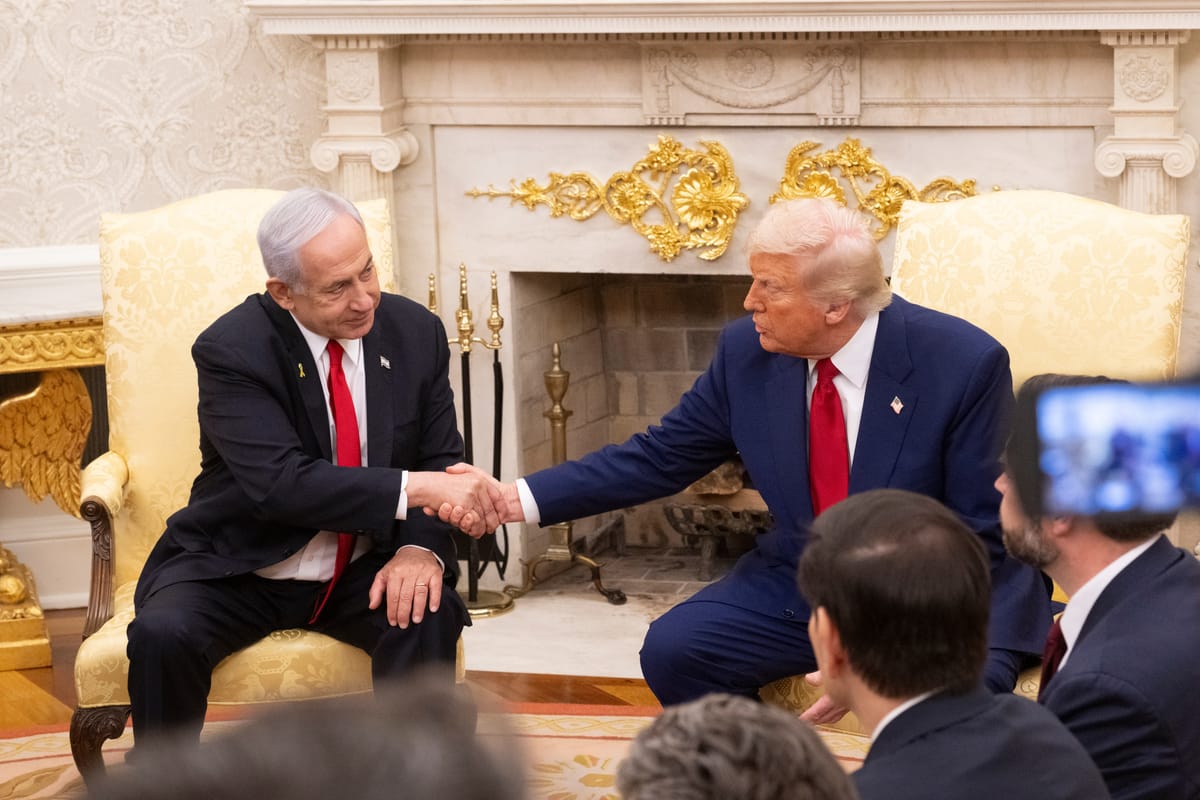
President Donald Trump has said more than once in recent weeks that he would "most likely" endorse Prime Minister Benjamin Netanyahu in Israel's upcoming elections. Each time, he has attached a caveat. He wants to see who else is running. He wants Netanyahu to be "more rational." He wants, as he put it, a "softer touch" in Lebanon. For a president who rarely hesitates to throw his full weight behind allies he likes, the qualifiers are notable, and they may point to something larger than a personal spat over military tactics.
That something is Saudi Arabia.
Riyadh's normalization with Israel has become the connective tissue of Trump's entire regional strategy since the ceasefire with Iran. It is also the deal that has eluded him. Crown Prince Mohammed bin Salman once showed real openness to the idea, but his enthusiasm has cooled over the past year, and Saudi officials continue to insist on an irreversible, time-bound path to Palestinian statehood as the price of admission. Netanyahu's coalition will not accept that price. It cannot, without collapsing.
The late Senator Lindsey Graham understood this dynamic better than almost anyone in Washington. In his final weeks, Graham was pushing Trump to make Saudi-Israel normalization the centerpiece of a broader postwar settlement for the region, with a diplomatic push planned to begin only after Israel's own elections concluded. Those close to the effort acknowledged an uncomfortable truth: it remained unclear whether Israel's political landscape after the vote would create room for the kind of concessions Riyadh is demanding. That is, in effect, an admission that Netanyahu himself may be the obstacle.
Trump's ambitions here are not subtle. He has complained publicly and often that he deserves a Nobel Peace Prize and has not received one, ticking through Serbia and Kosovo, India and Pakistan, Egypt and Ethiopia, and the Abraham Accords as evidence he has been overlooked. A Saudi-Israeli normalization deal, arguably the last undone piece of the Abraham Accords project he started in his first term, is the closest thing to a guaranteed Nobel case he has left on the table. It is difficult to look at Trump's hedged, transactional language toward Netanyahu and not wonder whether he is keeping his options open for a partner more willing to move.
That is where Gadi Eisenkot's name keeps surfacing. The former IDF chief of staff, now positioned as one of Netanyahu's most formidable challengers, has a history that fits neatly into this picture. Years ago, while still in uniform, Eisenkot gave an unprecedented interview to a Saudi-owned outlet at a moment when Israeli officials were trying, carefully, to break the taboo around public engagement with the Gulf. It was a small gesture, but a telling one, from a man who has never carried Netanyahu's ideological baggage on the question of Palestinian statehood.
None of this amounts to proof that Riyadh has sent Washington a direct message about the Israeli election. No such communication has been reported. What is documented is the shape of the incentives: a Saudi kingdom that will not move without a partner willing to discuss Palestinian statehood, a president chasing a legacy-defining deal, and an Israeli prime minister whose coalition depends on refusing exactly that discussion. Whether or not Trump ultimately endorses Netanyahu, the calculation behind his hesitation looks less like personal pique over Lebanon and more like a president unwilling to close the door on the one partner who might finally get him his Nobel.