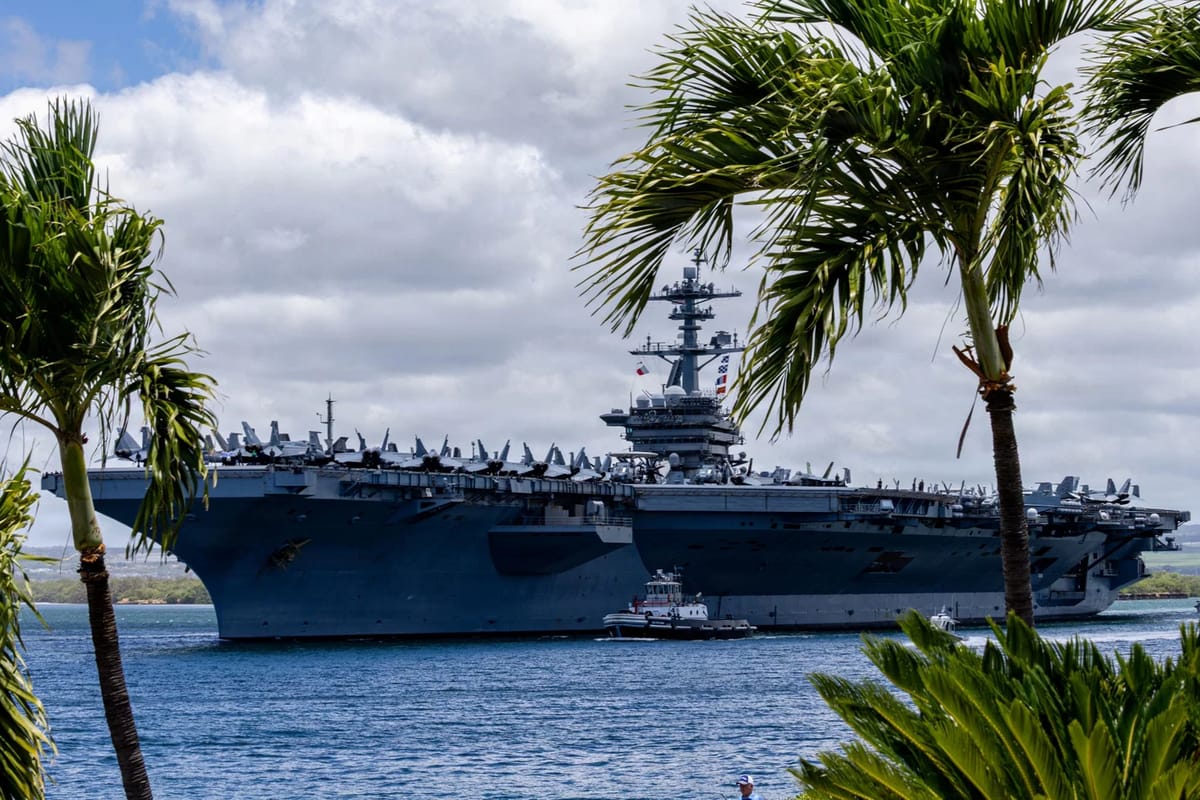
While the world remains obsessed with giant aircraft carriers costing billions of dollars, Israel is choosing a completely different path. In July 2026, defense contractor Elbit Systems introduced a revolutionary concept that could transform the nature of naval war. The company revealed a system that converts simple, civilian merchant ships into highly effective, drone-launching military platforms.
This creative idea did not emerge from a vacuum. Iran previously proved with its Shahid Mahdavi vessel that a standard civilian cargo ship could be converted into a dangerous forward operating military base. Elbit Systems took this concept a massive step forward, choosing to design lean, accessible naval airpower rather than constructing multi-billion dollar American-style supercarriers.
At the heart of this Israeli project is the maritime version of the Hermes 650 Spark drone. This unmanned aerial vehicle can be launched from and recovered by standard container ships. The harsh economic realities of modern war are forcing this dramatic rethink in naval strategy.
A modern naval frigate costs upwards of six hundred million dollars, making it impossible for any nation to build a fleet large enough to protect every trade route. When hostile forces launch cheap drones costing just thirty thousand dollars, navy commanders cannot afford to deploy multi-million dollar helicopters to intercept them. The converted cargo ships will provide a permanent, low-cost aerial umbrella over critical offshore gas rigs and vital shipping lanes.
The commercial success of Israeli defense innovations is already visible on the global stage. Elbit Systems recently secured a massive one point four billion dollar contract with a major European customer for unmanned systems and electronic warfare technology. This massive deal highlights the rising international demand for combat-proven Israeli maritime defense solutions.
Converting a civilian vessel into a drone carrier presents immense engineering challenges. Severe sea movements, unpredictable wind turbulence, and deck obstacles make every drone landing highly hazardous. Elbit solved these issues by integrating artificial intelligence and laser detection systems that predict deck movements during landings.
The drones will be stored in specialized, climate-controlled, salt-resistant containers to protect them from corrosive marine environments. This technological adaptability is a core strength of the defense giant. The Israeli Ministry of Defense recently signed a separate one hundred million shekel contract with Elbit to develop external fuel tanks for F-35 fighter jets, proving their ability to modify existing systems.
This new operational concept dismantles traditional naval centralization. Instead of concentrating power on a single, expensive warship, the system allows military forces to scatter their capabilities across dozens of converted merchant ships. Every container ship on the ocean can now become a mobile operational base, providing continuous aerial coverage, intelligence gathering, and precision strike capabilities.
Rising global naval tensions prove that flexible defenses are urgently needed. Recently, a tense encounter occurred in the Norwegian Sea when a Russian patrol aircraft performed dangerous maneuvers near the British aircraft carrier HMS Prince of Wales, forcing British F-35B jets to scramble. If the Elbit project succeeds, Israel will not only protect its trade routes but also rewrite the rules of asymmetric naval war.