A fragment of a Torah scroll that a German soldier brought home from occupied Belarus, as the canvas of a portrait of his wife, has been returned to the Jewish community of Bobruisk more than 80 years later.
The soldier’s son, a German doctor, inherited the portrait after his parents died. He noticed what looked like calligraphy on the back but did not know what it was. Only recently, after photographing it and searching online, did he discover that the writing was Hebrew.
“These texts are on the back of a portrait of my mother,” the doctor wrote in an email to Chabad of Munich, according to Chabad.org. He explained that his father had brought the portrait home from Bobruisk, where he served as a clerk at a German field command from August 1941 to August 1943. As the doctor recalled, his father told the family that a Russian prisoner had painted it.
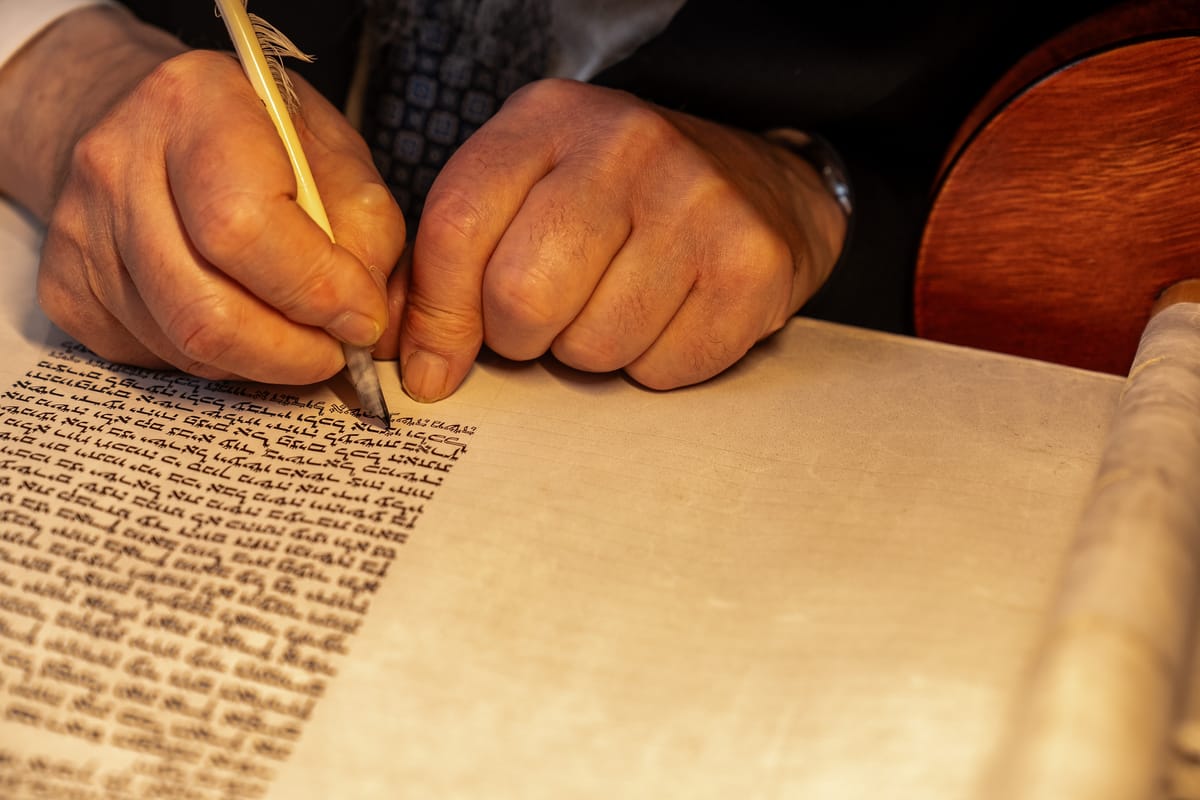
Rabbi Yochanan Gordon of Chabad of Munich arranged to see the painting the next morning. The writing on the back was unmistakably from a Torah scroll, handwritten in traditional script on parchment that had been cut from the scroll and used as the canvas.
According to the doctor, his father served in the German army only as a clerk and did not take part in the murder of Jews. When he met Rabbi Gordon and told the story, the doctor broke down in tears, Chabad.org reported, and said he wanted to right the wrong by returning the fragment to Bobruisk.
During the Holocaust, the Nazis sought to destroy Jewish religious life alongside the Jewish people themselves, burning synagogues and deliberately desecrating Torah scrolls. Torah parchment was cut up and turned into everyday objects such as shoes and wallets.
Rabbi Gordon, whose great-grandfather was a native of Bobruisk, contacted Rabbi Shaul Hababo, who has served as Chabad emissary to the city since 2010. As it turned out, both rabbis were traveling to New York for the International Conference of Chabad-Lubavitch Emissaries, held last weekend. Rabbi Gordon handed over the fragment there.
“This time, it was a spark of holiness in the words of the Torah,” Rabbi Gordon told Chabad.org, describing it as hidden behind a painting for more than 80 years.
Under Jewish law, even a damaged or desecrated Torah fragment retains its sanctity and would normally be buried. Rabbi Gordon consulted a rabbinic authority, who pointed him to a ruling by Rabbi Moshe Feinstein. Rabbi Feinstein had permitted fragments of Torah scrolls desecrated by the Nazis to be displayed when the display shows the contrast between the Nazis’ treatment of the Torah and the reverence Jews hold for it.
Following that ruling, the fragment will be displayed at the Jewish Spiritual Center of Belarus, a museum housed in Bobruisk’s historic synagogue and directed by Rabbi Hababo, alongside a complete Torah scroll that was rescued from the Nazis.
“It seems that Heaven had decided the time had come for this holy object to return home,” Rabbi Hababo said.