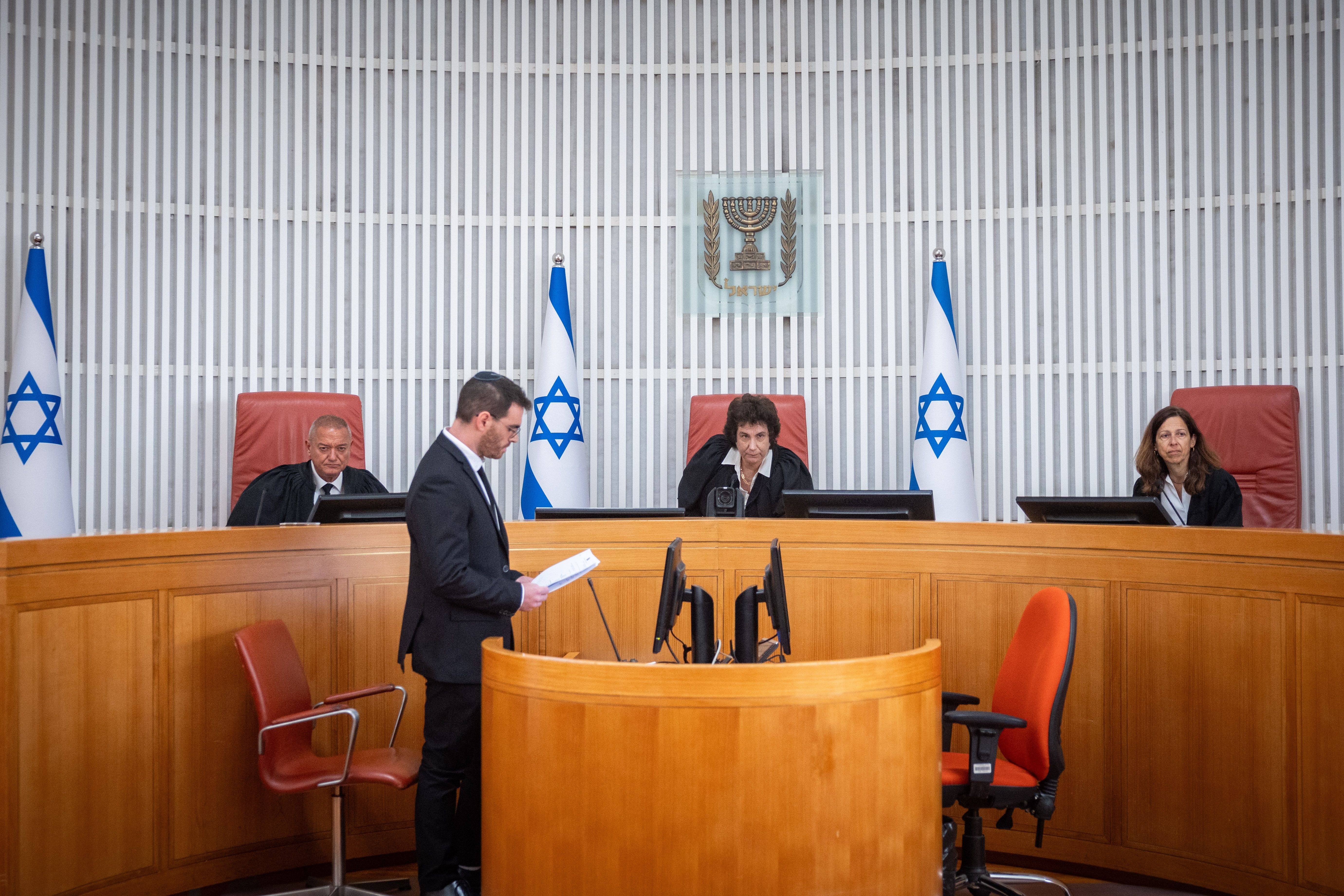

Former Supreme Court President Aharon Barak marks his 90th birthday today (Tuesday). He hasn't served as a judge for nearly 20 years, but many of the tools now at the center of Israel's battle over the judiciary developed during his tenure. And no, it's not just about the constitutional revolution.
To understand the scale of the transformation, one must start with the reasonableness standard. Long before the doctrine became the focus of public struggle, Barak advanced its use to review government decisions.
The question the court examined was no longer merely whether a minister or official had the authority to make a decision. Judges also scrutinized how the decision was reached, what considerations were weighed, and whether the outcome fell within the bounds of reasonableness.
Barak formulated it sharply: "An unreasonable option is an illegal option." In his view, the judge does not replace the authority or choose among several reasonable alternatives in its stead. He intervenes when the decision exceeds those bounds.
But the power to determine what lies within those bounds was placed in the hands of judges. From this grew the criticism that the reasonableness test allows the court to substitute its judgment for that of elected officials.
The Petition Was Denied, But the Door Opened
One case illustrating the shift is the Ressler petition, which dealt with drafting yeshiva students. The petition itself was denied, a detail that tends to disappear from discourse about the ruling. But on the way to denying it, the court established two significant principles: petitioners have standing to approach the High Court, and the issue of drafting yeshiva students is capable of being determined by a court of law [justiciable].
The immediate result was a victory for the state, but the principled determination opened the subject to continued judicial intervention. Barak believed that "the whole land is justiciable," and that even an inherently political dispute can be subject to court review.
Thus two changes he promoted came together: expanding standing, which determines who can file a petition, and expanding justiciability, which determines what subjects the High Court can address. When more people are permitted to petition and more subjects are deemed justiciable, the court enters places that previously remained outside the courtroom.
Barak once explained how he views the boundaries of the role: "I am not a doctor, but I have tools to know when a doctor was negligent. I am not a pilot, but I have tools to know when a pilot was negligent. I am not chief of staff, but I have tools to know when a chief of staff performed his duty improperly. This is my profession."
The Authority to Strike Down Knesset Legislation
Above all the changes stands the constitutional revolution. Following the enactment of Basic Law: Human Dignity and Liberty and Basic Law: Freedom of Occupation, Barak argued that the Basic Laws acquired a status higher than ordinary legislation.
In the Mizrahi Bank ruling, the Supreme Court determined it has authority to strike down Knesset legislation that conflicts with Basic Laws. Barak did not decide this alone (other justices were partners in the determination), but he was the one who shaped and advanced this legal doctrine.
I's important to distinguish between the principled decision and actual nullification. The Mizrahi Bank ruling recognized the authority, but the first case in which the High Court actually struck down a statutory provision after the constitutional revolution came in the Investment Advisors Chamber ruling. The court invalidated provisions in a law regulating investment portfolio advice and management, after determining they violated freedom of occupation. The Knesset was asked to amend the law, and it did.
That was the practical meaning of the move: a law passed by the Knesset was no longer necessarily the end of the discussion. The court gained the ability to examine it against Basic Laws and nullify it.
The confrontation over importing non-kosher meat also shows the picture is more complex. The High Court ruled that the import ban contradicted freedom of occupation, and following the crisis the Basic Law was amended and the Meat and Meat Products Law was enacted. Later, a panel headed by Barak rejected petitions filed against the new law. Barak recognized the Knesset's authority to change through legislation rulings established by the court, though he opposed a prior commitment to enact laws that would overturn rulings affecting the religious status quo.
Not Just the High Court and Government
Barak's influence did not remain in constitutional law. In the Approim ruling he changed how courts interpret contracts. Instead of adhering only to the words written in an agreement, weight is also given to the circumstances under which it was signed and the purpose the parties sought to achieve.