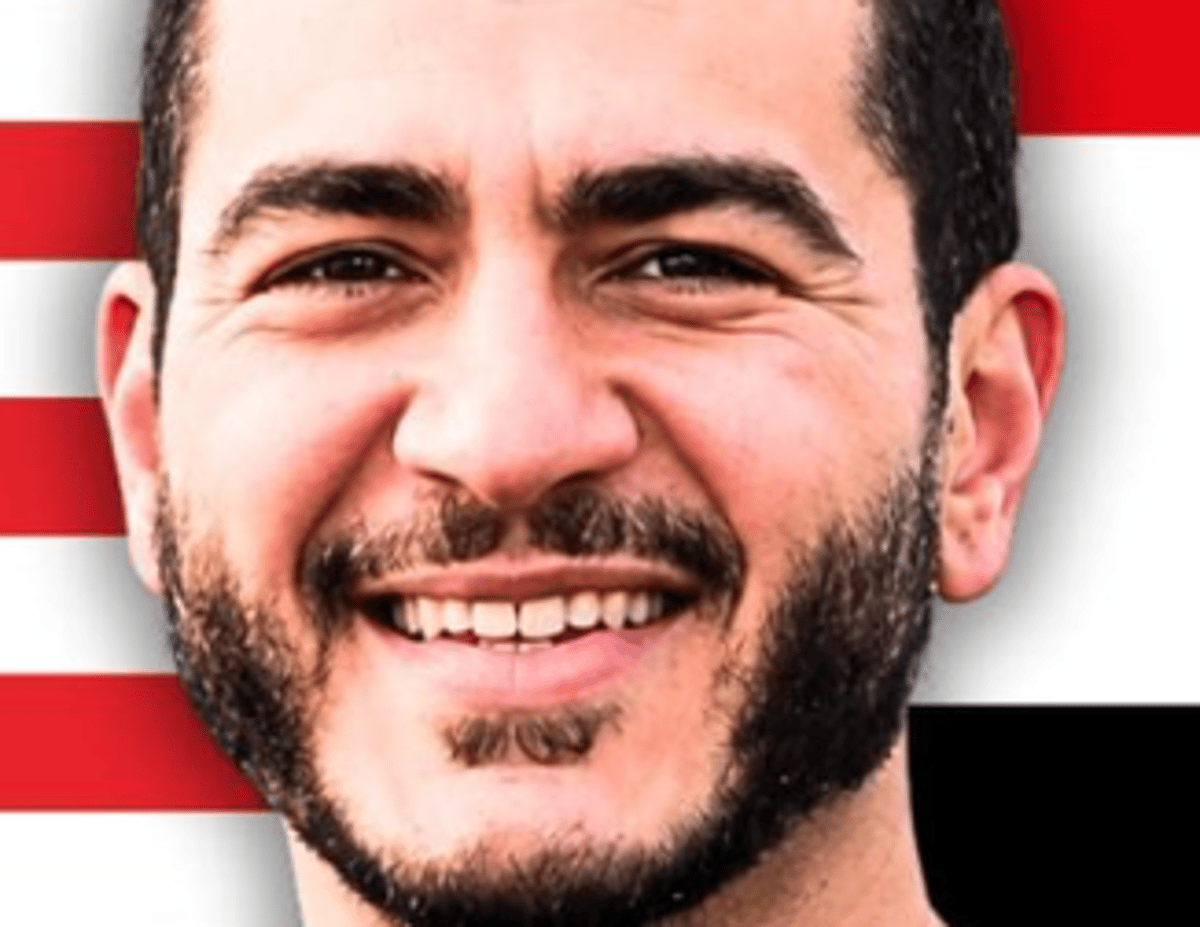
Michigan Democratic Senate nominee Abdul El-Sayed signed a 2012 Arabic-language statement backing then-Egyptian President Mohamed Morsi's sweeping power grab and urging him to "purge the media and the police as quickly as possible." The document is resurfacing five weeks before the November 3 election.
The statement ran on November 25, 2012, on the Egyptian news portal Al-Ahram Gate under a headline announcing that Morsi supporters in America backed his decisions. It was signed by 46 self-described "leaders of the Egyptian community" in the United States. The 33rd name on the list was "Dr. Abdul Rahman El-Sayed" of New York. El-Sayed, who was born in Michigan to Egyptian immigrants, was a medical student at Columbia University at the time.
"We, leaders of the Egyptian community, support the revolutionary decisions taken by the president, and we call on him to purge the media and the police as quickly as possible," the statement reads, according to the Washington Free Beacon's translation. The signatories also said they "strongly reject those voices that are courting America and Europe to take a position against the Egyptian regime."
Sources familiar with Arabic-language media told the Free Beacon that the candidate is the same man who signed the letter. The document was first flagged in April by conservative activist Laura Loomer. After El-Sayed's primary win in August, Egyptian journalists also circulated images of the Al-Ahram announcement bearing his name, according to the Middle East Media Research Institute. The Free Beacon report this week brought it into the mainstream of the campaign, and the account Visegrád 24 amplified it on Sunday.
El-Sayed's campaign did not respond to the Free Beacon's requests for comment on the letter or on the candidate's current view of the Muslim Brotherhood.
The Power Grab
The statement came days after Morsi, a senior Muslim Brotherhood figure who had won Egypt's presidency five months earlier, issued a constitutional declaration giving himself sweeping powers and shielding his decisions from judicial review. One liberal Egyptian lawmaker called it "a horrifying coup against legitimacy and the rule of law," and Human Rights Watch warned it undermined the rule of law.
The crackdown on the press that the signatories called for soon arrived. In January 2013, the Committee to Protect Journalists said it was alarmed by a wave of investigations into independent newspapers for "insulting the president." Those targeted included Al-Watan editor Magdi Algallad, over cartoons, and satirist Bassem Youssef, often called Egypt's Jon Stewart. In the first nine months of Morsi's presidency, the Egyptian Organization for Human Rights counted at least 600 criminal defamation cases, far outpacing the rate under Hosni Mubarak, according to CPJ.
Morsi was removed by the military in July 2013. Egypt later banned the Muslim Brotherhood and designated it a terrorist organization. Morsi died in custody in 2019.
A Longer Record on Egypt
The letter was not El-Sayed's first public comment on Egyptian politics. In a January 2011 HuffPost column titled "Why the U.S. Should Support the Protesters in Egypt," he urged the Obama administration to back the uprising. He dismissed fears that democracy would hand the country to the Brotherhood, arguing that even if the group took power, "the ensuing state would look nothing like Iran." He also wrote that the Brotherhood would not resemble Hamas because of their "differing contexts."
A Bridge Michigan fact-check published September 3 found no evidence that El-Sayed has ties to the Brotherhood or ever pledged support to the organization. The outlet concluded the 2012 group letter defending Morsi did not amount to such a pledge either, while noting that El-Sayed has weighed in on Egyptian politics and figures associated with the group. Critics counter that the fact-check did not address the letter's call to purge the press.
Mariam Wahba of the Foundation for Defense of Democracies told the Free Beacon the letter and El-Sayed's earlier writing "should raise serious questions."
The Race
El-Sayed narrowly won the Democratic primary on August 4 with 48.5% of the vote, defeating Rep. Haley Stevens. He faces former Republican congressman Mike Rogers, who ran unopposed and narrowly lost the 2024 Senate race to Elissa Slotkin. The open seat, vacated by retiring Democrat Gary Peters, is among the most closely watched races in the fight for Senate control. If elected, El-Sayed would be the first Muslim member of the U.S. Senate.
Rogers has repeatedly accused El-Sayed of Brotherhood sympathies, and Bridge Michigan found no evidence for his claim that El-Sayed "pledged his support" to the group. The letter has also landed as El-Sayed criticizes the Trump administration for interfering with the press, which conservative outlets have framed as hypocrisy.
The controversy adds to pressure El-Sayed already faces over his positions on Israel. This week, as former Vice President Kamala Harris campaigned with him in Michigan, a group of Jewish Democrats in the state wrote to Harris urging her to press El-Sayed to affirm that Jewish safety, "including for Zionists, is nonnegotiable."