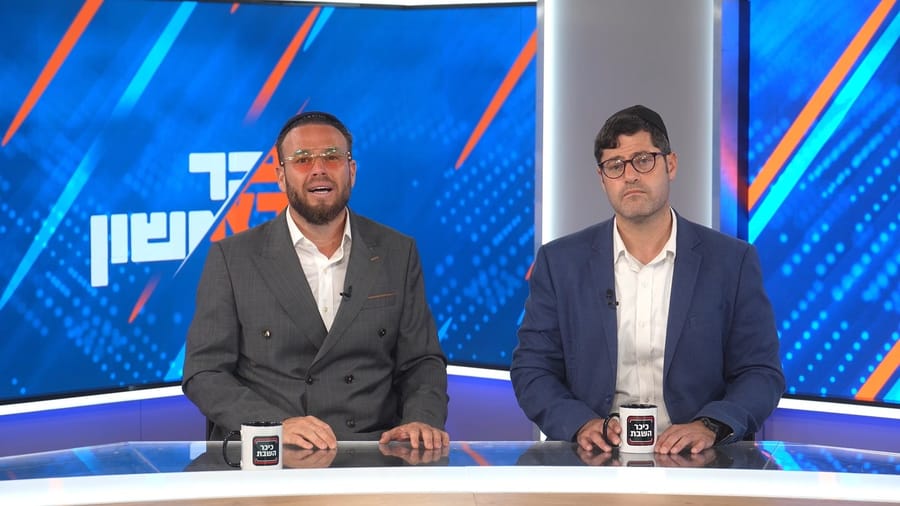
What happens when someone in the haredi community experiences a personal crisis? When did WhatsApp groups become the modern town square where people are publicly shamed? These questions opened this week's episode of "Davar Rishon" (First Thing), a morning radio program hosted by Moshe Manes and Shuki Salomon that tackles pressing issues in Israeli haredi society.
The show addressed multiple hot-button topics, from gossip culture to ADHD medication debates, military draft controversies, and rising fuel prices. But it was Salomon's deeply personal opening monologue that set the tone for an unusually charged broadcast.
"Searching for Blood": The Price of Living Online
The discussion began with the contentious issue of privacy boundaries for public figures in the haredi sector. Manes presented harsh comments that had circulated online targeting "modern haredim" and media personalities who share their lives on social networks.
"If you share everything with the world on Instagram about what's happening in your home, you need to be prepared for the price," read one comment. Another stated: "Someone who decided to share their entire life with the public, what they wore, where they're spending the holiday, what they cooked for lunch, has no right to complain about privacy when there's drama in their life."
In response to these sentiments, Salomon delivered an unusually candid and emotional monologue, referencing a difficult period he recently experienced:
"I recently went through something not very pleasant and not easy, and through it I was exposed up close to the most shocking thing that exists. Suddenly I understood even more why I constantly shout 'lashon hara doesn't speak to me,' and why I fight for ahavat chinam, not as a slogan, but as real pain. When you're standing on the sidelines, everything is easy: it's easy to judge, easy to say 'I know exactly what happened there.' But when you see what one word does to a person, what a message does to a family, and what gossip does to children — you understand how much words can burn."
Salomon sharply criticized the culture of forwarding messages in group chats: "What happened to us? When did we reach a point where when a Jew falls, instead of our hearts hurting, our eyes light up with curiosity and joy at misfortune? It's written 'when your enemy falls, do not rejoice', even about an enemy! And today? It's enough for a known person to experience a trial, and the phones are burning: 'Did you see?', 'Did you hear?', 'Do you have the video?' There's a human being there! There's a wife crying, a husband who can't sleep, parents falling apart, and children who tomorrow have to look people in the eyes."
"Suddenly We're All Sitting in G-d's Cabinet"
He compared the situation on social networks to dark periods in history: "In the past, they would bring a person to the town square, and the crowd would cheer. We're horrified by that, but how are we different? Today there's no town square, there's a WhatsApp group, a story, and social networks. You don't need to put someone on a stake, you can burn them with one screenshot. And instead of clapping, we simply press 'forward.'"
A particularly pointed section of the monologue was directed at those who rush to explain "heavenly accounts", the theological reasoning behind someone's suffering: "It's not enough for us to gossip, we also know exactly why it happened. Suddenly we're all sitting in G-d's cabinet: 'It's because of the internet,' 'It's because of Instagram,' 'It's because of the father.' Who told you? Did G-d call you? Where does the confidence come from to take the judge's seat? Maybe precisely because he's righteous he received a trial? Are we lacking righteous and G-d-fearing people without smartphones who went through troubles? To believe there are heavenly accounts is faith. To think you know what they are, that's already arrogance.
We're in the month of Elul. When a Jew falls, don't rejoice. When you receive gossip, don't forward it. Don't be G-d's spokesperson. Feel pain, be silent, and if you can, extend a hand and pull them out of there."
The Poisoned Keyboards on Twitter: The Gap Between Reality and the Network
Later in the program, the hosts discussed the phenomenon of online bullying on the social network X (formerly Twitter). The two shared an interesting case that occurred over the recent weekend:
"This Shabbat I met a person who in reality is a shy type, reserved, quiet, and gentle-souled. But when you open his Twitter profile, you discover a toxic, aggressive figure full of venom. It's amazing to see how the screen gives certain people a mask that brings out all the evil from them, simply because they don't have to look the other side in the eyes."
The Ritalin Storm: "We Managed Without It" vs "We Didn't Demand 10-Hour Days"
A burning educational issue raised on the program concerns the use of attention and concentration medications in the haredi sector. The hosts presented a pointed appeal from a father who warned against the casual administration of chemical substances to children: "In our generation we managed excellently without all these pills and substances, we grew up wonderfully and everything was fine."
In contrast, a firm position was presented showing the dramatic change in educational demands: "The comparison to previous generations simply isn't correct. In the past we didn't force a young child to sit for hours upon hours continuously over a shtender [study stand] and book, at the level of intensity and demands that exists today. The academic load and social expectations have changed completely, and if the medication is what allows a child to realize their learning potential and not experience frustration and self-destruction, we're talking about literally saving lives."
Current Events Flash: Draft, Attorney General, and Fuel Prices
Alongside the social discussions, the hosts reviewed the main current affairs headlines:
The draft issue and arrests: A report on a proposal being discussed whereby compensation or a grant of 1,000 shekels would be given for each day in prison for yeshiva students arrested under the draft law.
Attack on the justice system: Reference to the sharp attack by rabbis and senior Shas party officials on the Attorney General, who was called "crazy." The background: recurring claims by party officials that the state memorial ceremony for former Prime Minister Yitzhak Rabin has not been canceled, even though it's only scheduled for November and isn't funded by the state.
Hit to the wallet: Starting tomorrow at midnight (between Monday and Tuesday), the price of a liter of 95-octane gasoline will stand at 8.25 shekels, a sharp increase of 16 agorot compared to August. The full-service surcharge will be 26 agorot per liter. This matches the all-time peak price set 14 years ago, in September 2012.