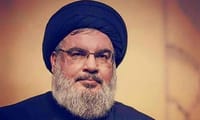
A report released Monday by Senate Democrats exposes Iran's extensive use of the USDT stablecoin, issued by Tether, to circumvent US sanctions. According to the Wall Street Journal, the report by Democrats on the Senate Permanent Subcommittee on Investigations found that the cryptocurrency became a primary payment method for the Iranian regime and served as a funding mechanism for its proxy organizations, including Hezbollah. Of more than 800 sanctioned crypto wallets reviewed, about 84 percent used USDT as their main or exclusive asset, and Iran's Central Bank had accumulated at least $507 million in USDT. Tether said it has helped freeze about $550 million in Iran-linked USDT this year.
The financial exposure comes as Washington continues to tighten economic pressure on Tehran, aiming to choke off its funding arteries. As part of this campaign, the United Arab Emirates has stopped all flights by Iranian airlines, while Turkey and Oman have halted flights by Mahan Air. In the banking sector, the UAE central bank blocked branches of Iran's Bank Melli from processing transactions with Iran, and Turkey revoked the operating license of Iran's Bank Mellat.
As part of the American pressure campaign, known as Operation Economic Outcast, Treasury Secretary Scott Bessent said teams were dispatched across the globe to demand action against the Iranian regime, making clear to Iran's trading partners that they must choose between continued commerce with Tehran and their economic ties with Washington. Bessent thanked the United Kingdom, Turkey, Oman and the UAE for supporting the campaign.
In response to the economic pressure, Tehran is attempting to apply counter-leverage through shipping routes. An editorial in Kayhan, a newspaper aligned with the Iranian regime, called for halting energy trade and raising fuel prices in the US ahead of the midterm elections to restrain the American administration.
The editorial stated that "continued blockade of the Strait of Hormuz and cutting off the source of oil dollars are the only way to restrain Washington's ambitions; the key to restraining the gambler from the White House is not found in negotiations, but in stopping energy trade and raising America's economic cost ahead of the elections."
The newspaper claimed that "the White House's assessments regarding Iran have again proven mistaken," adding that "Trump thought that if he couldn't subdue the Iranian people in a war of 12 days or 40 days, he could achieve the same military goal through 'negotiation fraud.' Therefore, Washington saw the Islamabad memorandum of understanding not as a step toward resolving the conflict, but as Iran's complete surrender."
The editorial's authors emphasized that "reality on the ground has struck hard at the White House's beliefs," noting that "when Trump saw that Iran was determined to implement all its conditions, he understood he would achieve nothing from this agreement, and in an unusual move, declared it 'dead.'" The piece concluded that "you cannot restrain a gambler through groveling and showing eagerness for negotiations. You can only restrain a gambler by raising the price of war and through the language of missiles on the ground."
Meanwhile, Rear Admiral Habibollah Sayyari, chief of staff and deputy coordinator of Iran's regular army, claimed that "the west of the Strait of Hormuz, the very strait itself, and the Persian Gulf are under the complete control of the IRGC Navy, while the eastern part of the Strait of Hormuz and northern Indian Ocean are under the complete control of the Army Navy." He added, "We are operating decisively in the northern Sea of Oman and east of the Strait of Hormuz, and we do not allow anyone to pass."
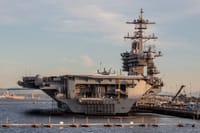
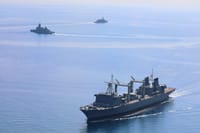
US Central Command rejected the claim as incorrect, saying Iran lacks a functional navy because American forces have sunk its fleet, and that the continued passage of thousands of vessels through the strait disproves any notion of Iranian control.
Revolutionary Guards spokesman Brigadier General Hossein Mohebbi also said that "the Strait of Hormuz is not only not open, but is a hunting ground of the IRGC Navy for American underwater vehicles," as he claimed the capture of a second US underwater drone. The Pentagon said an underwater drone had malfunctioned more than a day earlier and was an older model that carried no classified equipment.
Separately, a source close to Iran's representation in New York told the IRNA news agency that there are no plans for additional meetings with the US, and that Tehran is waiting to receive a response from the American side after conveying its positions through the Qatari mediator.