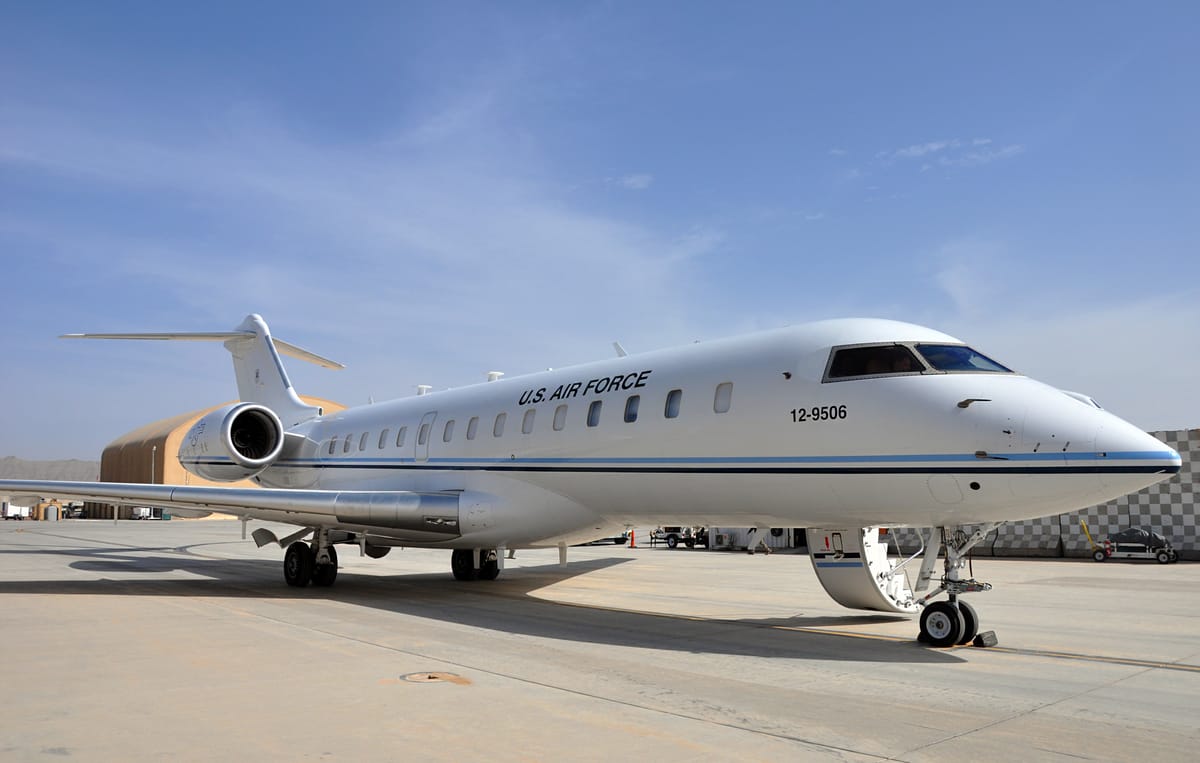
Aviation trackers are flagging the movement of a US Air Force E-11A, a specialized airborne command-and-control communications jet, as it makes its way toward the Middle East following a brief stop in Europe, a flight pattern that open-source military analysts often read as a precursor to escalation. One report identifies the aircraft by tail number 24-9049, flying under a callsign resembling BACN33, as having departed the Warner Robins area in Georgia before transiting through Europe on its way east.
The E-11A is a modified Bombardier Global 6000/6500 business jet fitted with the Battlefield Airborne Communications Node payload, commonly pronounced "BACN" and developed by Northrop Grumman. Its job is to act as a flying relay station at high altitude, bridging incompatible data links, voice channels, and other communications systems between US and coalition aircraft, ground forces, ships, drones, and command centers, closing gaps that terrain, distance, or mismatched platforms would otherwise leave open.
The aircraft can operate at altitudes up to roughly 51,000 feet, has a range exceeding 6,000 miles, and is built for extended airborne orbits, giving it the endurance to serve as a persistent communications node over a battlespace for hours at a stretch. It has earned the nickname "Wi-Fi in the sky" for its ability to extend connectivity across difficult terrain, including mountainous regions where normal radio signals struggle to reach, a capability that has made it a fixture of American operations in the Middle East since the mission began in 2008.