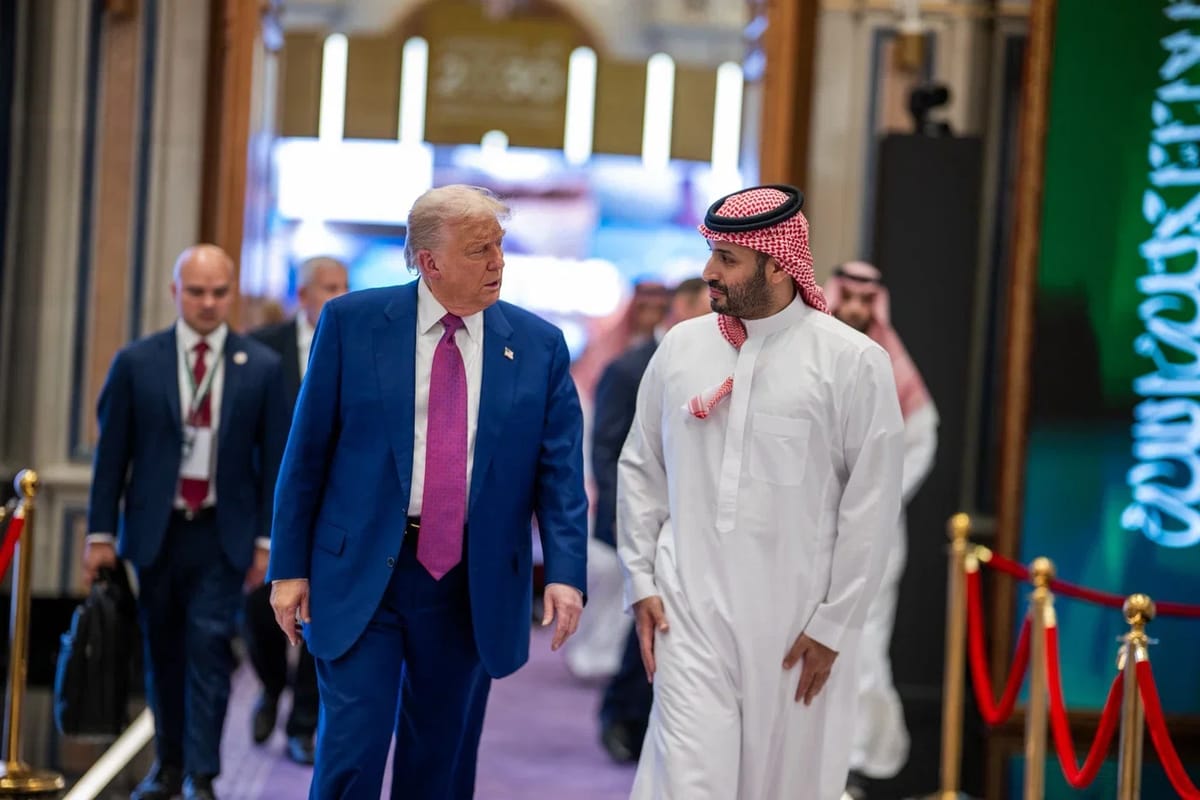
President Donald Trump has formally approved a landmark nuclear cooperation agreement with Saudi Arabia worth tens of billions of dollars over thirty years, according to the Wall Street Journal, which first reported the decision Tuesday night citing US officials. The deal is expected to be announced publicly as early as Wednesday and signed by Energy Secretary Chris Wright and Saudi Energy Minister Prince Abdulaziz bin Salman.
The agreement would give American companies the leading role in building out Saudi Arabia's civilian nuclear infrastructure, and contains a provision that has already drawn attention in Washington and Jerusalem alike. Under the deal, American firms could build a uranium enrichment facility on Saudi soil, contingent on a joint US-Saudi study determining the step is strategically justified. The White House has argued that structuring the agreement this way, rather than letting Saudi Arabia enrich independently, gives Washington leverage to prevent the technology from being diverted toward weapons use.
A Break From Past Precedent
The most significant shift, as reported by the New York Times, is that Trump has separated the civilian nuclear agreement from any precondition tied to Saudi recognition of Israel or a normalization deal. That marks a departure from the approach taken under President Joe Biden, who had insisted that any American nuclear cooperation with Riyadh be linked to progress on Saudi-Israel normalization, an approach rooted in the broader push to expand the Abraham Accords.
The timing is notable. In recent weeks President Isaac Herzog gave a rare interview to Saudi television in which he spoke of his hope for peace between Israel and Saudi Arabia, and reporting since then has indicated Riyadh is holding firm on tough preconditions for normalization, including a change of government in Israel and a reversal of settlement policy in Judea and Samaria. By approving the nuclear deal without extracting any commitment on normalization, Trump has effectively handed Saudi Arabia a major economic and strategic win while leaving the normalization track exactly where it was.
Proliferation Concerns
The enrichment provision is expected to face stiff resistance in Congress. Lawmakers from both parties have raised concerns for months about the precedent of allowing Saudi Arabia, rather than the United States, to control enrichment capability on its own territory, warning it could fuel a regional arms race. Congressional documents reviewed by the Associated Press this month showed the Trump administration is pursuing roughly twenty separate nuclear cooperation agreements worldwide, with the Saudi deal among the largest, and arms control groups have warned that the administration does not appear to have fully weighed the proliferation risks or the precedent the deal could set.
Under the framework being used to bring the deal to Congress, blocking it would require a two-thirds vote in both chambers, a high bar that effectively allows Trump to veto any congressional objection. The deal will be submitted for review in the coming days.
The proliferation concerns are sharpened by two other regional developments. Crown Prince Mohammed bin Salman has previously said Saudi Arabia would pursue nuclear weapons if Iran obtained one. And last year, following an Israeli strike on Hamas officials in Qatar, Saudi Arabia signed a mutual defense pact with nuclear-armed Pakistan, after which Pakistan's defense minister said its nuclear capability would be made available to Saudi Arabia if needed, a statement widely read in the region as a message aimed at Israel, long assumed to be the Middle East's only nuclear power.
What It Means
For Jerusalem, the deal lands as a mixed signal. It confirms that the Trump administration is willing to advance major strategic and economic agreements with Riyadh on their own terms, without treating normalization with Israel as leverage to be cashed in first, a approach that decouples two issues Israeli diplomats had hoped would stay linked.
At the same time, the enrichment provision, even if hedged by a joint study requirement and framed by the White House as a nonproliferation safeguard, sets a precedent that Israeli security officials have opposed for years: any pathway that puts centrifuge technology on Saudi soil, under any conditions, changes the region's nuclear calculus in ways that cannot be fully undone.