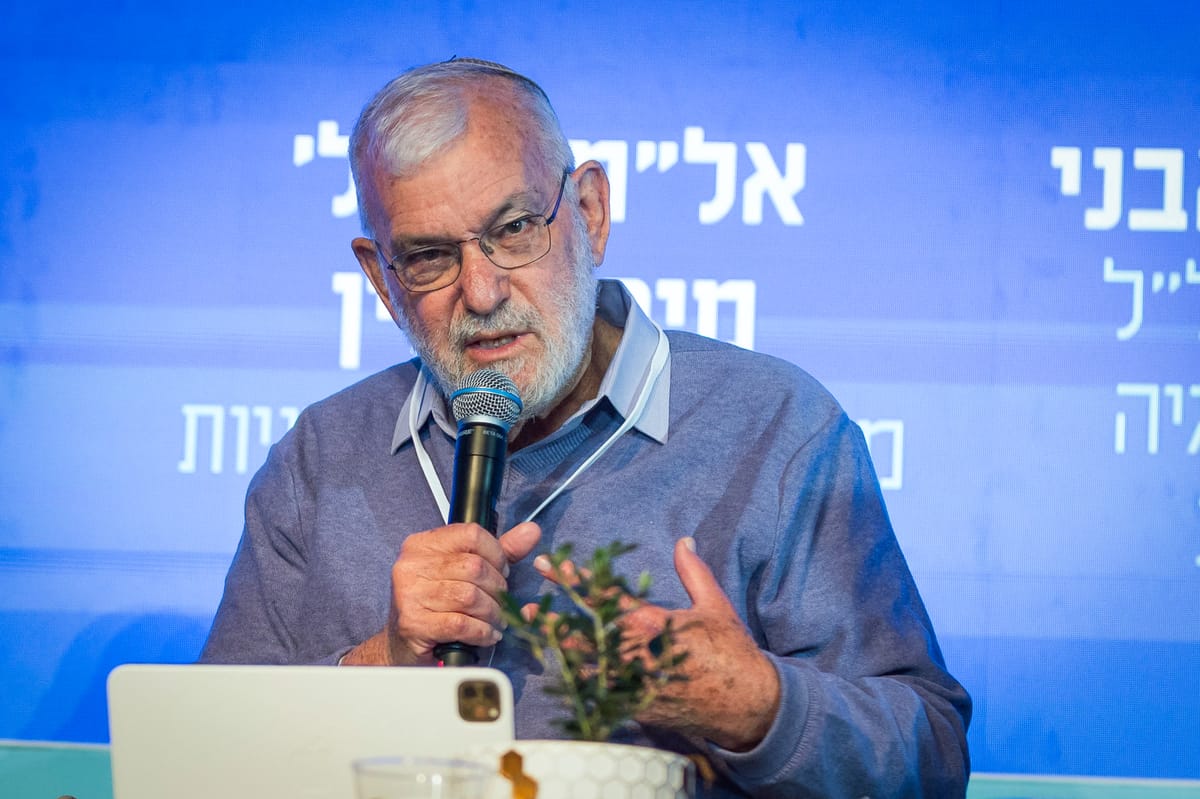
Maj. Gen. (res.) Yaakov Amidror, a senior fellow at the Jerusalem Institute for Strategy and Security and a former head of Israel’s National Security Council, spoke Tuesday with Ron Kofman and Aryeh Eldad on 103FM.
During the interview, he discussed US President Donald Trump’s changing policies, Qatar’s regional role, possible arrangements in the Gaza Strip and developments concerning Iran and Hezbollah.
“Various people are trying to understand Trump, but it is meaningless,” Amidror said at the beginning of the interview.
“The Gulf states are divided into those that want an agreement because they are afraid, those that cooperate with the Iranians behind the scenes, such as Qatar, and those that are more opposed to Iran but are not prepared to attack it.”
“Saudi Arabia asked the American president, assuming, of course, that Trump accurately reported his conversation with Crown Prince Mohammed bin Salman, to reach an agreement.”
“Qatar Is Trying to Destroy Israel”
Amidror recalled an encounter from a decade ago involving a group of American Jews invited to visit Qatar.
“Ten years ago, a group of American Jews approached me excitedly because the Qataris had invited them to visit the country and meet its leaders,” he said.
“I told them that the Qataris cared about them as much as they cared about garlic peels. They only wanted legitimacy, because what they are doing is trying to destroy the State of Israel, not through military force, because they do not possess such force, but through Al Jazeera and the money they invest around the world to buy anyone they possibly can against us.”
“Unfortunately, over the years we have given them far too much legitimacy,” Amidror continued. “In some cases, we had no choice because they provided us with quiet.”
“I believe that, overall, Qatar is a negative state. Once the war ends and matters stabilize, we must go after it with all our strength.”
Warning Over an International Force in Gaza
Amidror also addressed possible postwar arrangements in Gaza and the prospect of an international force being deployed in the territory.
“We should not violate the agreement, but such an agreement cannot be made without the State of Israel,” he said. “Our country has interests, and those interests must be protected.”
“We need to see what happens because the Qataris will not send an army here. I would prefer for the weapons to be removed from the Gaza Strip, but I do not know what is included in the agreement.”
Amidror noted that the US military already has a command headquarters in the region and could command foreign forces deployed in Gaza.
“No one other than us will open fire on Hamas members,” he said.
“If the weapons are stored in a warehouse and we discover that Hamas has opened it, we will bomb the warehouse. At that point, there will be no agreement and nothing else.”
“We will not ask the Americans for permission if we discover that Hamas has reached a warehouse and is taking weapons from it. We will inform them that we are attacking the warehouse and tell them to remove all their forces, because Hamas has arrived and we are not prepared to allow it to take the weapons.”
Asked whether international troops could interfere with IDF operations in Gaza, Amidror said they would create serious complications for Israel.
“They will interfere significantly because we will hesitate to harm them, while Hamas will not hesitate to harm them,” he said.
“An international force is not a good thing for us. But if the Americans command it, then we must expect them to succeed in creating some degree of security.”
US Strategy Toward Iran
Amidror also discussed Washington’s priorities in its dealings with Iran and a possible future agreement concerning Tehran’s nuclear program.
“The Americans view Iran in two stages,” he said. “First, reopening the Strait of Hormuz, and afterward ensuring that Iran does not become nuclear.”
“They are still at the Hormuz stage, which interests us less. But the president continues to say that Hormuz must be reopened and that Iran must not become nuclear.”
“For now, they are saying the right things. We do not know what will happen in Hormuz, but from their perspective, it is a preliminary stage before negotiations over the nuclear issue.”
“The Lebanese Government Does Not Want Hezbollah to Exist”
Concluding the interview, Amidror addressed Hezbollah and the Lebanese government’s efforts to establish greater authority over armed groups in the country.
“An agreement will weaken Hezbollah, but will it weaken it militarily?” he asked. “Not until we see the organization disarmed.”
“We are entering an experiment, and the Lebanese government also does not want Hezbollah to exist because it disrupts the lives of all Lebanese citizens except for a certain group within the Shiite community.”
“Even within that community, people understand that they are paying a heavy price.”
“The Lebanese government is now setting a goal that it never dared to set in the past: it does not want Hezbollah to continue existing as an armed organization.”
“We should try to help them, because if they succeed, it will be significant for the entire Arab world.”