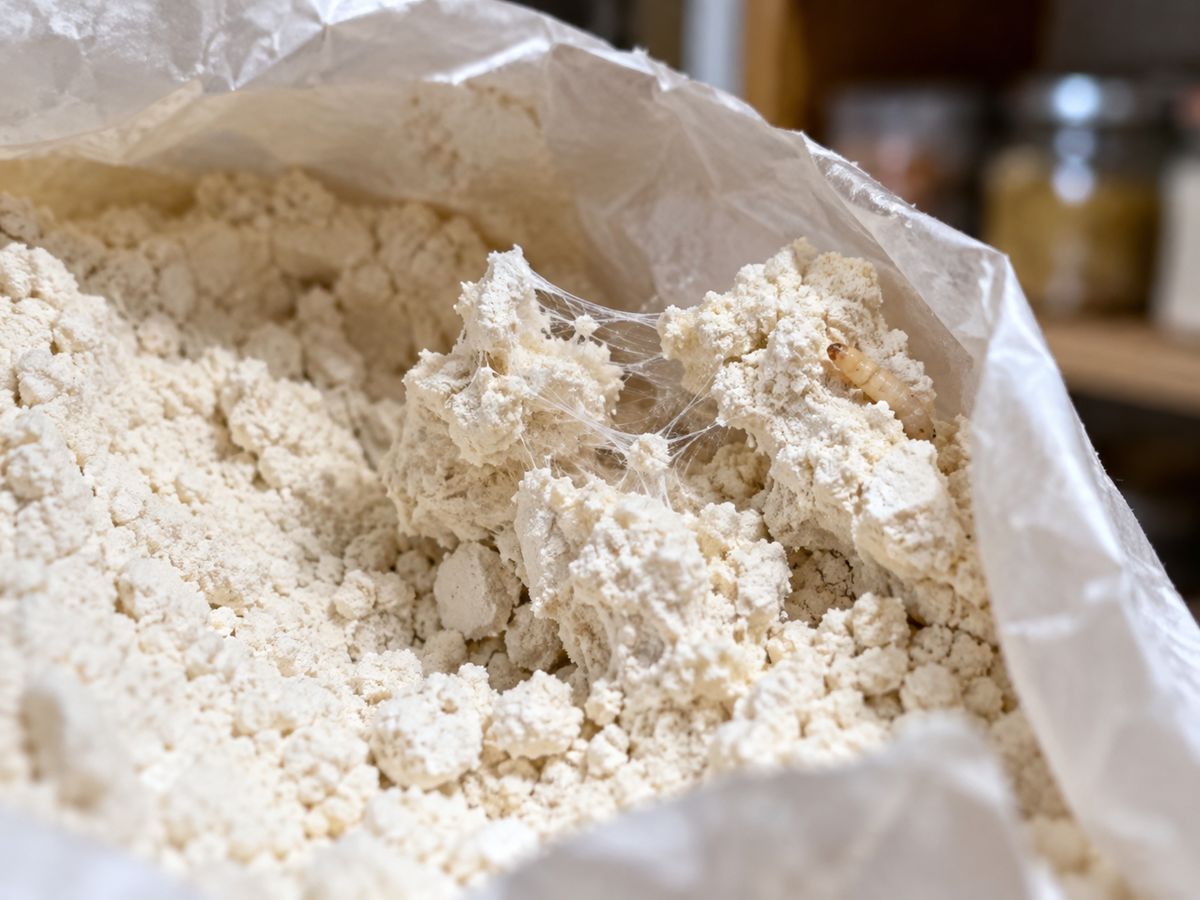
Spotted white threads inside a bag of flour? Don't ignore them
You open a bag of flour, rice or cereal, reach in with a spoon, and notice something odd. A few grains stuck together, and between them, fine white threads stretched like tiny cobwebs.
Many people shake the bag and carry on. But that small sign can mean you have an unwelcome guest in the pantry.
The pantry moth, also known as the flour moth or Indian meal moth, is one of the most common pests in dry food products. Its larvae feed on flour, rice, pasta, breakfast cereals, nuts, dried fruit, spices, chocolate and even dry pet food. As they move, they spin fine silk threads, which can cause grains to stick together and look as though someone has spread tiny cobwebs through them.
It doesn't always start with a moth flying in the kitchen
The first sign doesn't have to be a small moth fluttering near the ceiling.
Sometimes you see a small, pale larva inside a package first. Sometimes just a few fine threads. And in other cases, small clumps of food stuck together in an unusual way.
The young larvae are very small and easy to miss. As they grow, they can leave the food and crawl on walls and ceilings on their way to a place to pupate. So even a small larva that suddenly appears on the kitchen wall may be linked to an infested product in a completely different cupboard.
Found an infested bag? Don't just check that one
This is one of the common mistakes.
If you've found signs in rice, for example, it's not enough to throw out just the rice bag and close the cupboard.
Pantry moths can be found in almost any dry product; flour, pasta, cereals, dried pulses, nuts, dried fruit, chocolate, spices and even crumbs left in the corners of the cupboard. The University of Minnesota recommends checking all susceptible products in the area, because there may be more than one source of infestation.
Open every package and check the top of the product carefully. If it's hard to see, pour a little onto a light-coloured tray and look for threads, larvae or small insects.
And what do you do with the affected food?
Food in which you've found insects, larvae or webbing, throw it out.
Don't sift the flour and carry on using it, and don't remove "just the part that looks infested".
Pantry pests may eat a relatively small amount of the product, but they contaminate a much larger amount of the food.
Now comes the important part: cleaning the cupboard
After removing all the suspect products, vacuum the shelves, corners, joints and crevices thoroughly.
It's precisely in these corners that crumbs, larvae or pupae can remain.
After vacuuming, it's important to empty the vacuum canister or throw out its bag, so as not to leave insects inside that could return to the kitchen.
There's no need to spray the pantry cupboard with household pesticides. In fact, the University of Minnesota notes that insecticides are not recommended for treating pantry pests: they don't affect insects inside sealed packages, and food that comes into contact with them must be thrown out.
And how do you stop them coming back?
After an incident like this, it's worth changing the way you store things a little.
Dry products are better transferred to glass, metal or hard plastic containers that seal well. That way, even if one product arrived home already infested, the chance of the pests spreading from it to the rest of the cupboard is smaller.
And it's worth knowing something else: in many cases the pests didn't "originate" in the home at all. They can arrive inside a product that was already infested during production, storage, transport or time in the shop.
In other words, a clean cupboard is no guarantee that this will never happen.
Threw everything out and still seeing a small moth?
Don't panic immediately.
Even after you locate the source of the infestation and throw it out, you may continue to see adult moths flying in the house for up to a few weeks.
But if the phenomenon continues beyond that, there may still be an infested product you didn't find.
So next time you open a bag of flour and see a fine white thread inside, don't rush to think it's "just something that got stuck".
Sometimes that small thread is exactly the first clue to what's going on inside the cupboard.