
On Simchat Torah morning, a long knife was plunged into the heart of the Jewish people, with scenes of Holocaust and pogroms staring back from every direction in the communities surrounding Gaza. Tens of thousands of Jewish hearts skipped a beat, and their lives would never be the same.
But on the other hand, Jews in another place, in greater Hollywood, clung to a slice of silence. Stars with influence over millions of people froze in that critical moment. Silence allows horror to continue, but they stuck to it, so while they might not have feared crowds or the stage, they feared speaking up.
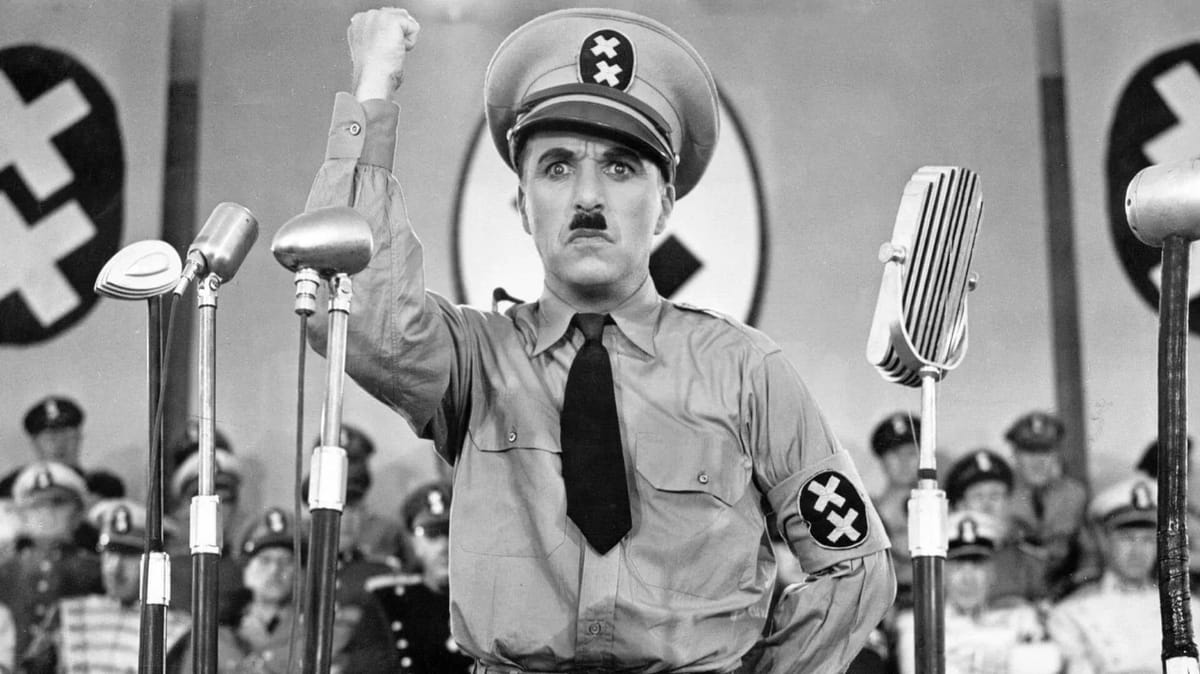
In the not-so-distant past, during the darkest period in human history, when the Jewish people faced a threat a thousand times more terrible, facing the devil Hitler, "The Great Dictator", a short-statured man stood alone, named Charlie Chaplin. He didn't stay silent at all. He chose to laugh right in the face of Hitler and his men.
Charlie Chaplin, born in London in 1889, began his career as a child in music halls and quickly became the world's first movie star and one of the most influential filmmakers in history. His most famous character, "The Tramp," a small, shabby man with a waddling gait, a tiny mustache, baggy pants, and a small bowler hat, turned him into an icon, a kind of underdog with gentlemanly manners.
His success was overwhelming, and by 1915, when his name appeared on every street corner and every movie theater sign, "Chaplinitis" ("Chaplin disease," a severe case of adoration and immense popularity for Charlie Chaplin) was already diagnosed across the United States. He soon gained artistic and financial independence, becoming one of the most influential movie stars and satirists.
But alongside his rise, rumors pursued him, rumors that began spreading in the 1930s. Nazi propaganda defined Chaplin as a Jew and a communist.
Joseph Goebbels himself referred to him privately as a Jew as early as 1928, and by 1931, Chaplin was openly called a "Jew" in the Nazi press. Chaplin consistently refused to deny the claim about his Jewishness, saying it would "play directly into the hands of the antisemites." Sometimes he added, jokingly, that "all geniuses have Jewish blood in their veins." Later, he was even quoted as saying, "I'm not Jewish, but I'm proud that people think I am."
His friend Ivor Montagu believed that this claim about his Jewishness was one of the reasons Chaplin went all out against the Nazis, especially after Montagu drew his attention to a Nazi publication that described him as "an inflatable toy in the shape of a little Jew," with the caption: "He's as disgusting as he is boring."
Chaplin donated millions of dollars to Jewish causes and helped save European Jews fleeing the war, as revealed by the American press. He saw Hitler as "the greatest imposter," and with unparalleled honesty, he recognized a physical resemblance between himself and the tyrant (they were born in the same week in 1889), which intensified his desire to mock him.