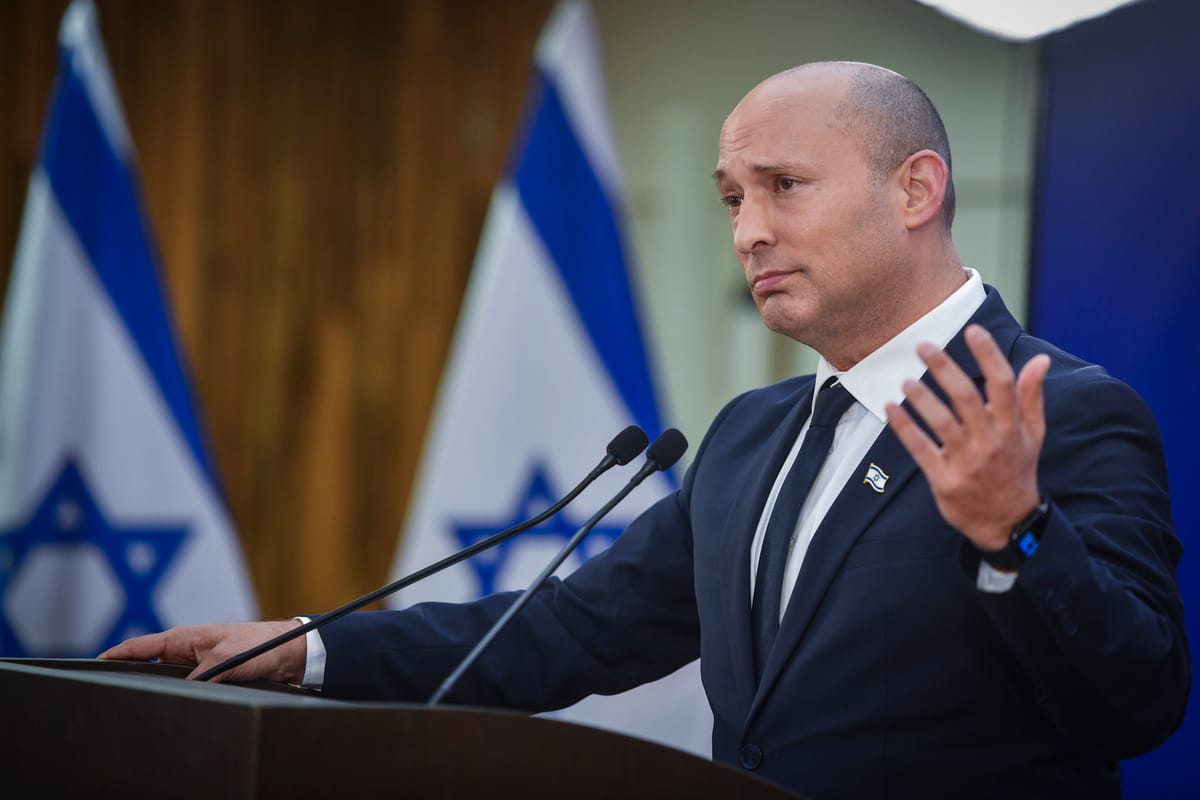
Former Prime Minister Naftali Bennett ignited a sharp political confrontation Tuesday after declaring that illegal construction in Judea and Samaria will not stand and that Areas A and B should remain under Palestinian autonomy, prompting immediate condemnation from Finance Minister Bezalel Smotrich and settler leaders who accused him of paving the way for a terror state in the heart of the country.
Bennett made the remarks during an appearance on the "HaManganon" podcast on Kan News, where he was presented with a map showing more than 200 new hilltop communities and agricultural outposts established throughout Judea and Samaria during the cSmotrichurrent government's term.
"Legal construction in Area C on state land that is not private Palestinian property is welcome," Bennett said. "Construction that is illegal, or not within Area C, or built on private land, is illegitimate." Asked what he would do about illegal construction if he came to power, he was unequivocal: "What is not legal will not be, certainly."
Bennett laid out his broader diplomatic vision, which he has articulated in various forms for years: Area C, which encompasses all Israeli settlements, would ultimately become part of the State of Israel, while Areas A and B would form a Palestinian autonomy. "Ultimately Area C will be part of the State of Israel," he said. "Areas A and B will be part of the Palestinian autonomy."
The remarks landed like a grenade in Israel's pre-election political landscape. Bennett's party has formed an electoral alliance with Yair Lapid called "Together," with the explicit aim of defeating Prime Minister Benjamin Netanyahu, and Smotrich moved quickly to frame Bennett's comments as a preview of what a center-left government would do to the settlement enterprise.
"Over the weekend and in recent days, I said that I know that if they, God forbid, come to power, an Eisenkot government will dismantle the new communities and farms we established in Judea and Samaria," Smotrich wrote. "Now Bennett, who would serve as a minister in an Eisenkot government, is saying it in his own voice: he will evacuate the farms."
Smotrich went further, warning that Bennett's autonomy framework amounts to a Palestinian state in all but name. "Bennett is saying a 'Palestinian autonomy' will be established, meaning a terrorist state in the heart of the country. Eisenkot's government will establish a Palestinian terror state and destroy the new towns and the agricultural farms. We cannot let them form the next government."
Israel Gantz, head of the Binyamin Regional Council and chairman of the Yesha Council, was equally sharp. "Naftali Bennett announced tonight the establishment of a terror state just ten minutes from his own home in Ra'anana," Gantz said. "We are already facing an army of some 50,000 armed Palestinian Authority forces — a corrupt, terror-incentivizing entity backed by Iran. After the massacre in the Gaza envelope, only someone completely detached from reality could propose handing strategic territories in the heart of the country over to this army. This is political suicide that puts the lives of millions of Israelis at risk."
Kedumim local council head Ozel Vatik went further still, saying Bennett's remarks prove "he is not just on the left, but on the far left."
Bennett has long held that Area C should be incorporated into Israel while Palestinians in Areas A and B govern themselves without Israeli interference — a position he has called "Palestinian autonomy on steroids" in past iterations. What is new is the electoral context: with elections approaching and Bennett running alongside Lapid in a joint list, his statements now carry direct implications for what a potential opposition government would do on the ground in Judea and Samaria.