Haredi IDF Commander: The Yeshiva Arrests are Radicalizing Haredim
In an uninhibited interview, Lt. Col. (Res.) Yossi Levi, CEO of the Shomer Yisrael Association, warns that military raids, economic sanctions, and collective draft notices are radicalizing the Haredi mainstream and sparking a direct path back to violence against soldiers.
Lt. Col. (Res.) Yossi Levi, CEO of the Shomer Yisrael Association, an organization that has spent 15 years developing and managing specialized Haredi tracks within the IDF, has sent an extraordinary warning letter to Prime Minister Benjamin Netanyahu and the Minister of Defense. Speaking in a special studio interview with Kikar HaShabbat, Levi states bluntly that current government and military policies are achieving the exact opposite of their intended goals.
"We Are on a Direct Path to Having Stones Thrown at Soldiers"
Levi traces the current crisis back to what he describes as aggressive, misguided strategies that are alienating the central core of the Haredi public.
"The current approach of sending collective draft orders, alongside arrests and military raids into Haredi neighborhoods and yeshivas, reminds me of very dark days in the State of Israel," Levi opened painfully.
"I am worried to the point that I am saying clearly: we are on a direct path to seeing stones thrown at Haredi soldiers in the streets again. I remember 2013 and 2014 well. In 2013, I walked through my neighborhood with pride; young Haredim respected and supported me, understanding that those who do not study Torah need to contribute.But then came Amendment 19 to the Defense Service Law - the infamous 'Lapid Law' - and the attempt to impose criminal sanctions. The Haredi street burned aggressively against the army. From that day on, stones were thrown at me and my soldiers. Today, the situation is returning to exactly that point, and it is even worse."
Ready for more?
Ready for more?
The Tactical Victory of the Extremists
According to Levi, the gravest damage is being done to the Haredi mainstream, a population that historically rejected extremist factions.
"Look at what happened from October 7 until today," Levi noted. "At the start of the war, people from the very heart of the Haredi mainstream, who had never spoken to me before, called to offer support and told me, 'We are praying for you.' Today, in this current round, that has completely vanished. The radicalization has penetrated the core."
Levi argues that by treating the entire sector collectively as criminals, the military is driving normative people into extremism. This has handed a "tactical victory" to the radical Jerusalem Faction (Hapaleg Hayerushalmi). "A decade ago, they told the mainstream Lithuanian rabbis to join their hardline stance," Levi said. "Today, unfortunately, they are poking everyone in the eye and saying, 'We told you so.' This must be stopped immediately."
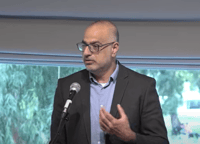
Lt. Col. (Res.) Yossi Levi, CEO of the Shomer Yisrael Association (Photo: Kikar HaShabbat)
Debunking the Myth of Sanction-Driven Recruitment
Levi used the interview to strongly reject claims in the general media that financial sanctions and legal pressures are successfully yielding combat enlistment.
"True, there is a certain increase in the number of Haredi enlistees," Levi stated. "But we must tell the truth honestly: 100 percent of this increase is in technological sectors, non-uniformed service, and positions where people do not serve in active reserves. This does not solve the national need at all.The country's actual need right now is for combat soldiers on the ground to relieve reserve forces who are collapsing under the burden. I myself recently finished 80 days of reserve duty in Tulkarm. My battalion consists of high-tech CEOs and economic leaders who are collapsing.
And in the combat sector? There has been zero growth during three years of war. In the recent draft, 96 combat soldiers arrived at the Chashmonaim Brigade, and they issued festive announcements boasting a 24 percent increase.
Have you gone mad? In 2013, before the laws and coercion, we opened two companies per draft cycle and had double the number of Haredi combat soldiers we have today, even though the Haredi population has doubled in size since then! Anyone claiming economic sanctions brought Haredim into combat is talking nonsense."
Political Disconnect and Failed Leadership
Levi directed harsh criticism toward the political establishment, calling the failure to pass a proper enlistment law the country's greatest internal failure.
"The fact that two and a half years since the outbreak of the war, a draft law has not passed to regulate the status of Torah scholars alongside the swift enlistment of those who do not study, something that had sweeping rabbinical consensus outside of the extremist factionm is the biggest failure there is," Levi said.
While noting that senior politicians have reached out to him recently looking for solutions, Levi declared that they have ultimately failed the test of results. He pointed out a profound disconnect among mainstream Haredi politicians, specifically within the Lithuanian faction:
"I happened to speak with a very senior Lithuanian politician. I told him that under our care, there are hundreds of lone soldiers who come from classic Lithuanian homes in Jerusalem and Bnei Brak. He completely denied reality and told me: 'No way, that's impossible, they aren't real Haredim.' I invited him to tour the housing facilities for these soldiers, and of course, he didn't come.In the Sephardic community, an average family will not throw a child out of the house over enlistment.
But in the Lithuanian community, unfortunately, it happens, and the representatives are simply detached from the ground and refuse to see these hundreds of young men wandering without a roof over their heads."
Levi credited the Shas party as the only political entity that has engaged intelligently and assisted via its government ministries, while stating the other Haredi representatives have provided "zero help."
The Solution: Education and Adaptation, Not Social Agendas
To fix the system, Levi advocates for a coherent government framework built on education and cultural accommodation rather than media battles. He noted that the Ministry of Defense recently officially announced the establishment of the Haredi Hesder Yeshiva Association, which currently includes 15 yeshivas and approximately 1,000 students. However, he stressed that bureaucratic hurdles and delayed budgets are blocking progress.
Levi concluded with a fierce critique of liberal elements in the media and public who try to force secular social agendas onto Haredi military tracks.
"The Netzah Yehuda battalion has existed for 26 years, and not a month goes by without it being attacked in the headlines of Haaretz and other newspapers over nonsense like 'whether women will enter the unit.' Recently, a brigade commander in Lebanon was interviewed, and the only thing troubling the interviewer was why there are no women in the Chashmonaim Brigade.
The answer is categorical: women will not enter Netzah Yehuda or Chashmonaim, and anyone who thinks otherwise is completely detached and fails to understand that Haredim will not come to the army under such conditions. I have served for 16 years as a reserve battalion commander, and I am putting it plainly on the table: we will not join a service that is not 100 percent adapted to the Haredi sector. Stop talking about equality and the exclusion of women; it’s nonsense.Every other unit in the IDF is open to women, and nothing happened. I can be an excellent combat soldier, defend the country, and not serve next to women. You want Haredim in the IDF? Stop with the nonsense and adapt yourselves to them."
In contrast to his criticism of the army's management, Levi praised the Israel Police and the Border Police (Magav). He commended National Security Minister Itamar Ben-Gvir, Border Police Commander Brick Yitzhak, and Israel Police Rabbi Rami Brachyahu for successfully launching a dedicated Haredi Border Police company through respectful dialogue and an understanding of the sector's specific needs.
Ready for more?
Join our newsletter to receive updates on new articles and exclusive content.
We respect your privacy and will never share your information.